Our Pick: KEEN
Check price →The Best Hiking Boots for Wide Feet (2026)
Most hiking-boot misery is not a bad boot. It is a D-width last on an EE-width foot. We ranked the eight boots and shoes that actually ship in wide sizes or are built on genuinely foot-shaped lasts, from a ~$110 Columbia in true women's wide sizing to a ~$200 Oboz, and explain the one sizing spec the shoe wall never tells you about.
By The WorldHike Gear Desk · ~13 min read · Updated 2026-07-25

KEEN Targhee III Mid Waterproof
KEEN
The wide-toe-box benchmark: a traditional waterproof mid whose roomy forefoot fits the feet other boots punish.
Check price★ Our Top Pick
Best Overall
KEEN Targhee III Mid Waterproof
The wide-toe-box benchmark: a traditional waterproof mid whose roomy forefoot fits the feet other boots punish.
Not sure yet? Compare all 8 picks below ↓
Here is the diagnosis behind most trail-boot suffering, and it is not the one people expect: the boot is usually fine, the width is wrong. Standard men's hiking boots are built on a D-width last, the wooden or digital foot form the shoe is shaped around, and standard women's boots on a B. If your forefoot is a 2E, a 4E, or simply wider than average, a D-width boot presses your metatarsals together for every one of the day's thousands of steps. The results have familiar names: numb toes, hot spots on the pinky side, black toenails on descents, and the creeping certainty that hiking boots just do not work for you. They work. You have been buying the wrong dimension.
The fix people reach for first, sizing up a half or full size, makes things worse. Length and width are separate measurements, and a longer D-width boot adds room in front of your toes while doing almost nothing across the ball of the foot. Now the boot is still tight where it hurts and loose where it matters, so your heel lifts, the boot flexes in the wrong place, and your toes slam the front on downhills. The real answer is a boot that either ships in true wide widths (2E and up) or is built on a foot-shaped last with an anatomically wide toe box. This guide covers both routes, with picks from about $110 for the women's Columbia Newton Ridge in true wide sizing up to about $200 for the Oboz Sawtooth X, with the wide-width Merrell Moab 3 and the benchmark KEEN Targhee III in the middle of the ladder.
One disclosure, up front and plainly: no brand paid for a spot in this guide, and no manufacturer saw it before publication. Some links go to Amazon; if you buy through one we may earn a small commission at no extra cost to you, and that never moves a pick up or down. Prices are approximate street prices at publication, and specs are the manufacturers' listed figures unless we say otherwise. Always check the live listing.
The short version
- Our pick is the KEEN Targhee III Mid Waterproof (about $165): the wide-toe-box benchmark, a traditional waterproof mid built on KEEN's famously roomy forefoot.
- Width and length are different measurements. Sizing up a standard D-width boot adds length, not forefoot room, and creates heel slip and toe bang. Buy width as width: 2E, 4E, or a foot-shaped last.
- The Topo Athletic Trailventure 2 (about $139) is the foot-shaped-last route: an anatomical toe box and a listed 5mm drop, a boot shaped like a foot instead of a boot.
- Budget answer: the Merrell Moab 3 in true wide sizing (about $105) puts America's best-selling hiking shoe comfort in a genuine wide width.
- Trail runners solve wide feet too: the Altra Lone Peak 9 Wide (about $145) and the New Balance Hierro v9 in 2E/4E (about $160) are the lighter, faster route for wide-footed hikers.
| Boot / shoe | Best for | Wide-fit route | Height | Approx. price |
|---|---|---|---|---|
| KEEN Targhee III Mid WP | Our Pick | Roomy KEEN toe box | Mid | ~$165 |
| Topo Trailventure 2 WP | Best Foot-Shaped | Anatomical last, 5mm drop (listed) | Mid | ~$139 |
| Oboz Sawtooth X Mid B-DRY | Best Support | True wide sizes | Mid | ~$200 |
| Merrell Moab 3 (Wide) | Best Value Wide | True wide sizes | Low | ~$105 |
| Altra Lone Peak 9 (Wide) | Best Zero-Drop Wide | Foot-shaped last + wide option | Low (trail runner) | ~$145 |
| New Balance Hierro v9 | Best Cushioned 2E/4E | 2E and 4E widths (listed) | Low (trail runner) | ~$160 |
| KEEN Targhee III Low WP | Best Low-Cut | Roomy KEEN toe box | Low | ~$145 |
| Columbia Newton Ridge WP (Women's) | Best Budget Wide (Women's) | True wide sizes (listed) | Mid | ~$110 |
The 2026 wide-feet shortlist at a glance. Widths and specs are the manufacturers' listed figures; prices are approximate street prices at publication, verified against our dataset in July 2026.
01 · Best Overall
Our PickKEEN Targhee III Mid Waterproof
The wide-toe-box benchmark: a traditional waterproof mid whose roomy forefoot fits the feet other boots punish.
Field check: Mid-height waterproof leather boot (listed) · KEEN's signature roomy toe box
The Targhee wins because it fixes the width problem without making you adopt a philosophy. The Targhee III Mid Waterproof is a traditional hiking boot in every way that matters: waterproof leather upper with KEEN's KEEN.DRY membrane (listed), a supportive mid-height collar, a lugged outsole, and the brand's signature rubber toe cap. The difference is the last underneath. KEEN shapes its footwear around a forefoot that is genuinely roomier than the D-width standard most brands treat as universal, which is why the Targhee line has spent years as the default recommendation in every wide-feet thread on the internet. Your toes splay, your metatarsals stop fighting each other, and the boot still laces down snug through the midfoot and heel where you actually want lockdown.
That last point is the one the shoe wall never explains. Width is its own dimension, and commonly published sizing charts step it in letters: B, D, 2E, 4E, with each step adding girth around the ball of the foot rather than length in front of the toes. Most hiking boots are made in exactly one of those letters. KEEN's answer is to widen the last itself, so one version fits the wide half of the population that everyone else ignores. On trail the Targhee behaves like the mainstream benchmark it is: stable under a daypack load, waterproof through wet meadow mornings, and comfortable out of the box in the way that made its Merrell rival famous. If you want one boot that ends the width fight and asks no further questions, this is the one we hand people.
- Height
- Mid, waterproof (KEEN.DRY, listed)
- Upper
- Leather with rubber toe cap (listed)
- Wide-fit route
- KEEN's roomy anatomical toe box
- Approx. price
- ~$165
What we like
- The wide-toe-box benchmark: roomy where D-width boots squeeze
- Conventional waterproof mid, no adaptation required
- Snug midfoot and heel lockdown despite the wide forefoot
- Years of wide-feet word-of-mouth behind it
Worth noting
- Heavier than the trail-runner picks below
- Too roomy for narrow and average forefeet
- About $165 is a full-price commitment
Who should buy it: Buy the Targhee III Mid if your feet are wide, your current boots go numb across the forefoot, and you want a conventional waterproof hiking boot rather than a trail-runner-style rethink. It is the right default for day hikers and weekend backpackers who carry a real load and want ankle coverage. If you run truly extra wide (4E), check the fit carefully; a roomy last helps everyone, but the widest feet may be better served by the labeled wide sizes of the Oboz or New Balance picks below.
What we don't like: It is a traditional boot with traditional weight; hikers who have tasted trail runners will feel it. The roomy fit that saves wide feet can feel sloppy on narrow ones, so this is emphatically a wide-foot recommendation, not a universal one. And at about $165 it costs real money, though the wide-fit alternatives above it on price do not clearly out-hike it.
Bottom line: The Targhee III Mid is the boot wide-footed hikers get told about by other wide-footed hikers, and the folk wisdom is correct. KEEN builds its lasts noticeably wider through the forefoot than the industry's D-width default, so the standard Targhee already fits like other brands' wide versions, wrapped in a conventional waterproof leather mid that hikes like a normal boot. It is the rare pick that solves width without asking you to change anything else about how you hike.
02 · Best Foot-Shaped
Best Foot-Shaped
Topo Athletic Trailventure 2 WP
A boot built on an anatomical last: foot-shaped toe box, listed 5mm drop, boot support up top.
Field check: Waterproof mid (listed) · anatomical toe box · 5mm heel-to-toe drop (listed)
There are two ways to fit a wide foot: make the standard shape bigger, or fix the shape. The Trailventure 2 takes the second route. Topo Athletic builds on lasts that mirror an actual foot outline, widest at the toes rather than tapering to a point, so toes splay naturally under load instead of stacking. The difference from a traditional boot is obvious the moment you stand in one, and it matters most exactly when wide feet suffer most: late in the day, when feet have swollen a half size and a tapered toe box turns into a press.
The rest of the package is more boot than the barefoot crowd usually gets. There is a waterproof membrane (listed), a cushioned midsole with real rock protection, and a mid-height collar that supports a loaded pack, which makes this the natural-fit pick that does not force you to give up boot virtues to get the shape. The listed 5mm drop splits the difference between the 10mm-plus of traditional boots and the zero-drop Altra below; most hikers adapt to it without the calf-strain transition period zero-drop demands. Women should go straight to the women's Trailventure 2, which is the same design on a women's last. At about $139 it undercuts the Targhee while offering the more anatomically honest shape; between those two is exactly the head-to-head we settle below.
- Height
- Mid, waterproof (listed)
- Toe box
- Anatomical, foot-shaped last
- Drop
- 5mm (listed)
- Approx. price
- ~$139
What we like
- Genuinely foot-shaped toe box, widest where toes actually are
- Listed 5mm drop: natural stance without a zero-drop transition
- Waterproof, cushioned, and supportive enough for loaded miles
- Undercuts the benchmark picks at about $139
Worth noting
- No stepped 2E/4E widths; the shape is the width solution
- Lower drop asks a small adaptation of traditional-boot hikers
- Harder to find in stores to try on first
Who should buy it: Buy the Trailventure 2 if your problem is toe-box shape as much as raw width: toes that stack or rub, a pinky that always loses, bunions that a tapered last torments. It suits hikers who are curious about natural-footwear geometry but still want waterproofing, cushion, and ankle-height support for real trail loads. It is also the value play in the premium half of this guide at about $139.
What we don't like: It is foot-shaped rather than offered in stepped widths, so the truly extra-wide (4E) foot may still want the New Balance below, which ships in labeled 4E. The lower drop, while gentler than zero, is still a change some traditional-boot hikers notice in their calves for the first weeks. And Topo's trail presence is smaller than KEEN's or Merrell's, which means fewer chances to try one on locally.
Bottom line: The Trailventure 2 is what happens when a natural-footwear brand builds an actual boot. The toe box follows the outline of a human foot, wide at the toes and secure at the heel, and the listed 5mm drop keeps you closer to the ground geometry your legs evolved for, while the mid-height waterproof build still protects like a boot. For wide feet that hate pointy lasts more than they need labeled widths, this is the smartest shape in the guide.
03 · Best Support
Best Support
Oboz Sawtooth X Mid B-DRY (Wide)
The supportive workhorse in true wide sizing: a structured, waterproof mid for wide feet carrying real weight.
Field check: Waterproof mid in true wide sizes (listed) · supportive fitted insole included (listed)
Wide feet do not stop needing support at the same time they need room. The Sawtooth X Mid in wide is for the hiker whose width problem shows up under a forty-pound pack, where a soft, roomy shoe collapses and a structured one earns its price. Oboz builds the Sawtooth around a firm, supportive chassis with a roomy forefoot, offers it in genuine labeled wide sizes rather than a one-shape-fits-most last, and seals it with its own B-DRY waterproof membrane (listed). The result carries load with the composure of a traditional backpacking boot while giving the forefoot the girth a 2E-class foot needs.
The quiet standout is the insole. Most boots at every price ship with a flat foam liner you are expected to replace; Oboz includes its own contoured, supportive footbed (listed) that most buyers never need to swap. For wide feet that also run flat, a common pairing, that stock support matters, because aftermarket insoles in a wide boot are one more variable to get wrong. The trade is honest: at about $200 this is the price ceiling of the guide, and the structure that flatters a heavy pack feels stiff on a casual walk. Women get the same build in the women's wide Sawtooth X. If your wide feet spend weekends under a bear canister, spend up; if they carry a daypack, the Targhee saves you $35.
- Height
- Mid, waterproof (B-DRY, listed)
- Wide-fit route
- True labeled wide sizes
- Insole
- Supportive contoured footbed included (listed)
- Approx. price
- ~$200
What we like
- True wide sizes on a genuinely supportive chassis
- Built for loaded backpacking miles, not just day hikes
- Included contoured insole most brands make you buy separately
- Waterproofing and build quality that match the price
Worth noting
- About $200 is the most expensive pick here
- Stiff and heavy for casual day hiking
- Overkill if you never carry more than a daypack
Who should buy it: Buy the Sawtooth X wide if you backpack with real weight, your feet are wide, and previous boots have either squeezed you or folded under load. It is also the pick for wide, flat, or support-hungry feet that benefit from the included contoured insole. Day hikers with wide feet can spend less; this boot's virtues bill by the pound carried.
What we don't like: About $200 is the top of this guide's price ladder, and the structured ride that earns it under load feels wooden on short, light hikes. It is also the heaviest style of pick here, a true boot in a market drifting toward trail runners. Buy it for what it is: the load-hauler of the wide-feet field.
Bottom line: The Sawtooth X is the premium answer for the wide-footed hiker who carries weight. It ships in true labeled wide sizes, its B-DRY waterproofing (listed) and structured chassis are built for loaded backpacking miles, and Oboz includes its own supportive contoured insole (listed) where most brands ship a foam throwaway. At about $200 it is the most boot in this guide, and under a heavy pack it feels like it.
04 · Best Value Wide
Best Value Wide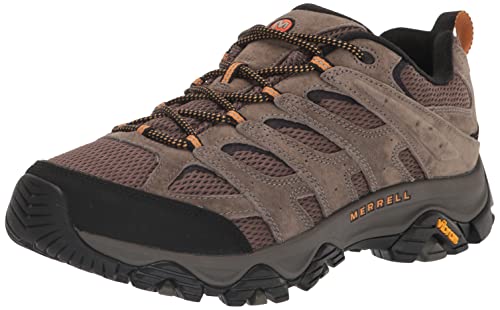
Merrell Moab 3 (Wide Width)
America's best-selling hiking shoe in a true wide width, for about $105: the easy first fix.
Field check: Moab 3 low in true wide sizing (listed) · the best-selling hiker's out-of-box comfort
Sometimes the right answer is the popular answer, one width letter over. The Moab 3 in wide is exactly what it sounds like: the shoe half of America seems to hike in, built in a true wide width instead of the standard D. Everything that made the standard Moab the volume king survives the translation, the plush out-of-box comfort, the supportive footbed, the proven outsole, the sane price. What changes is the girth across the ball of the foot, which for a wide-footed hiker is the difference between a pleasant shoe and a slow-motion vice.
This is the pick we point at first-time fixers, because it de-risks the experiment. For about $105 you find out what your feet feel like in footwear that actually matches their width, without committing to a $200 boot or a barefoot-geometry philosophy. It is a low-cut hiking shoe rather than a mid, so ankle coverage and deep-water protection are not its game; wide-footed hikers who want a waterproof mid should climb the ladder to the Targhee or Sawtooth X. But as the value proof that width was the problem all along, nothing else in the guide touches it.
- Height
- Low-cut hiking shoe
- Wide-fit route
- True labeled wide sizing
- Character
- Out-of-box comfort, best-seller platform
- Approx. price
- ~$105
What we like
- Cheapest true wide fit in the guide at about $105
- The best-selling hiker's proven comfort, one width over
- Breathable low-cut for hot-weather miles
- The lowest-risk way to test whether width was the problem
Worth noting
- No ankle coverage or waterproofing in this style
- Soft ride has a ceiling under heavy loads
- Wide sizes of popular shoes sell out; check your size
Who should buy it: Buy the Moab 3 wide if you suspect width is your problem and want the cheapest credible test, or if you already love the Moab and never knew it came in wide. It is the right pick for day hikers on maintained trails, travelers, and anyone who wants one comfortable wide shoe for trail and town. Heavy loads and rough terrain belong to the mids above it.
What we don't like: It is a low-cut shoe, so it offers no ankle coverage, and this listing is the non-waterproof style of the platform, which is a feature in summer heat and a limitation in spring melt. The Moab's soft, comfort-first ride also has a ceiling under heavy packs. None of that dents the value; it just defines the lane.
Bottom line: The Moab 3 is the best-selling hiking shoe in America because it is comfortable out of the box and priced like a shoe rather than an investment, and the wide version extends that deal to the feet the standard D width leaves out. At about $105 it is the cheapest true wide fit in this guide and the obvious first stop for a wide-footed hiker who wants the width problem solved this weekend.
05 · Best Zero-Drop Wide
Best Zero-Drop Wide
Altra Lone Peak 9 (Wide)
The thru-hiker default, already foot-shaped, now in wide: maximum toe splay in a fast trail runner.
Field check: Zero-drop trail runner (listed) · foot-shaped toe box · wide variant of the thru-hiker standard
Walk a long trail and count the shoes: the Lone Peak is the default for a reason. Altra built its brand on two ideas, a toe box shaped like a foot and a zero-drop platform with heel and forefoot at the same height (listed), and the Lone Peak 9 in wide pushes the first idea as far as this guide goes. The standard Lone Peak already out-rooms most brands' wide versions; the wide variant adds labeled girth on top. For the widest forefeet, for toes that want to fully splay under a thru-hiking day's swelling, this is the ceiling of available room.
It is also a trail runner, not a boot, and that is a feature for the miles-first crowd: light, fast-drying, flexible, and comfortable from the first step, the recipe that convinced thru-hikers to abandon boots en masse. The honest warnings are two. First, the listed zero drop genuinely works your calves and Achilles differently, and the transition from 10mm boots deserves weeks of gradual mileage, not a twenty-mile debut. Second, trail-runner uppers wear faster than leather; distance hikers treat these as consumable. If you want the foot shape with a gentler drop and boot protection, the Trailventure 2 is the halfway house; if you want the splay and the speed, this is the shoe the trail already chose.
- Type
- Trail runner, low-cut
- Drop
- Zero drop (listed)
- Wide-fit route
- Foot-shaped last plus labeled wide
- Approx. price
- ~$145
What we like
- The most forefoot room in this guide: foot-shaped plus wide
- Light, flexible, fast-drying thru-hiker favorite
- Comfortable immediately, no break-in
- The shape long-distance hikers standardized on
Worth noting
- Listed zero drop demands a real transition period
- Minimal support under heavy loads
- Upper durability is consumable by boot standards
Who should buy it: Buy the Lone Peak 9 wide if you count miles, your forefoot is the widest thing about you, and you either already run zero-drop or will honor the transition period. It is the pick for thru-hikers, fastpackers, and day hikers who have fully defected from boots. Pair it with good socks and let your feet spread out.
What we don't like: Zero drop is a commitment, and skipping the adaptation weeks is the classic way to buy yourself calf and Achilles complaints. The soft, flexible build offers little under heavy packs, and durability is trail-runner-grade, not boot-grade. This is a specialist that happens to have a huge following.
Bottom line: The Lone Peak is the closest thing long-distance hiking has to a uniform, and its foot-shaped toe box is a big reason why. The wide version stacks a labeled wide fit on top of a last that was already the roomiest in mainstream trail running, producing the most forefoot room in this guide. The catch is the listed zero drop, which rewards adapted legs and punishes impatient transitions.
06 · Best Cushioned 2E/4E
Best Cushioned Widths
New Balance Fresh Foam X Hierro v9
Big Fresh Foam cushion in listed 2E and 4E widths, from the brand that never abandoned wide sizing.
Field check: Cushioned trail runner · ships in 2E and 4E widths (listed)
For the widest feet in the room, the letters matter more than the marketing. A roomy toe box helps a 2E foot; a 4E foot needs the actual dimension, and almost nobody builds it. The Hierro v9 exists because New Balance kept faith with stepped width sizing while the rest of the athletic industry consolidated to D. This is a modern, generously cushioned Fresh Foam X trail runner, and it ships in listed 2E and 4E widths, which makes it close to unique among current trail shoes.
The shoe those widths come attached to is a comfort-first cruiser: a tall stack of Fresh Foam X cushioning (listed) that flatters long days on hard-packed trail and forgiving mileage on tired legs. It is a conventional-drop shoe, so unlike the Altra there is no gait transition to negotiate, and unlike everything mid-height here there is no ankle collar to break in. The trade-offs are a trail runner's: modest support under big loads and a soft ride that the precision-footwork crowd finds vague on technical rock. But if you have read this far because 'wide' has never actually been wide enough, this and its listed 4E option are the answer to your specific problem.
- Type
- Cushioned trail runner
- Widths
- 2E and 4E available (listed)
- Midsole
- Fresh Foam X (listed)
- Approx. price
- ~$160
What we like
- Listed 2E and 4E widths, the rarest offer in trail footwear
- Plush Fresh Foam X cushion for long days
- Conventional drop: no gait transition required
- From the one big brand still serious about widths
Worth noting
- Soft ride feels vague on technical rock
- Not built for heavy pack loads
- Width/colorway stock fluctuates; buy when available
Who should buy it: Buy the Hierro v9 if you need labeled 2E or 4E width, full stop, because almost nothing else on trail offers it. It also suits wide-footed hikers who prioritize plush cushioning for long, non-technical miles, and anyone who wants the wide fit without the Altra's zero-drop adaptation.
What we don't like: The soft, tall cushion that makes it comfortable makes it less precise on technical terrain, and like every trail runner here it is not a load-hauler. Width availability can also vary by colorway and season, so a 4E buyer should grab the size when it is in stock.
Bottom line: New Balance is the last major brand that treats stepped widths as a standard offering rather than a favor, and the Hierro v9 brings that to the trail: a plush Fresh Foam X trail runner listed in 2E and 4E. For the extra-wide foot that found even wide boots snug, and for wide-footed hikers who want maximum cushioning underfoot, this is the pick the rest of the industry forgot to make.
07 · Best Low-Cut
Best Low-Cut
KEEN Targhee III Low Waterproof
Our top pick's low-cut twin: the same roomy toe box and waterproofing without the ankle collar.
Field check: Low-cut waterproof hiking shoe (listed) · same roomy KEEN toe box as our top pick
Most day hikers wear mids out of habit, not need. On maintained trail with a light pack, the ankle collar of a mid boot mostly adds weight and heat, and the Targhee III Low is the case for skipping it. Underfoot and through the forefoot it is the same story as our top pick: KEEN's famously roomy last that lets wide feet spread, a waterproof KEEN.DRY membrane (listed) for wet mornings, a protective toe cap, and a stable, lugged platform. What is missing is the cuff, and with it a meaningful chunk of weight and all of the collar break-in.
The choice between this and the Mid is honestly a terrain-and-load question rather than a quality one. Rocky, root-laced trails and multi-day pack weights argue for the Mid's extra coverage; smooth-trail day hiking, travel, and hot weather argue for the Low, and save about $20 besides. Wide-footed women should note the Targhee family also runs a women's mid on KEEN's women's last. Either way the essential purchase is the same: a toe box shaped for the feet you actually have.
- Height
- Low-cut, waterproof (KEEN.DRY, listed)
- Wide-fit route
- KEEN's roomy anatomical toe box
- Character
- Top pick's platform, minus the cuff
- Approx. price
- ~$145
What we like
- Same roomy KEEN toe box as our top pick
- Lighter and cooler than the mid, about $20 cheaper
- Waterproof protection in a low-cut package
- No cuff break-in: comfortable immediately
Worth noting
- No ankle coverage on rough terrain
- Lets in debris and deep water a mid would block
- Waterproof lows run warm in high heat
Who should buy it: Buy the Targhee III Low if you loved everything about our top pick except the height: day hikers on maintained trails, hot-climate hikers, travelers who want one wide waterproof shoe for everything. It is the same width solution in a lighter, cooler package.
What we don't like: Low-cut means debris and deep puddles find their way in more easily, and there is no collar support when the trail turns to ankle-rolling scree. Like all waterproof lows it also runs warmer than a non-waterproof mesh shoe in real heat. The lane is clear; stay in it.
Bottom line: The Targhee III Low is our top pick with the collar cut off, and for a lot of wide-footed day hikers that is the better shape. You keep the roomy KEEN toe box, the waterproof membrane (listed), and the stable platform, and you drop the weight, the warmth, and the break-in of a mid cuff. If your trails are maintained and your pack is light, this is the Targhee to buy.
08 · Best Budget Wide (Women's)
Best Budget (Women's)
Columbia Newton Ridge Waterproof (Women's, Wide)
A real trail brand's waterproof women's boot in true labeled wide sizing, for about $110: the cheapest credible wide fit in the guide.
Field check: Women's waterproof mid in true wide sizes (listed) · lightweight Newton Ridge build · the budget wide pick from a major trail brand
The budget end of the wide-feet aisle is where no-name brands live, which is what makes this boot the exception worth knowing about. The Newton Ridge women's waterproof takes the labeled-width route: Columbia builds its long-running entry boot on a women's last and ships it in true wide sizes (listed), so a 2E-class forefoot gets genuine girth across the ball of the foot rather than a marketing phrase about generous fit. Around it is the boot that has introduced an enormous number of hikers to the category: a waterproof seam-sealed construction (listed), a lightweight mid-height build, and a lug outsole that handles maintained trail and light rough stuff without complaint.
The honest frame is that this is an entry boot and it hikes like one. The midsole and support are built for day hikes and light loads, not forty-pound weekends; the leather-and-synthetic upper is warmer than a mesh shoe in summer; and the fit rewards trying your normal length in wide rather than sizing up. What you are buying at about $110 is the combination the wide-footed budget shopper almost never gets offered: the right dimension, a real waterproof membrane, and a brand whose sizing, quality control, and returns behave the way established brands behave. If the wide fit proves out and your mileage grows, the Targhee and women's wide Sawtooth X are the upgrade path; plenty of hikers never need it.
- Wide-fit route
- True labeled wide sizes (listed)
- Height
- Mid, waterproof seam-sealed (listed)
- Fit
- Women's sizing
- Approx. price
- ~$110
What we like
- True labeled wide sizing from a major trail brand at about $110
- Waterproof seam-sealed construction (listed) at a budget price
- The same Newton Ridge platform as our flagship guide's budget pick
- Low-risk way to test whether width was the problem
Worth noting
- Entry-level support: day hikes and light loads, not haulers
- Wide stock fluctuates by size and colorway
- Women's listing only; men should use the labeled wide picks above
Who should buy it: Buy the Newton Ridge wide if you are a wide-footed woman who wants the cheapest credible route into a true wide fit: day hikers, casual and light-duty trail miles, and anyone testing whether width was the problem before spending Targhee or Oboz money. It is the entry ticket to this guide from a brand you already know.
What we don't like: It is an entry-level boot: support and cushioning have a day-hike ceiling, and heavy packs and rough terrain belong to the Oboz above. Wide availability varies by size and colorway, so check your size is actually in stock in wide. And it is the women's line in this listing; wide-footed men should look to the labeled wide picks above.
Bottom line: The Newton Ridge is Columbia's long-running entry hiking boot, the same platform that holds the budget slot in our flagship boots guide, and the women's line ships in true labeled wide sizes. That combination is exactly what the budget end of the wide-feet market almost never offers: a waterproof boot from a brand with decades of trail pedigree, in the actual dimension a wide foot needs, for about $110. It is the cheapest credible wide fit on this page, and there is no asterisk attached to the brand.
More gear worth comparing
Beyond this guide: the highest-rated gear across every category and budget, with a live price check on each.




As an Amazon Associate we may earn from qualifying purchases, at no cost to you.
Quick shop: every pick
Skip the scroll — the whole lineup, with a live price check on each.
- KEEN Targhee III Mid WaterproofBest OverallKEEN · ~$165Check price →
- Topo Athletic Trailventure 2 WPBest Foot-ShapedTopo Athletic · ~$139Check price →
- Oboz Sawtooth X Mid B-DRY (Wide)Best SupportOboz · ~$200Check price →
- Merrell Moab 3 (Wide Width)Best Value WideMerrell · ~$105Check price →
- Altra Lone Peak 9 (Wide)Best Zero-Drop WideAltra · ~$145Check price →
- New Balance Fresh Foam X Hierro v9Best Cushioned 2E/4ENew Balance · ~$160Check price →
- KEEN Targhee III Low WaterproofBest Low-CutKEEN · ~$145Check price →
- Columbia Newton Ridge Waterproof (Women's, Wide)Best Budget Wide (Women's)Columbia · ~$110Check price →
How we chose
We judged this field on exactly one question first: does the shoe genuinely solve width? That means either true labeled wide sizes (2E, 4E, or a brand's own wide designation) or a last that is anatomically wide through the forefoot by design, and we say which route each pick takes. Marketing phrases like 'generous fit' did not count; a shipping wide size or a documented foot-shaped last did. Widths, drops, and materials below are the manufacturers' listed figures, and we hedge them as listed every time, because we did not put every boot on a Brannock device.
After width, we ranked the usual trail virtues: support and stability under a loaded pack, waterproofing that earns its letters, outsole grip, and durability per dollar. And we weighted honesty about trade-offs, because the wide-feet market splits into two philosophies, traditional boots offered in wide widths and foot-shaped shoes that are wide for everyone, and each pick below says plainly which camp it belongs to and who should choose the other one. No brand has bought a placement.
Key terms
- Last
- The foot-shaped form a shoe is constructed around. The last determines everything about fit: width, toe-box shape, instep height, heel girth. A 'foot-shaped' or 'anatomical' last (Topo, Altra, KEEN's roomy forefoot) is wide at the toes where feet actually are; a traditional last tapers toward a point.
- Width letters (B / D / 2E / 4E)
- The stepped US width system. D is standard for men's shoes and B for women's; 2E (often written EE) is wide, and 4E is extra wide. Each step adds girth around the ball of the foot, commonly published as roughly a quarter inch per step. Most hiking boots ship only in D, which is the quiet reason so many hikers hurt.
- Toe box
- The front chamber of the shoe where your toes live. For wide feet the shape matters as much as the measurement: a wide but tapered toe box still stacks toes, while a foot-shaped one lets them splay under load, which is what toes are for.
- Heel-to-toe drop
- The height difference between the heel and forefoot of the midsole, in millimeters. Traditional boots commonly list 10 to 12mm, the Topo Trailventure 2 lists 5mm, and Altra's Lone Peak lists zero. Lower drops feel more natural to many hikers but demand a gradual transition to avoid calf and Achilles strain.
- Foot splay
- The natural widening of the foot under load, especially late in a hiking day when feet swell as much as a half size. Splay is why a boot that fit fine in the store can strangle you at mile ten, and why fitting should happen late in the day in your hiking socks.
Questions, answered
Are wide hiking boots worth it?
If your forefoot is wider than the standard D width (men's) or B (women's), yes, unambiguously. A too-narrow boot compresses the metatarsals on every step, producing numbness, hot spots, pinky-toe blisters, and black toenails that no insole or lacing trick fixes, because the problem is a missing dimension. A true wide fit like the Merrell Moab 3 wide costs about the same as the standard version (about $105), so you are not paying a premium, just buying the right measurement.
What does 2E or 4E mean in hiking boots?
They are steps in the US width lettering system. D is the standard men's width, 2E (also written EE) is wide, and 4E is extra wide, with each step adding girth around the ball of the foot (commonly published charts put it near a quarter inch per step). Most hiking boots ship only in D. In this guide, the Merrell Moab 3 wide and Oboz Sawtooth X wide offer labeled wide sizes, and the New Balance Hierro v9 lists both 2E and 4E, the rarest offering in trail footwear.
Do KEEN boots run wide?
KEEN builds its footwear on a last with a noticeably roomier forefoot than the industry standard, which is why the Targhee line is the perennial word-of-mouth answer for wide feet. A standard Targhee fits many wide feet the way other brands' labeled wide versions do. Note the flip side: hikers with narrow or average forefeet often find KEEN too roomy, which is exactly the sorting the last is doing.
Should I size up hiking boots for wide feet?
No, and this is the most expensive mistake in the category. Length and width are separate measurements: a half size up adds room in front of your toes but only a sliver of girth where you actually need it. The result is a boot that is still tight across the ball of the foot and now loose everywhere else, so your heel lifts, hot spots form, and your toes hit the front on descents. Buy width as width: a labeled 2E/4E size or a foot-shaped last, in your normal length (plus the usual thumb's width of toe room).
Are Altra shoes good for wide feet?
The Lone Peak's foot-shaped toe box is one of the roomiest in mainstream trail footwear, and the wide version of the Lone Peak 9 (about $145) adds labeled girth on top of it, giving it the most forefoot room in this guide. The caveat is Altra's listed zero-drop platform: if you are coming from traditional 10mm-class boots, transition gradually over several weeks, or your calves and Achilles will file complaints. If you want the foot shape with a gentler 5mm listed drop, look at the Topo Trailventure 2.
Does the Merrell Moab come in wide?
Yes. The Moab 3, the best-selling hiking shoe in America, ships in true wide sizing, and it is our value pick at about $105. It carries over everything that made the standard Moab the volume king, the out-of-box comfort, supportive footbed, and proven outsole, with real girth across the forefoot. It is a low-cut shoe, so hikers wanting ankle coverage and waterproofing should look at the KEEN Targhee III Mid or Oboz Sawtooth X instead.
How do I know if I need wide hiking boots?
Symptoms first: forefoot numbness or tingling on long hikes, blisters or calluses on the outside of your pinky toes, a visible bulge of your forefoot over the sole's edge, or relief the moment you unlace. Then measure: get length and width measured on a Brannock device late in the day, when feet are at their largest, in your hiking socks. If your width measurement is E or beyond at your length, or your foot is near the top of the D range and you hike long days (feet swell up to about a half size), shop this guide.
Are wide trail runners better than wide hiking boots?
They are different tools. Wide trail runners like the Altra Lone Peak 9 wide and New Balance Hierro v9 (listed 2E/4E) are lighter, faster-drying, and comfortable immediately, which is why long-distance hikers overwhelmingly choose them. Wide boots like the KEEN Targhee III Mid and Oboz Sawtooth X carry heavy packs better, protect ankles from rock and debris, and last longer. Day hiking light on maintained trail favors the runners; loaded backpacking and rough terrain favor the boots.
Filed under Buyer's Guide
Keep reading
The Best Hiking Boots (2026)
The all-widths flagship guide: the boots we would actually lace up, benchmark to budget.
The Best Trail Running Shoes (2026)
The lighter, faster half of the footwear argument, including the shoes thru-hikers actually wear.
Hiking Boots vs Trail Runners
The full case for each side, so you can pick your camp before you pick your width.
The Best Hiking Socks
The other half of every fit problem: the socks that keep hot spots from becoming blisters.
The Best Daypacks for Hiking (2026)
Get the load off your feet and onto your hips: the six packs we would actually carry.