Our Pick: Darn Tough
Check price →The Best Hiking Socks (2026)
Socks are the cheapest gear decision that can ruin a trip or quietly save it. The right pair manages moisture, kills friction before it becomes a blister, and refuses to stink after three days on trail. We ranked the three that matter: the lifetime-guaranteed benchmark nearly every hiker ends up owning, the softer merino alternative for sensitive feet, and the toe socks that solve blisters the others cannot. Plus the value merino multi-pack that makes the rotation advice affordable.
By The WorldHike Gear Desk · ~10 min read · Updated 2026-07-25

Darn Tough Hiker Micro Crew Midweight
Darn Tough
The sock to beat: dense merino knit, Vermont-made, guaranteed for life without conditions.
Check price★ Our Top Pick
Best for Most Hikers
Darn Tough Hiker Micro Crew Midweight
The sock to beat: dense merino knit, Vermont-made, guaranteed for life without conditions.
Not sure yet? Compare all 4 picks below ↓
Ask a room of experienced hikers what gear punches furthest above its price and socks win every time. The reason is simple mechanics: blisters are made by three ingredients working together, moisture, friction, and heat, and a good hiking sock attacks all three at once. It wicks sweat off the skin, it pads the pressure points where a boot rubs, and it holds its shape mile after mile so fabric never bunches into a hot spot. A twenty-five dollar sock that does those jobs will improve a hike more than a three-hundred dollar jacket that does not.
Almost every sock worth buying is built around merino wool, and the education is worth thirty seconds. Merino is a fine-fibered wool that does three things cotton and cheap synthetics cannot: it keeps insulating when damp, it moves moisture away from skin as vapor, and it resists odor naturally, which is why a merino sock can go days between washes without becoming a biohazard. Modern hiking socks blend merino with nylon for durability and a touch of spandex for fit, and the blend ratios, cushion levels, and knit quality are where the good brands separate from the drawer-fillers. Cotton, for the record, does the opposite of everything above: it soaks, it stays wet, and it rubs. Cotton socks are how blisters get made.
Our disclosure, plainly: no brand paid to be here, nobody placed a product, and no manufacturer saw this guide before publication. Some links go to Amazon; if you buy through one we may earn a small commission at no cost to you, and it never moves a ranking. Prices are approximate street figures from our verified dataset, and any spec we cite is the manufacturer's listed figure, flagged as such.
The short version
- Our pick is the Darn Tough Hiker Micro Crew Midweight (about $25): a dense merino knit, made in Vermont, with an unconditional lifetime guarantee. Wear a hole in it and the company replaces it. It is the last sock recommendation most hikers ever need.
- The soft alternative is the Smartwool Hike Light Cushion (about $23): a plusher, softer merino feel for hikers who find dense knits too firm, in a lighter cushion that suits warm weather.
- The blister solution is the Injinji Trail Midweight toe sock (about $20): by wrapping each toe in fabric, it eliminates the skin-on-skin rubbing that ordinary socks cannot reach. Hikers with chronic toe blisters call these a cure, and they mean it.
- Merino wool is the reason all three work: it insulates when damp, wicks sweat as vapor, and resists odor for days. Avoid cotton on trail entirely; it holds moisture against skin, which is exactly how blisters start.
- Buy two or three pairs and rotate them daily on multi-day trips. A dry sock in the morning is one of hiking's great cheap luxuries, and rotation doubles the life of every pair.
| Sock | Best for | Cushion | Signature strength | Approx. price |
|---|---|---|---|---|
| Darn Tough Hiker Micro Crew | Our Pick | Midweight | Unconditional lifetime guarantee | about $25 |
| Smartwool Hike Light Cushion | Best Soft Merino | Light | Plush, soft-hand merino comfort | about $23 |
| Injinji Trail Midweight | Best Blister Prevention | Midweight | Five-toe design stops toe blisters | about $20 |
| Danish Endurance Merino 3-Pack | Best Value Merino Pack | Cushioned | A full sock rotation in one purchase | about $27 |
The 2026 hiking sock shortlist at a glance. Prices are approximate street figures; materials are the manufacturers' listed blends.
01 · Best for Most Hikers
Our PickDarn Tough Hiker Micro Crew Midweight
The sock to beat: dense merino knit, Vermont-made, guaranteed for life without conditions.
Field check: Merino blend, midweight cushion, made in Vermont, unconditional lifetime guarantee (the company's published policy) · the benchmark hiking sock
There is a reason thru-hikers treat this sock as a default and not a choice. The Hiker Micro Crew Midweight is knit in Darn Tough's Vermont mill from a listed merino wool blend, and the construction is the story: a high-density knit that translates on trail into a sock that keeps its shape, keeps its cushion, and shrugs off the abrasion that kills lesser socks in a season. Midweight cushion pads the sole and heel where a boot actually presses, the fit stays locked without bunching, and the merino does its quiet work of wicking sweat and suppressing odor across multi-day wear.
Honest notes: the dense knit that makes them durable also makes them feel firmer and less plush than a Smartwool, and some hikers with sensitive feet prefer the softer hand of our second pick. In deep summer heat, some will also prefer a lighter cushion than midweight. But as a single answer to "which hiking sock should I buy," this is it, for day hikers and 2,000-mile thru-hikers alike. A women's version with the same knit and the same guarantee is available here.
- Material
- Merino wool blend with nylon and spandex (listed)
- Cushion
- Midweight, underfoot and heel
- Height
- Micro crew
- Guarantee
- Unconditional lifetime (published policy)
- Approx. price
- about $25
What we like
- Unconditional lifetime guarantee: wear a hole, get a new pair
- Dense Vermont knit holds shape and cushion over hard miles
- Merino blend manages moisture and odor across multi-day wear
- Fits locked-in with no bunching, the root cause of hot spots
Worth noting
- Firmer, less plush hand than softer merino rivals
- Midweight cushion runs warm in peak summer heat
- Highest up-front price in the guide
Who should buy it: Buy the Hiker Micro Crew if you want the most durable, best-fitting, lowest-regret hiking sock available: beginners buying their first real pair, backpackers who need socks that survive wet days, and anyone charmed by the idea of never truly buying socks again. It is the default for good reason.
What we don't like: The dense knit feels firmer and less plush than softer merino socks, which some feet read as less comfortable out of the box. Midweight cushion can run warm in peak summer, and at about $25 the up-front price is at the top of the category, even if the lifetime guarantee makes it the cheapest sock long-term.
Bottom line: The Hiker Micro Crew is the sock the entire category gets measured against. The knit is unusually dense, which is exactly why it holds its shape, resists holes, and refuses to bunch after wet, hard miles. The merino blend manages moisture and odor the way merino should. And behind all of it stands the famous unconditional lifetime guarantee: wear through a pair, send them in, get new socks. At about $25, it is arguably the best value in all of hiking gear.
02 · Best Soft Merino
Best Soft Merino
Smartwool Hike Light Cushion Crew
The plush one: softer merino feel and a lighter cushion, for feet that find dense knits too firm.
Field check: Merino blend crew with light cushion and Smartwool's signature soft hand (listed) · the comfort-first alternative to the dense benchmark knits
Some feet want armor, and some feet want a hug: this is the hug. The Hike Light Cushion uses Smartwool's listed merino blend in a knit that leads with softness. Where the Darn Tough feels dense and structured, this sock feels plush from the first step, with light cushioning zoned underfoot and a breathable body that suits warm-weather hiking, lighter footwear, and anyone whose skin protests firmer knits. The merino content does its species-typical work: sweat moves off the skin, feet stay comfortable damp or dry, and the socks go days without offending anyone.
The trade-offs are honest ones. Smartwool's warranty is a standard satisfaction guarantee, not Darn Tough's unconditional lifetime promise, and the softer knit generally gives up some seasons of life to the denser benchmark. But durability is not the only virtue in a sock. For hikers who tried the dense knits and found them harsh, and for warm-weather miles where light cushion shines, this is the merino sock that makes every step feel better. That is worth about $23.
- Material
- Merino wool blend (listed)
- Cushion
- Light, zoned underfoot
- Height
- Crew
- Guarantee
- Standard satisfaction guarantee
- Approx. price
- about $23
What we like
- Noticeably softer, plusher hand than dense benchmark knits
- Light cushion breathes well for summer and warm climates
- Classic merino moisture and odor management
- Pairs beautifully with trail runners and light footwear
Worth noting
- Wears out sooner than the dense Darn Tough knit
- No unconditional lifetime guarantee
- Too little cushion for heavy packs and stiff boots
Who should buy it: Buy the Hike Light Cushion if comfort and softness lead your priorities: hikers with sensitive feet, warm-climate and summer hikers, and anyone pairing socks with lighter trail shoes rather than stiff boots. It is the plush counterpoint to the dense benchmark knits.
What we don't like: No unconditional lifetime guarantee, and the softer knit typically wears out sooner than the dense Darn Tough. Light cushion is not the right match for heavy packs, stiff boots, or cold weather, where a midweight sock earns its bulk.
Bottom line: Smartwool built its name on making merino feel luxurious, and the Hike Light Cushion is that reputation in sock form. The hand is noticeably softer and plusher than Darn Tough's dense knit, the light cushion breathes better in warm weather, and the merino delivers the same moisture and odor management the fiber is famous for. It gives up the lifetime guarantee and some outright durability, and gains a comfort that certain feet will not trade away.
03 · Best Blister Prevention
Blister Killer
Injinji Trail Midweight Mini-Crew
Toe socks that look odd and work: wrapping each toe kills the friction ordinary socks cannot reach.
Field check: Five-toe anatomical design in a midweight trail knit (listed) · the standard prescription for hikers with chronic toe blisters
If your blisters live between your toes, ordinary socks cannot help you, and these can. A conventional sock wraps all five toes in one pocket, leaving skin pressed against skin, and on a long descent that contact becomes friction and that friction becomes the blister that ruins the week. The Injinji Trail Midweight ends the problem at the root: each toe gets its own sleeve of moisture-wicking fabric, so there is simply no bare skin left to rub. Among ultrarunners, this is not a quirky option; it is the standard answer, and thru-hikers adopted it for the same reason.
Beyond the toes, this is a legitimately good trail sock: the listed knit is a wicking blend with midweight cushion in the places trail shoes press, a snug arch, and a mini-crew height that keeps grit out without extra fabric. At about $20 it is also the least expensive pick in this guide, which makes trying one pair a cheap experiment with a potentially trip-changing payoff. Injinji's women's-specific listings drift in and out of stock; when they are gone, the unisex Trail Midweight crew two-pack covers smaller feet in the same five-toe knit. If toe blisters have ever ended your hike early, run the experiment.
- Material
- Moisture-wicking blend, five-toe construction (listed)
- Cushion
- Midweight
- Height
- Mini-crew
- Design
- Anatomical toe sleeves
- Approx. price
- about $20
What we like
- Eliminates skin-on-skin toe friction, the blister source other socks cannot reach
- The standing prescription among ultrarunners and thru-hikers
- Works alone or as a liner under a cushioned sock
- Least expensive pick in the guide: a cheap, high-payoff experiment
Worth noting
- Slower to put on; some foot shapes never love the feel
- Slightly warmer and snugger in tight footwear
- The look invites trailhead commentary
Who should buy it: Buy the Trail Midweight if blisters form between your toes or under toenails on long days: ultrarunners, thru-hikers, downhill-heavy hikers, and anyone who has tried tape and powder without lasting success. It is the specific cure for a specific problem, at the lowest price in this guide.
What we don't like: The toe-by-toe fit takes longer to put on and some foot shapes never find it comfortable. Fabric between the toes adds a touch of warmth and snugness in tight footwear, and the styling is an acquired taste you will be explaining at trailheads.
Bottom line: Injinji's toe socks solve a problem no conventional sock can touch: skin-on-skin friction between the toes. By giving each toe its own fabric sleeve, the Trail Midweight stops toes from rubbing each other raw on descents and long miles, which is why these are the standing prescription among ultrarunners and thru-hikers with chronic toe blisters. They look strange, they take a minute to put on, and for the feet that need them, nothing else works as well.
04 · Best Value Merino Pack
Best Value Pack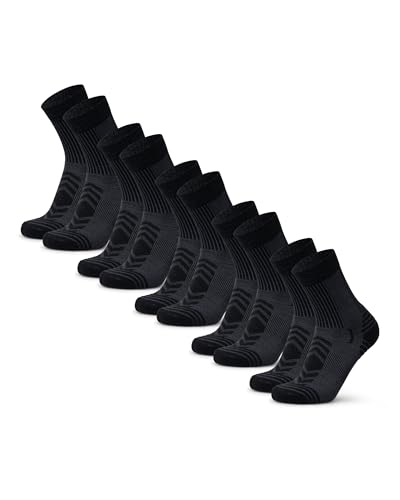
Danish Endurance Merino Wool Hiking Socks (3-Pack)
Three pairs of cushioned merino hiking socks for about $27: a full rotation for the price of one premium pair.
Field check: Merino blend 3-pack, cushioned and breathable (listed) · the established Copenhagen value-merino specialist
The rotation advice in this guide has a price tag, and this pack shrinks it. The Danish Endurance merino 3-pack follows the same playbook as the premium picks: a merino wool blend for moisture and odor management, cushioning zoned underfoot, and a breathable knit, all per the listed specs. What changes is the arithmetic. At about $27 for three pairs, the full worn-drying-sleeping rotation costs what one premium pair costs, which is the least painful way ever devised to find out what merino does for your feet.
The honest positioning: this is the volume play, not the benchmark. There is no unconditional lifetime guarantee behind it, and the dense knit that lets a Darn Tough survive wet decades remains the premium picks' territory. But socks are a rotation sport. A full cycle of cushioned merino for about $27 keeps a dry pair in the morning queue, extends the life of every pair in the drawer, and leaves budget for the rest of the kit. As a first merino purchase, or as the depth behind one or two premium pairs, the pack earns its slot.
- Material
- Merino wool blend, cushioned and breathable (listed)
- Format
- 3-pack, unisex sizing bands (listed)
- Cushion
- Cushioned (listed)
- Guarantee
- Standard retail returns
- Approx. price
- about $27 per 3-pack
What we like
- A full rotation of merino for about $27, the price of one premium pair
- Established Copenhagen brand with a decade-long track record
- Cushioned, breathable merino build per the listed specs
- One of the largest positive owner bases in the category
Worth noting
- No lifetime guarantee
- Knit unlikely to match the dense premium picks for longevity
- Banded sizing: check the chart before ordering
Who should buy it: Buy the Danish Endurance pack if you are building a sock rotation from zero, outfitting a family or group trip, or want merino depth behind a premium pair or two without paying premium prices three times. It is the right first merino purchase for new hikers who want to feel what the fiber does before committing to the guaranteed-for-life tier.
What we don't like: No lifetime guarantee, and the knit gives up some long-haul durability to the dense Darn Tough benchmark; blend details are the manufacturer's listed figures. Sizing runs in banded ranges rather than precise sizes, so check the chart. It wins on value per drawer, not on any single-pair spec.
Bottom line: Everything above this card tells you to buy several pairs and rotate them daily, and the Danish Endurance 3-pack is the cheapest credible way to follow that advice. For about $27, roughly the price of a single Darn Tough pair, you get three pairs of cushioned merino-blend hiking socks from the Copenhagen brand that built its reputation on exactly this play: honest technical basics, developed with input from endurance athletes, sold in multi-packs at prices the heritage brands do not touch.
More gear worth comparing
Beyond this guide: the highest-rated gear across every category and budget, with a live price check on each.




As an Amazon Associate we may earn from qualifying purchases, at no cost to you.
Quick shop: every pick
Skip the scroll — the whole lineup, with a live price check on each.
- Darn Tough Hiker Micro Crew MidweightBest for Most HikersDarn Tough · about $25Check price →
- Smartwool Hike Light Cushion CrewBest Soft MerinoSmartwool · about $23Check price →
- Injinji Trail Midweight Mini-CrewBest Blister PreventionInjinji · about $20Check price →
- Danish Endurance Merino Wool Hiking Socks (3-Pack)Best Value Merino PackDanish Endurance · about $27Check price →
How we chose
We judge hiking socks on the jobs that decide foot comfort over real miles: moisture management (does the sock move sweat off skin and dry fast), fit retention (does it hold its shape hour after hour, or bunch and slide into hot spots), cushion placement (padding underfoot and at the heel where boots actually press), durability for the price, and odor resistance across multi-day wear. Every ounce earns its place applies to socks too: none of these picks waste bulk where it does no work.
On honesty: we do not run a textile lab, so fiber blends and construction details are the manufacturers' listed specs and we flag them that way. Prices are approximate street figures from our PA-API-verified dataset. Guarantees we cite, like Darn Tough's lifetime replacement, are the companies' own published policies. No brand paid for placement here.
Key terms
- Merino wool
- Fine-fibered wool that wicks moisture, insulates even when damp, and resists odor naturally. The foundation fiber of nearly every serious hiking sock, blended with nylon and spandex for durability and fit.
- Cushion weight
- How much padding a sock carries, usually zoned underfoot and at the heel. Light cushion breathes better for summer and trail runners; midweight suits boots, packs, and shoulder seasons; heavy cushion is for cold weather and big loads.
- Toe socks
- Socks that wrap each toe in its own fabric sleeve, eliminating the skin-on-skin friction between toes that causes blisters ordinary socks cannot prevent. Injinji is the category's standard-bearer.
- Hot spot
- The warm, tender point of friction that precedes a blister. Treating it immediately with tape or a patch, rather than hiking on, is the single most effective blister habit on trail.
- Sock rotation
- Carrying two or three pairs on multi-day trips and swapping daily so each pair dries fully between wears. Extends sock life, keeps feet drier, and guarantees the small luxury of a dry morning sock.
- Liner sock
- A thin sock worn under a cushioned one so friction happens between fabric layers instead of against skin. Toe socks like Injinjis are a popular modern liner for blister-prone feet.
Questions, answered
What are the best hiking socks in 2026?
Our pick is the Darn Tough Hiker Micro Crew Midweight, at about $25: a dense, Vermont-made merino knit that holds its shape over hard miles and carries an unconditional lifetime guarantee, so worn-out pairs are replaced free. Hikers who prefer a softer, plusher feel should choose the Smartwool Hike Light Cushion, and hikers whose blisters form between their toes should go straight to the Injinji Trail Midweight toe socks.
Why is merino wool better than cotton or synthetic socks?
Merino wicks sweat away from skin, keeps insulating even when damp, and resists odor naturally, so one pair can hike for days. Cotton does the opposite: it absorbs sweat, stays wet against your skin, and creates exactly the moist friction that causes blisters, which is why experienced hikers refuse it entirely. Pure synthetics wick and dry well but hold odor badly. Merino blended with nylon and spandex, the recipe all three of our picks use, gives the best overall balance.
Is the Darn Tough lifetime guarantee real?
Yes, and it is the company's own published, unconditional policy: if you wear a hole in a pair of Darn Tough socks, they will replace them, without a receipt requirement or a time limit. Hikers genuinely use it, including thru-hikers who destroy socks professionally. It effectively converts the roughly $25 price into a one-time cost for that drawer slot, which is a large part of why the Hiker Micro Crew is our top pick.
Do toe socks actually prevent blisters?
For blisters that form between the toes, yes, and dramatically. Conventional socks leave toe skin pressed against toe skin, and long descents turn that contact into friction blisters no external padding can prevent. Toe socks like the Injinji Trail Midweight wrap each toe in its own wicking sleeve, removing the bare-skin contact entirely. They are the standard answer among ultrarunners for exactly this reason. For heel or sole blisters, fit and moisture management matter more than toe design.
How many pairs of socks should I carry backpacking?
Three is the classic answer for trips of any length: one worn, one drying from yesterday, and one dry pair reserved for sleeping that never hikes. Rotating daily lets each pair dry fully, which keeps feet healthier and roughly doubles sock life. On short overnights, two pairs plus discipline works. What matters most is never starting a day in yesterday's wet socks when a dry pair is available.
What cushion weight should I choose?
Match cushion to footwear, load, and season. Light cushion, like the Smartwool Hike Light, breathes best and suits summer hiking and trail runners. Midweight, like our Darn Tough and Injinji picks, is the versatile default for boots, loaded packs, and three-season use. Heavy cushion earns its warmth in winter and under big loads. If you own only one weight, midweight covers the most ground; many hikers keep light and midweight pairs and choose by forecast.
How do I stop a blister once I feel it starting?
Stop at the first hint of a hot spot, that warm tender point before the blister forms, and cover it immediately with blister tape or a patch. Those five minutes save days of pain; hiking on because the trail is nice is how hot spots become open blisters. Dry your socks or swap to a spare pair while you are stopped, since moisture is half the recipe. If a blister has already formed, protect it with a doughnut-shaped pad and keep it clean.
Filed under Buyer's Guide
Part of Best Hiking Gear
Keep reading
The Best Rain Jackets for Hiking (2026)
Dry feet start with a dry body: the four rain shells that earn their pack space, from $25 to $170.
The 15 Best Hikes in the World (2026)
The trails worth wearing out a pair of guaranteed-for-life socks on, from Patagonia to the Alps.
The Best Hiking Boots (2026)
The other half of the blister equation: the boots we trust, and how to fit them properly.
Hiking Boots vs. Trail Runners
The footwear debate that decides which socks you need: the honest case for each side.
The Ten Essentials, Explained
Spare socks earn a place in the pack. Here is the full checklist every hiker should carry.