Our Pick: Sawyer
Check price →Sawyer Squeeze Review (2026)
The Sawyer Squeeze is the filter you will see on more thru-hiker packs than any other: a listed 0.1 micron hollow-fiber element, about 3 ounces listed, and a price around $40. Here is the full verdict on the standard Squeeze and the smaller Micro, how they stack up against the Katadyn BeFree and LifeStraw Peak Squeeze, and the three honest limitations every buyer should know.
By The WorldHike Gear Desk · ~9 min read · Updated 2026-07-02

Sawyer Squeeze (SP129)
Sawyer
About 3 ounces listed, roughly $40, no moving parts: the filter the trail itself chose.
Check price★ Our Top Pick
The Thru-Hiker Standard
Sawyer Squeeze (SP129)
About 3 ounces listed, roughly $40, no moving parts: the filter the trail itself chose.
Not sure yet? Compare all 2 picks below ↓
If you want to know what gear actually works, watch what thru-hikers carry, because they live with their choices for two thousand miles and abandon anything that does not earn its ounces. By that measure the Sawyer Squeeze may be the most validated piece of gear in backpacking. Season after season it shows up in gear surveys and on pack shoulder straps from Georgia to Katahdin: a palm-sized hollow-fiber filter, about 3 ounces listed, roughly $40, that threads onto its included pouches and onto common disposable bottles, a pairing so widespread among long-distance hikers it amounts to a standard kit.
The design is almost aggressively simple. Dirty water goes in a pouch or bottle, the pouch squeezes through the listed 0.1 micron hollow-fiber element, clean water comes out the other side, and there are no pumps, batteries, hoses, or moving parts to fail. Sawyer's listed claims cover bacteria and protozoa, the microorganisms behind most backcountry water worries in North America. Simplicity is also why it dominates our lens of every ounce earning its place: the Squeeze does one job, weighs almost nothing doing it, and doubles as a gravity or inline filter for hikers who rig it that way. We review the standard Squeeze and its smaller sibling, the Micro Squeeze, below, against the two rivals most shoppers weigh: the fast-flowing Katadyn BeFree and the value-priced LifeStraw Peak Squeeze.
Standard disclosures before the verdict: Sawyer did not pay for this review, has no relationship with this site, and did not know we were writing it. We verify every listed spec against manufacturer data and our PA-API-verified gear dataset, and we judge gear on the long public track record of owner reports rather than a single trip. If you buy through our links we may earn an Amazon affiliate commission at no extra cost to you, and that never changes a rating or a ranking.
The short version
- The Sawyer Squeeze is the closest thing backpacking has to a standard water filter: listed 0.1 micron hollow fiber, about 3 ounces listed, roughly $40, and the perennial thru-hiker favorite.
- Like hollow-fiber filters generally, its listed claims cover bacteria and protozoa but not viruses, which matters for some international travel more than for most North American backcountry.
- Freezing can ruin the element: manufacturer guidance treats a frozen filter as compromised, so it sleeps in your sleeping bag on cold nights.
- Flow slows as the filter clogs, and regular backflushing to restore it is a widely documented part of ownership.
- The Micro Squeeze saves money and a little bulk at about $29, but the standard Squeeze's faster flow is the trade most long-distance hikers choose.
| Filter | Element | Format | Approx. price |
|---|---|---|---|
| Sawyer Squeeze (SP129) | 0.1 micron hollow fiber (listed) | Squeeze pouch / bottle-thread / gravity-rig | ~$40 |
| Sawyer Micro Squeeze | 0.1 micron hollow fiber (listed) | Smaller squeeze unit, same threading | ~$29 |
| Katadyn BeFree 1.0L | Hollow fiber (listed) | Soft flask with a reputation for the fastest flow in class | ~$45 |
| LifeStraw Peak Squeeze 650ml | LifeStraw membrane (listed) | Squeeze bottle | ~$38 |
Both Sawyer models vs. the two rivals shoppers weigh most. All figures are the makers' listed specs, cross-checked against our PA-API-verified dataset, July 2026. Prices are approximate street figures.
01 · The Thru-Hiker Standard
Our PickSawyer Squeeze (SP129)
About 3 ounces listed, roughly $40, no moving parts: the filter the trail itself chose.
Field check: Listed 0.1 micron hollow-fiber element, ~3 oz listed; the perennial thru-hiker survey favorite at approximately $40.
Judged as one filter for the widest range of backcountry trips, this is the one to beat. The Sawyer Squeeze earns its reputation on three things. Weight: about 3 ounces listed, light enough that carrying it is never a debate. Simplicity: a listed 0.1 micron hollow-fiber element with no pump, no batteries, and nothing to break in the cold morning fumble. Versatility: it squeezes through its included pouches, threads onto common disposable water bottles, a pairing so standard among long-distance hikers it is practically folklore, and hangs into a dirty-bag gravity rig at camp so a liter filters itself while you pitch the tent.
Owning one comes with three honest homework items, all covered in depth below. Its listed claims do not include viruses, which is typical of hollow-fiber filters and mostly matters for certain international travel rather than the average North American trail. A hard freeze can ruin the element per manufacturer guidance, so it lives in your sleeping bag on cold nights. And flow slows as the element clogs, so regular backflushing with the included plunger is real, widely documented maintenance rather than optional fine print. Hikers who prioritize sheer flow speed should also look at the Katadyn BeFree, which built its reputation on the fastest flow in class, though its soft flask ties you to its own bottle ecosystem where the Squeeze plays with nearly everything.
- Element
- 0.1 micron hollow fiber (listed)
- Listed weight
- About 3 oz
- Listed claims
- Removes bacteria and protozoa; viruses not covered
- Formats
- Squeeze pouch, bottle-thread, gravity or inline rig
- Maintenance
- Backflush with included plunger to restore flow
- Approx. price
- About $40
What we like
- About 3 ounces listed; weight is never a reason to leave it home
- No pumps, batteries, or moving parts to fail
- Threads onto common bottles and rigs into gravity setups
- The deepest public track record in the category: the thru-hiker standard
- Roughly $40 for years of use if maintained
Worth noting
- Listed claims do not cover viruses, like hollow-fiber filters generally
- Freezing can ruin the element, per manufacturer guidance
- Flow slows without regular backflushing, per widely documented user experience
Who should buy it: Buy the standard Squeeze if you want one filter for everything from day hikes to a full thru-hike: it is the best-validated, most versatile choice in the category, and its bottle-threading and gravity-rig tricks grow with your ambitions. It is also our pick over the Micro for anyone filtering for more than one person or covering big-mile days, where flow rate matters more than saving roughly $11.
What we don't like: No virus removal, which is typical of hollow-fiber filters per the listed claims, so certain international destinations call for a purifier instead. A freeze can silently ruin the element, per manufacturer guidance, which makes shoulder-season carelessness genuinely costly. And the flow, decent when clean, slows noticeably as the element clogs, a behavior so widely documented among users that we treat the backflush plunger as part of the filter, not an accessory.
Bottom line: The Squeeze is the default backcountry filter for good reason: a listed 0.1 micron hollow-fiber element in an ultralight, no-moving-parts package that squeezes, threads onto common bottles, or rigs into a gravity system. Its listed claims cover the bacteria and protozoa that dominate North American water risks. The honest asks: keep it from freezing, backflush it regularly, and do not expect virus protection.
02 · Best for Minimalists on a Budget
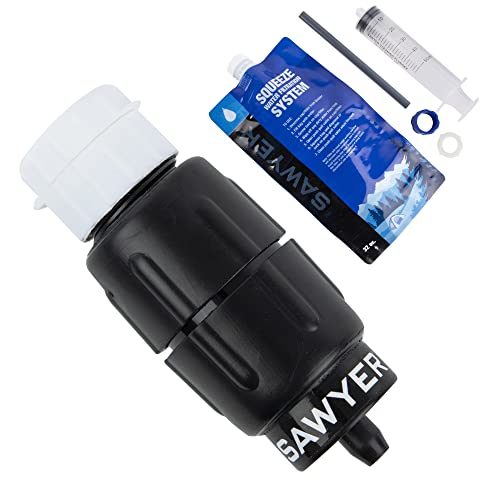
Sawyer Micro Squeeze
The Squeeze shrunk down and marked down: same listed element rating, slower flow, about $29.
Field check: Smaller-format hollow fiber with the same listed 0.1 micron rating; approximately $29.
The right filter for a specific hiker. The Micro Squeeze keeps everything that defines the family: the same listed 0.1 micron hollow-fiber filtration, the same listed bacteria-and-protozoa claims, the same no-moving-parts durability logic, and the same threading that mates with common bottles and squeeze pouches. It is simply smaller and about $11 cheaper, and for a solo hiker filtering a liter here and a liter there, a day-hike kit, or a just-in-case pouch in a travel bag, that is a genuinely appealing trade.
Every caveat from the standard model applies unchanged, because the technology is the same: no virus coverage in the listed claims, a hard freeze can ruin the element per manufacturer guidance, and the backflush plunger is part of the deal. Our guidance lands simply. If minimum bulk and minimum spend are the mission, the Micro is a legitimate, well-proven pick at about $29. If there is any chance you will filter for two, chase big miles, or draw from murky sources, the standard Squeeze's stronger flow is worth more than the savings.
- Element
- 0.1 micron hollow fiber (listed)
- Listed claims
- Removes bacteria and protozoa; viruses not covered
- Format
- Compact squeeze unit; bottle-compatible threading
- Flow character
- Slower than the standard Squeeze, per Sawyer's positioning and wide user consensus
- Maintenance
- Backflush to restore flow
- Approx. price
- About $29
What we like
- Same listed 0.1 micron rating as the standard Squeeze for about $11 less
- Smaller and lighter-packing; disappears into a day-hike or emergency kit
- Same versatile bottle-friendly threading
Worth noting
- Noticeably slower flow than the standard Squeeze
- Same family limits: no virus coverage (listed), freeze-vulnerable, needs backflushing
- Frustrating as a group or big-mile filter
Who should buy it: Buy the Micro Squeeze if you are a solo hiker who values minimum bulk and spend, if you are building a day-hike or emergency kit that mostly waits for its moment, or if roughly $29 is what gets a real filter into your pack today. It delivers the same listed protection as its bigger sibling for less money.
What we don't like: Flow is the whole compromise: slower than the standard Squeeze by design, slower still as it clogs, and a real drag when filtering for more than one person. It also inherits the family limitations, no virus coverage in the listed claims, vulnerability to freezing per manufacturer guidance, and the standing need to backflush.
Bottom line: The Micro Squeeze compresses the Squeeze formula into a smaller, cheaper package with the same listed 0.1 micron rating and the same bottle-friendly threading. The catch is flow: it is the slower of the two by design and by wide user consensus, and slower still as it clogs. Great for solo minimalists and emergency kits; big-mile hikers should spend the extra roughly $11.
More gear worth comparing
Beyond this guide: the highest-rated gear across every category and budget, with a live price check on each.



As an Amazon Associate we may earn from qualifying purchases, at no cost to you.
Quick shop: every pick
Skip the scroll — the whole lineup, with a live price check on each.
- Sawyer Squeeze (SP129)The Thru-Hiker StandardSawyer · ~$40Check price →
- Sawyer Micro SqueezeBest for Minimalists on a BudgetSawyer · ~$29Check price →
How we chose
How we judge a water filter: we verify every listed spec against the manufacturer's own published data and our PA-API-verified gear dataset, and we put heavy weight on the long public track record, because a filter's real report card is written by thousands of hikers over thousands of miles, not by one reviewer at one stream. Where a figure below is the maker's number, micron rating, weight, or removal claims, we say so with words like listed and claimed. We do not invent measurements or run lab tests we are not equipped to run, and we will not pretend otherwise.
The behaviors that decide a filter rating are practical. How fast does it move water when you are thirsty, and how much does that slow as it clogs? How fussy is maintenance, and what happens when you skip it? What are the failure modes, and are they obvious or silent? Freezing is the one we weight most heavily, because a frozen hollow-fiber element can be compromised without looking damaged. And finally, ecosystem: what does the filter thread onto, and how easily does it rig into a gravity setup at camp? The Squeeze's answers to those questions are why it owns the category, and its honest weak points are stated plainly below. No brand bought a placement here.
Key terms
- Hollow-fiber filter
- A filter element made of bundled hollow fibers whose walls are perforated with microscopic pores. Water passes through the walls; anything larger than the pore rating stays behind. The Squeeze's element is rated at a listed 0.1 micron.
- 0.1 micron (listed)
- The pore-size rating Sawyer lists for the Squeeze family: small enough to block bacteria and protozoa per the listed claims, but not viruses, which are smaller than hollow-fiber filters generally trap.
- Backflushing
- Forcing clean water backward through the element with the included plunger to flush out trapped sediment and restore flow. Widely documented as the maintenance habit that separates a years-long Squeeze from a frustrating one.
- Filter vs. purifier
- A filter (Squeeze, BeFree, Peak Squeeze) removes bacteria and protozoa per its listed claims; a purifier (like the GRAYL GeoPress) also addresses viruses. The distinction decides the tool for international travel.
- Gravity rig
- Hanging a dirty-water reservoir above a filter and letting gravity do the squeezing. The Squeeze's threading makes this an easy camp setup: water filters itself while you make dinner.
Questions, answered
Why is the Sawyer Squeeze the thru-hiker standard?
Because it wins on the axes thru-hikers actually optimize: it is about 3 ounces listed, roughly $40, has no moving parts to fail, and threads onto the pouches and common disposable bottles hikers already carry. Season after season it tops long-trail gear surveys, which is the deepest field validation gear can get. It is not that nothing else is good; it is that nothing else has been proven at this scale.
Does the Sawyer Squeeze remove viruses?
No. Its listed claims cover bacteria and protozoa, and like hollow-fiber filters generally it does not claim virus removal, because viruses are smaller than the listed 0.1 micron pore rating. For most North American backcountry this is rarely the deciding factor, since bacteria and protozoa dominate the risk profile. For international travel where waterborne viruses are a genuine concern, choose a purifier such as the GRAYL GeoPress instead.
What happens if my Sawyer Squeeze freezes?
Treat it as compromised. Manufacturer guidance is that a filter that has frozen with water inside may be damaged in ways you cannot see or test on trail, so the safe move is to replace it. Prevention is free: once temperatures might touch freezing, the filter sleeps in your sleeping bag at night and rides in a warm pocket during cold days. This is the single most important habit a Squeeze owner can build.
Why is my Sawyer Squeeze so slow, and how do I fix it?
Slowing flow is the classic, widely documented behavior of a hollow-fiber element picking up sediment, and the fix is backflushing: use the included plunger to push clean water backward through the filter until flow recovers. Regular backflushing, especially after silty sources, plus storing the filter clean, keeps flow healthy; users who maintain the habit commonly report filters lasting for years. If flow will not recover after thorough backflushing, or the filter may have frozen, replace it.
Sawyer Squeeze vs. Katadyn BeFree: which should I buy?
The BeFree, at about $45, built its reputation on the fastest flow in its class and a convenient soft-flask format: scoop and drink, minimal ceremony. The trade is ecosystem: its collapsible flask uses its own wide threading, while the Squeeze plays with common bottles, pouches, and gravity rigs, and has the longer field record on long trails. Fast-and-light day missions and runners lean BeFree; thru-hikers and anyone who values rigging flexibility lean Squeeze. Both are excellent filters.
Is the Micro Squeeze good enough, or should I pay up for the standard Squeeze?
The Micro delivers the same listed 0.1 micron protection for about $29, and for a solo hiker on modest days or an emergency kit it is genuinely enough. The standard Squeeze's advantage is flow, which compounds: filtering more liters, for more people, from murkier sources, at the end of longer days. Our rule: if you can imagine regularly filtering more than a liter or two at a sitting, the roughly $11 upgrade to the standard Squeeze is the best value in the category.
Keep reading
Sawyer Squeeze vs Katadyn BeFree
The Squeeze against the fastest squeeze filter sold. Who should buy which.
The Best Water Filters (2026)
Squeeze, gravity, soft flask, and purifier: every backcountry water treatment worth carrying, ranked.
The Ten Essentials
Water treatment is one of the ten. The full safety list every pack should carry, explained.
How to Choose a Daypack
Where a filter, water, and the rest of your kit actually ride: picking the pack that carries it all well.