Our Pick: Sawyer
Check price →The Best Backpacking Water Filters (2026)
Sawyer Squeeze for most hikers (3 oz listed, 0.1 micron, about $46), Katadyn BeFree for flow, Platypus GravityWorks for groups, GRAYL GeoPress for viruses. Pore sizes, listed weights, rated life, and the freeze rule that kills filters.
By The WorldHike Gear Desk · ~13 min read · Updated 2026-08-23

Sawyer Squeeze (SP129)
Sawyer
The 0.1 micron thru-hiker standard: light, field-maintainable, and proven over thousands of miles.
Check price★ Our Top Pick
Best Overall
Sawyer Squeeze (SP129)
The 0.1 micron thru-hiker standard: light, field-maintainable, and proven over thousands of miles.
Not sure yet? Compare all 6 picks below ↓
Short answer: the Sawyer Squeeze (about $46 at time of writing, SP129 kit with two 32 oz pouches) is still the backpacking water filter to buy. It is a 0.1 micron absolute hollow-fiber filter, listed at 3 oz, threads onto any standard 28 mm soda-bottle or Smartwater bottle, backflushes to restore flow, and Sawyer rates the membrane for a practical lifetime rather than a liter count. If you want faster flow and accept a shorter life, the Katadyn BeFree 1.0L (about $43) pours at up to 2 L/min listed and weighs 2.3 oz with its flask, but the membrane is rated for about 1,000 L and only fits Katadyn's 42 mm flasks. Groups of three or more should stop squeezing and buy the Platypus GravityWorks 6.0L (about $155). International travel with virus risk is the GRAYL GeoPress (about $100), the only purifier here.
The physics that decides this: every hollow-fiber filter on this page (Sawyer, Katadyn, LifeStraw, Platypus) removes bacteria and protozoa and does not remove viruses, which are smaller than the 0.1 to 0.2 micron pores. In North American backcountry that is the correct trade, because viruses are rare in cold running water away from people. In India, Central America, or any water near villages, it is the wrong trade and you need the GRAYL or chemical treatment. All four hollow-fiber filters are destroyed by a single hard freeze with water inside, with no visible sign. Specs are the manufacturers' listed figures cross-checked against the live Amazon listings in August 2026; we have not run lab challenge tests.
Disclosure: no brand paid for a place here; links go to Amazon and we earn a commission on purchases. It does not change the order.
The short version
- Our pick: Sawyer Squeeze SP129, about $46. 0.1 micron absolute hollow fiber, 3 oz listed, fits 28 mm bottles, backflushable with the included syringe. Flow slows with sediment; backflush every few days on silty water and it lasts for years.
- Fastest flow: Katadyn BeFree 1.0L, about $43. 0.1 micron, listed up to 2 L/min, 2.3 oz with the soft flask, 1,000 L listed life, swish-to-clean (no syringe). Fits only 42 mm Katadyn and HydraPak flasks.
- Alternative squeeze: LifeStraw Peak Squeeze 650 ml, about $36. 0.2 micron, listed about 3.8 oz with flask, 2,000 L listed membrane life, backflushable. Slightly larger pore than Sawyer; still meets the bacteria/protozoa standard.
- Groups: Platypus GravityWorks 6.0L, about $155. 0.2 micron hollow fiber, listed 1.75 L/min, 1,500 L cartridge life, about 12 oz for the full kit. Six liters filters itself while you pitch the tent.
- Viruses and travel: GRAYL GeoPress 24 oz, about $100. Press purifier rated for viruses, bacteria, protozoa, and particulates; listed 15.9 oz, about 8 seconds per press, cartridge rated for 250 presses (about 65 gal) and about $30 to replace.
- The bottle: Nalgene 32 oz wide mouth, about $16. 6.25 oz listed, 63 mm mouth. It does not fit the Sawyer; it is here because it is what the clean water goes into and it survives being dropped off a ledge.
- Freeze rule: if the filter may have frozen with water in it, replace it. Sleep with it in your bag below about 35 F.
| Filter | Best for | Pore size | Listed weight | Listed flow / life | Viruses | Price (Aug 2026) |
|---|---|---|---|---|---|---|
| Sawyer Squeeze SP129 | Our Pick | 0.1 micron absolute | 3 oz (filter) | About 1 L/min clean; backflush to restore; practical lifetime | No | about $46 |
| Katadyn BeFree 1.0L | Fastest flow | 0.1 micron | 2.3 oz with flask | Up to 2 L/min; 1,000 L | No | about $43 |
| LifeStraw Peak Squeeze 650 ml | Alternative squeeze | 0.2 micron | about 3.8 oz with flask | About 1 L/min; 2,000 L | No | about $36 |
| Platypus GravityWorks 6.0L | Groups of 3+ | 0.2 micron | about 12 oz full kit | 1.75 L/min; 1,500 L cartridge | No | about $155 |
| GRAYL GeoPress 24 oz | Travel, viruses | Purifier (electroadsorption + carbon) | 15.9 oz | 24 oz per 8-second press; 250 presses per cartridge | Yes | about $100 |
| Nalgene 32 oz Wide Mouth | The bottle | n/a | 6.25 oz | n/a | n/a | about $16 |
Listed manufacturer specs, cross-checked against the live Amazon listings in August 2026. Weights are listed figures; field weights with water in the membrane run 1 to 2 oz higher. Prices are what the linked listings showed at time of writing.
01 · Best Overall
Our PickSawyer Squeeze (SP129)
The 0.1 micron thru-hiker standard: light, field-maintainable, and proven over thousands of miles.
Field check: About 3 oz listed, 0.1 micron hollow-fiber membrane rated for bacteria and protozoa; backflushable in the field and threaded for standard soda-style bottles.
If the long trails held an election, this filter would win it. The Sawyer Squeeze has become the thru-hiker standard because it nails the whole job at once: a listed 0.1 micron hollow-fiber membrane for bacteria and protozoa, a listed weight around 3 oz, and a design so simple there is almost nothing to break. You fill a pouch or bottle from the source, screw the filter on, and squeeze clean water into your mouth or your bottle. That is the entire skill curve.
The threads are the other half of the case. The Squeeze screws onto standard 28 mm soda-style bottles and most squeeze pouches, so your dirty-water container is replaceable at any gas station on earth. If counting grams is the mission, the smaller Sawyer Micro Squeeze (about $29) trades some flow for a bit less weight and money; most hikers are happier with the full-size Squeeze's faster flow. Know its limits: it does not remove viruses, it must never be allowed to freeze once wet, and squeezing for a group gets old fast. Within those lines, it is the best pure backpacking filter you can buy.
- Threads
- 28 mm (Smartwater, soda bottles, included pouches)
- Pore size
- 0.1 micron absolute
- Listed weight
- 3 oz (filter only)
- Type
- Squeeze filter, hollow fiber
- Filter rating
- 0.1 micron (listed)
- Removes
- Bacteria, protozoa (listed); not viruses
- Weight
- about 3 oz (listed)
- Field maintenance
- Backflushable
- Price
- about $46
What we like
- The proven thru-hiker standard, about 3 oz listed
- 0.1 micron hollow fiber handles bacteria and protozoa
- Backflushable in the field for a long working life
- Threads fit standard 28 mm bottles and pouches
Worth noting
- Does not remove viruses
- Ruined by freezing once the membrane is wet
- Squeezing for a group is slow, tiring work
Who should buy it: Buy the Squeeze if you are a solo hiker or a pair treating backcountry water in the US or Canada and you want the lightest, most proven, most repairable-on-trail option. It suits everyone from weekend walkers to thru-hikers, and it is the filter we would grab first for almost any trip on this continent.
What we don't like: Squeezing is real work when you are treating water for more than one or two people, and the included pouches have a reputation for wearing out before the filter does; many hikers swap in a sturdier bottle. Like every hollow-fiber filter it does not touch viruses, and a single hard freeze while wet can destroy the membrane.
Bottom line: The Squeeze is the default for a reason. It weighs about 3 oz listed, its 0.1 micron hollow-fiber membrane handles the bacteria and protozoa that actually threaten North American water, and when flow slows you backflush it and keep walking. Add a price around $40 and threads that fit bottles you already own, and it is the filter we hand almost everyone.
02 · Best Flow
Best Flow
Katadyn BeFree 1.0L
The fastest-drinking filter here: scoop the soft flask, squeeze gently, and water simply pours.
Field check: Soft-flask filter with the fastest flow in its class as commonly reported; wide flask opening scoops from shallow sources, and the filter cleans by swishing rather than backflushing.
Some filters make you work for every sip. This one does not. The Katadyn BeFree is the filter people hand a skeptical friend, because the experience is so effortless: dunk the soft flask, screw the cap, tip it back, and water flows almost like an open bottle. Among mainstream squeeze filters its flow rate is widely regarded as the best in class, and on a hot day when you are drinking constantly, that difference is not a spec-sheet nicety, it is the whole experience.
The downsides: the BeFree uses a proprietary 42 mm thread, so unlike the Sawyer Squeeze you cannot swap in a gas-station bottle when the flask fatigues, and soft flasks do fatigue with hard use. Its membrane also prefers clearer water; silty sources will slow it sooner than they slow a backflushable Sawyer. It shares the family limits, no virus removal and no surviving a wet freeze. But for fast-and-light hikers, trail runners, and anyone who values drinking speed over container flexibility, this is the most pleasant filter on the list.
- Listed life
- 1,000 L
- Listed flow
- up to 2 L/min
- Pore size
- 0.1 micron
- Listed weight
- 2.3 oz with 1 L flask
- Type
- Soft-flask squeeze filter
- Filter rating
- 0.1 micron class hollow fiber (listed)
- Removes
- Bacteria, protozoa (listed); not viruses
- Capacity
- 1.0 L flask
- Field maintenance
- Swish and shake to clean
- Price
- about $43
What we like
- Fastest, easiest flow of any filter in this guide
- Wide flask mouth scoops shallow sources well
- Cleaning is a simple swish, no syringe needed
- Light, packable soft-flask format
Worth noting
- Proprietary thread limits replacement containers
- Flow drops in silty water, with no backflush
- Soft flasks fatigue with heavy use
Who should buy it: Buy the BeFree if drinking speed and low fuss top your list: trail runners, fastpackers, and day hikers who treat water on the move. It is also the pick for routes with shallow water sources, where its wide scooping mouth beats every narrow-neck rival here.
What we don't like: The proprietary flask thread locks you into compatible flasks, which wear out faster than the filter and are harder to replace mid-trip than a standard bottle. It prefers clear water, slows in silt with no true backflush option, and like all filters here it does not address viruses.
Bottom line: The BeFree wins on the thing you feel every single time you drink: flow. Its membrane pours water with barely a squeeze, the collapsible 1-liter flask scoops easily from shallow trickles, and cleaning is a swish-and-shake rather than a syringe ritual. The trade is the proprietary flask thread, which limits your container options when the flask eventually wears out.
03 · Best Alternative Squeeze

LifeStraw Peak Squeeze 650ml
LifeStraw's membrane in a tough squeeze bottle, a genuine rival to the big two for less money.
Field check: Squeeze-bottle filter built on LifeStraw's hollow-fiber membrane; the flask is notably durable for the category, and the whole kit lands around $38.
Think of this as the value blend of the two picks above it. The LifeStraw Peak Squeeze takes the soft-bottle, drink-direct format that makes the BeFree so pleasant and builds it around LifeStraw's own hollow-fiber membrane, in a flask that has a reputation for shrugging off the abuse that kills flimsier pouches. You can drink straight from it, squeeze it into a cook pot, or rig it inline. At about $38 it usually undercuts both of the picks above.
Where it gives ground: flow is good but most hikers find the BeFree faster, and its ecosystem is less universal than Sawyer's screw-onto-anything threads. LifeStraw's brand mission, funding safe water programs through purchases, is a genuine bonus rather than a reason to buy. The family limits apply as always: bacteria and protozoa per the listed rating, no viruses, and no wet freezes. If the Sawyer is out of stock or the budget is tight, nobody should feel they settled by carrying this.
- Listed life
- 2,000 L
- Pore size
- 0.2 micron
- Listed weight
- about 3.8 oz with 650 ml flask
- Type
- Squeeze-bottle filter
- Filter rating
- Hollow-fiber membrane (listed)
- Removes
- Bacteria, protozoa (listed); not viruses
- Capacity
- 1 L flask
- Field maintenance
- Backflush per manufacturer instructions
- Price
- about $36
What we like
- Noticeably durable flask for a squeeze filter
- Drink-direct format at the lowest price of the squeeze picks
- Versatile: squeeze, drink direct, or rig inline
- LifeStraw membrane with a solid track record
Worth noting
- Flow is a step behind the Katadyn BeFree
- Less universal container compatibility than Sawyer
- Standard hollow-fiber limits: no viruses, no freezing
Who should buy it: Buy the Peak Squeeze if you want a drink-direct squeeze filter with a tougher-than-average flask at the friendliest price of the three squeeze picks. It is an excellent first filter for new backpackers and a sensible backup for anyone who already runs a Sawyer or BeFree.
What we don't like: Flow trails the BeFree, and the container ecosystem is not as universal as Sawyer's standard threads. It shares every hollow-fiber caveat: no virus protection, slower flow as sediment loads, and a wet freeze can ruin it silently.
Bottom line: The Peak Squeeze is the strong third option most people skip past, and should not. It pairs LifeStraw's hollow-fiber membrane with a squeeze flask that is tougher than most in the category, drinks comfortably straight from the bottle, and typically costs a few dollars less than either the Sawyer or the Katadyn. A very easy filter to recommend as a first filter.
04 · Best for Groups

Platypus GravityWorks 6.0L
Hang a bag, walk away, come back to four liters of clean water: the group-camp workhorse.
Field check: 6-liter gravity system: fill the dirty reservoir, hang it, and gravity pushes water through the hollow-fiber cartridge into a clean reservoir with no squeezing at all.
Squeeze filters scale terribly, and this is the fix. One person squeezing a liter is fine; one person squeezing eight liters for a family at the end of a long day is misery. The Platypus GravityWorks replaces effort with physics: scoop four liters into the dirty reservoir, hang it, connect the hose, and clean water fills the second reservoir below while you do literally anything else. Camp chores overlap instead of stacking.
The trade-offs are weight and fiddle. The full kit of reservoirs, hose, and cartridge is heavier and bulkier than any squeeze filter in this guide, which is why solo hikers should look at the Sawyer Squeeze instead, and hanging a 4-liter bag assumes something to hang it from, though a helper holding it up works in a pinch. The hollow-fiber cartridge carries the same non-negotiables as its siblings: no virus removal per the listed rating, and no wet freezes. As camp infrastructure for groups, nothing else here comes close.
- Listed life
- 1,500 L cartridge
- Listed flow
- 1.75 L/min
- Pore size
- 0.2 micron
- Listed weight
- about 12 oz full kit
- Type
- Gravity filter system
- Filter rating
- Hollow-fiber cartridge (listed)
- Removes
- Bacteria, protozoa (listed); not viruses
- Capacity
- 4.0 L dirty reservoir
- Field maintenance
- Built-in backflush by reversing bags
- Price
- about $155
What we like
- Treats camp-scale volumes with zero squeezing
- Four liters hands-free while you do other chores
- Backflushing is designed in and takes seconds
- The clear pick for groups of three or more
Worth noting
- Heaviest, bulkiest option in the guide
- Priced well above every squeeze filter here
- Needs a hang point to work at its best
Who should buy it: Buy the GravityWorks if you regularly camp with three or more people, or if you simply hate squeezing: families, scout groups, and basecamp-style trips where water needs come in multi-liter batches. It also suits hikers with hand or wrist issues, since the system asks nothing of your grip.
What we don't like: It is the heaviest and bulkiest system in the guide, overkill for solo hikers, and the price is roughly triple a squeeze filter. It works best where there is something to hang it from, and the cartridge shares the usual hollow-fiber limits on viruses and freezing.
Bottom line: The GravityWorks changes the chore itself. Instead of squeezing liter after liter for a group, you fill a 6-liter reservoir, hang it from a branch, and gravity does the work while you pitch the tent. For families, scout trips, and any camp of three or more, it is the difference between water duty being a job and being a thing that happens in the background.
05 · Best for Travel and Viruses
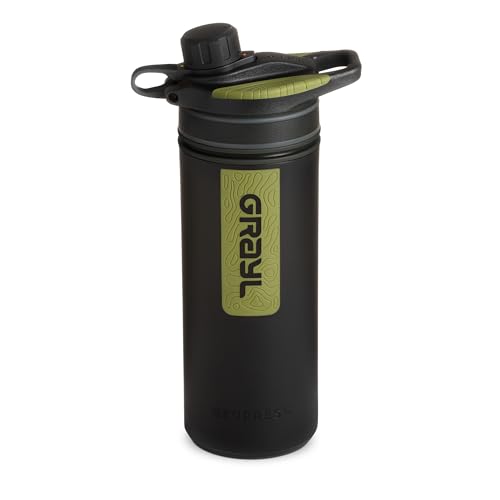
GRAYL GeoPress 24oz
The one pick that claims to handle viruses too: fill, press, and drink almost anywhere on earth.
Field check: A press-style purifier, not a filter: per its listed rating it is designed to remove viruses in addition to bacteria and protozoa, which no hollow-fiber filter in this guide addresses.
Everything above this card shares one blind spot, and this is the answer to it. Hollow-fiber filters do not remove viruses; their pores are simply too large. In most North American backcountry that is a reasonable risk profile. In a guesthouse in the developing world, at a heavily trafficked water source, or anywhere humans crowd the watershed, it is not. The GRAYL GeoPress is built for exactly those places: per its published purifier rating it is designed to remove viruses along with bacteria and protozoa, and the action is gloriously simple. Fill the outer cup, insert the inner press, and push down with your body weight. Clean water in well under a minute, no hoses, no waiting, no chemicals to taste.
On a gram-counted backpacking trip, the math turns against it: it is a rigid bottle-sized unit far heavier than a Sawyer, capacity is limited to its 24 oz vessel per press, and replacement cartridges are a recurring cost with a finite rated life. That is why the Squeeze remains our overall pick for the backcountry. But as one tool that makes water drinkable across airports, cities, and trails on any continent, nothing else here can do the GeoPress's job.
- Cartridge life
- 250 presses (about 65 gal), about $30 to replace
- Listed weight
- 15.9 oz
- Type
- Press purifier
- Purifier rating
- Viruses, bacteria, protozoa (claimed)
- Capacity
- 24 oz per press, about 8 seconds
- Cartridge
- Replaceable, finite rated life
- Format
- Rigid bottle press
- Price
- about $100
What we like
- The only pick here rated for viruses (claimed)
- Fill-press-drink simplicity in under a minute
- One tool for taps, trails, and travel worldwide
- No hoses, pumping, or chemical aftertaste
Worth noting
- Heavy and bulky next to squeeze filters
- 24 oz per press caps its volume
- Replacement cartridges are a recurring cost
Who should buy it: Buy the GeoPress if your water risks include viruses: international travelers, expedition hikers in heavily populated watersheds, and anyone building an emergency kit for water of truly unknown quality. It is the pick when the question is not just Giardia but everything.
What we don't like: It is heavy and rigid next to every squeeze filter here, capacity is capped at the 24 oz vessel per press, and cartridges are a recurring cost with a finite rated lifespan. For domestic backcountry weekends it is more purifier than most hikers need.
Bottom line: The GeoPress is the only pick here that plays a different sport. It is a purifier: per its listed rating it addresses viruses as well as bacteria and protozoa, which makes it the tool for international travel, urban taps of unknown quality, and heavily used water sources where the hollow-fiber filters above are out of their depth. Fill it, press like a French press, and drink.
06 · The Bottle

Nalgene 32oz Wide Mouth
Not a filter at all, but the indestructible bottle the whole water system snaps around.
Field check: The classic 32 oz wide-mouth bottle: effectively indestructible in normal use, with volume markings for cooking and rehydrating, and a wide mouth that fills easily from any source.
Every filter above needs somewhere for the clean water to go, and this is the somewhere. The Nalgene 32oz Wide Mouth has been the default backcountry bottle for generations because it simply refuses to die: dropped on granite, frozen solid, crammed into overstuffed packs, it keeps working. The wide mouth gulps water from shallow or awkward sources, accepts ice, and makes end-of-day cleaning painless. Printed volume markings turn it into a measuring cup for dinner rehydration, a job a smart water bottle cannot do.
Honesty about fit: the Nalgene treats nothing by itself, and its wide mouth does not thread onto a Sawyer Squeeze the way a standard 28 mm bottle does, so it usually plays the clean-water role, catching filtered output or pairing with the GeoPress workflow. It is also heavier than a disposable bottle, an ounce cost ultralighters may skip. But as the durable anchor of a trail water system, and the cheapest item in this entire guide, it has more than earned the supporting-pick slot.
- Listed weight
- 6.25 oz
- Type
- Water bottle (no treatment)
- Capacity
- 32 oz / about 1 L
- Mouth
- 63 mm wide mouth
- Durability
- Famously drop-proof in normal use
- Hot liquids
- Handles hot water for cold-night duty
- Price
- about $16
What we like
- Effectively indestructible in normal trail use
- Wide mouth fills fast and cleans easily
- Takes hot water: sleeping-bag radiator on cold nights
- Volume markings double as a camp measuring cup
Worth noting
- Provides no water treatment by itself
- Heavier than a disposable or soft bottle
- Wide mouth does not thread onto standard squeeze filters
Who should buy it: Buy a Nalgene as the clean-water anchor of whatever filter system you choose: it suits everyone from first-time campers to winter mountaineers. If you own one bottle for the backcountry, decades of hikers have voted that this is the one.
What we don't like: It treats nothing on its own, it is heavier than a disposable bottle, and the wide mouth does not thread directly onto standard squeeze filters, so it plays the receiving role rather than the filtering one.
Bottom line: The Nalgene is here because a filter without a container system is half a tool. The 32 oz wide mouth is the indestructible default: it shrugs off drops, takes boiling water for cold-night duty, carries measurement markings for camp cooking, and its wide mouth fills fast from awkward sources. At about $17 it is the cheapest reliability on this page.
More gear worth comparing
Beyond this guide: the highest-rated gear across every category and budget, with a live price check on each.



As an Amazon Associate we may earn from qualifying purchases, at no cost to you.
Quick shop: every pick
Skip the scroll — the whole lineup, with a live price check on each.
- Sawyer Squeeze (SP129)Best OverallSawyer · about $46Check price →
- Katadyn BeFree 1.0LBest FlowKatadyn · about $43Check price →
- LifeStraw Peak Squeeze 650mlBest Alternative SqueezeLifeStraw · about $36Check price →
- Platypus GravityWorks 6.0LBest for GroupsPlatypus · about $155Check price →
- GRAYL GeoPress 24ozBest for Travel and VirusesGRAYL · about $100Check price →
- Nalgene 32oz Wide MouthThe BottleNalgene · about $16Check price →
How we chose
What we did: we built the shortlist from the filters that dominate thru-hiker gear surveys and trailhead conversations, pulled pore size, listed weight, flow rate, rated life, and bottle-thread compatibility from each manufacturer, and cross-checked every ASIN, image, and price against the live Amazon listing in August 2026. We read long-term owner reports for the real failure modes: flow collapse from silt, freeze damage, cracked flasks on the BeFree, and GRAYL cartridge cost. The virus-removal statements follow the manufacturers' own claims and the EPA purifier definition, not our testing.
What we did not do: we did not run microbiological challenge tests, measure flow with a stopwatch and a graduated cylinder, or weigh the filters. Flow rates are listed figures for a new, clean membrane; every hollow-fiber filter slows as it loads with sediment.
How we rank: removal standard first (all hollow-fiber picks meet the same bacteria/protozoa bar), then weight and bottle compatibility, then flow, then cost of ownership. The Sawyer wins because it fits the bottle you already own, can be restored with a syringe for years, and costs under $50.
Key terms
- Hollow-fiber membrane
- The filtering heart of most modern backpacking filters: a bundle of tiny straws whose walls are perforated with microscopic pores. Water passes through the walls; anything larger than the pore rating stays behind. Light and fast, but vulnerable to freeze damage once wet.
- 0.1 micron rating
- The listed pore size of the leading squeeze filters, small enough to strain out bacteria and protozoa such as Giardia and Cryptosporidium per manufacturer ratings. Viruses are smaller than this and pass through, which is the defining limit of every filter in this class.
- Filter vs. purifier
- A filter physically removes bacteria and protozoa. A purifier also addresses viruses, by finer media, chemical action, or adsorption. In this guide only the GRAYL GeoPress is a purifier; everything else is a filter, and we label them accordingly.
- Backflushing
- Reversing water flow through a filter to push accumulated sediment back out of the membrane, restoring flow rate. The Sawyer Squeeze is designed for it, and the GravityWorks builds it in; doing it regularly is the difference between a filter lasting a season and lasting years.
- Gravity system
- A treatment setup where a hung reservoir of dirty water pushes itself through a filter cartridge into a clean reservoir below, no squeezing required. Slower to set up than a squeeze filter but effortless at volume, which is why it is the group-camp standard.
- Freeze damage
- The silent killer of hollow-fiber filters: water trapped in a wet membrane expands as it freezes and can crack the fibers, compromising filtration without any visible sign. A wet filter that has frozen hard should be treated as ruined and replaced.
Questions, answered
What is the best backpacking water filter overall in 2026?
Our overall pick is the Sawyer Squeeze, at about $40. Its 0.1 micron hollow-fiber membrane is rated for the bacteria and protozoa that actually threaten North American backcountry water, it weighs about 3 oz listed, it backflushes in the field to keep flowing for years, and it threads onto standard 28 mm bottles you can buy anywhere. It is the filter a huge share of thru-hikers carry, and the one we would hand almost anyone for trips in the US or Canada.
Do backpacking water filters remove viruses?
No, and any guide that blurs this is doing you a disservice. Hollow-fiber filters like the Sawyer Squeeze, Katadyn BeFree, LifeStraw Peak Squeeze, and Platypus GravityWorks are rated at around 0.1 micron, which stops bacteria and protozoa but not viruses, which are smaller than the pores. In most North American wilderness that is an accepted risk profile. For international travel or heavily used water sources, use a purifier: the GRAYL GeoPress in this guide claims virus removal per its listed rating, and boiling or chemical treatment also work.
Sawyer Squeeze or Katadyn BeFree: which should I buy?
Buy the Sawyer Squeeze if you value longevity and flexibility: it backflushes to restore flow, threads onto standard bottles replaceable at any convenience store, and has the deepest track record on the long trails. Buy the Katadyn BeFree if you value drinking speed and low fuss: its flow is the best in class, its wide flask scoops shallow sources easily, and cleaning is a swish rather than a syringe. Thru-hikers tend Sawyer; trail runners and fastpackers tend BeFree. Neither is a mistake.
What is the best water filter for a group or family?
The Platypus GravityWorks 6.0L, at about $155. Squeezing a filter for one person is easy; squeezing eight liters for a family every evening is miserable. The GravityWorks treats four liters at a time with zero effort: fill the dirty reservoir, hang it, and gravity pushes water through the cartridge while you set up camp. For three or more people it pays for itself in saved labor almost immediately, and backflushing is built into the design.
Can my water filter freeze, and how do I know if it is ruined?
Freezing is the most common way filters die, and the damage is invisible. Once a hollow-fiber membrane is wet, freezing expands the water inside the fibers and can crack them, and a cracked filter still flows normally while no longer filtering to its rating. Prevention is simple: on cold nights, sleep with the filter inside your sleeping bag. If a wet filter has frozen hard, there is no reliable field test; the safe answer is to assume it is compromised and replace it. Manufacturers say the same.
Do I still need to filter water from clear mountain streams?
Yes. Clarity tells you nothing about microbiology: Giardia and Cryptosporidium cysts and bacteria are invisible, and a crystal-clear stream below a meadow full of wildlife or a popular campsite can carry all of them. The consequences, days of severe gastrointestinal illness, are wildly out of proportion to the roughly 3 oz and few seconds a squeeze filter costs you. Treat all backcountry water; the exceptions are not worth learning about the hard way.
How long does a backpacking water filter last?
Manufacturers list very large lifetime figures for hollow-fiber filters, and with regular backflushing a Sawyer Squeeze routinely survives entire thru-hikes; treat the exact numbers as claims. What actually ends most filters early is not mileage but abuse: a wet freeze, silty water without cleaning, or a cracked housing. Replace a filter after any suspected freeze, when flow will not recover after cleaning, or per the cartridge life on rated systems like the GeoPress. And carry backup tablets on trips where failure would be serious.
Filed under Buyer's Guide
Part of Best Hiking Gear
Keep reading
Sawyer Squeeze vs Katadyn BeFree
The two top squeeze filters compared on flow, backflushing, element life, and thread.
Platypus GravityWorks vs Katadyn BeFree Gravity
The gravity decision for pairs and groups: stored clean water against half the weight.
Sawyer Squeeze Review
The full deep-dive on our top pick: what thousands of trail miles reveal about the thru-hiker standard.
The Ten Essentials
Water treatment is one of the ten; here is the complete safety system every pack should carry.
Ultralight Backpacking 101
How a 3 oz filter fits the bigger picture of cutting pack weight without cutting safety.
The Best Backpacking Stoves (2026)
Boiling is the oldest water treatment there is: the stoves that do it fastest, ranked.