Our Pick: MSR
Check price →The Best Backpacking Stoves (2026)
Four canister stoves from $49 to $117: the 2.6 oz MSR PocketRocket 2 for most hikers, the Jetboil Flash for boil-only speed, the Jetboil MiniMo for real cooking, and the SOTO WindMaster for wind and cold. Listed weights, boil times, fuel math, and the fire-restriction rule.
By The WorldHike Gear Desk · ~13 min read · Updated 2026-08-23

MSR PocketRocket 2
MSR
2.6 oz listed, boils fast, works with any pot: the default stove of the entire backcountry.
Check price★ Our Top Pick
Best Overall
MSR PocketRocket 2
2.6 oz listed, boils fast, works with any pot: the default stove of the entire backcountry.
Not sure yet? Compare all 4 picks below ↓
Short answer: buy the MSR PocketRocket 2 (about $49 at time of writing) unless you know you only boil water. It is a 2.6 oz listed canister-top burner that boils a liter in about 3.5 minutes (listed, no wind), simmers, folds to the size of a lighter, and works with any pot you already own. If you only boil for freeze-dried meals and coffee and want it fast, the Jetboil Flash 1.0L (about $116) is the integrated system: 13.1 oz listed with its cup, boils 0.5 L in about 100 seconds (listed), push-button igniter, and almost no heat lost to wind. If you actually cook, the Jetboil MiniMo (about $117) adds a regulator valve that simmers and a wide 1 L pot you can eat from. If you hike where wind is the normal condition, the SOTO WindMaster with 4Flex (about $70) is a 3.1 oz listed burner with a concave head and a micro-regulator that keeps output up in wind and cold better than the PocketRocket.
What decides it: whether you cook or only boil (a standalone burner for cooking, an integrated system for boiling), wind exposure (integrated systems and the WindMaster shrug it off; the PocketRocket needs a windscreen or a body block), and cold (regulated valves on the MiniMo and WindMaster hold pressure down to about 20 F; unregulated burners fade as the canister chills). All four burn standard threaded isobutane canisters. Weights and boil times are the manufacturers' listed figures cross-checked against the live Amazon listings in August 2026; we did not time boils or weigh these stoves.
Disclosure: no brand paid for a place here; links go to Amazon and we earn a commission on purchases. It does not change the order.
The short version
- Our pick: MSR PocketRocket 2, about $49. 2.6 oz listed, 1 L boil in about 3.5 min listed, folding pot supports, real simmer, no igniter. Fits in a 750 ml pot with a 110 g canister. The stove to buy if you are not sure.
- Boil system: Jetboil Flash 1.0L, about $116. 13.1 oz listed system weight, 0.5 L in about 100 seconds listed, push-button igniter, heat-indicator sleeve, canister stabilizer and measuring cup stow inside. Two settings in practice: off and blast.
- Cooking system: Jetboil MiniMo, about $117. 14.6 oz listed, 1 L wide pot with metal handles, regulated valve for a true simmer, igniter. Buy it instead of the Flash if you cook rice, eggs, or anything that burns.
- Wind and cold: SOTO WindMaster, about $70. 3.1 oz listed with the 4Flex pot support, concave burner head, micro-regulator, stealth igniter. Boils in wind where the PocketRocket stalls. The support detaches, which is the thing owners lose.
- Fuel math: a 110 g canister yields about 10 to 12 one-liter boils on a PocketRocket in calm conditions, about 12 to 14 on a Jetboil. Budget 1 L of boiled water per person per day for freeze-dried meals and a hot drink.
- Cold rule: below about 30 F, keep the canister in your jacket until you light, and use a regulated stove (MiniMo, WindMaster) or an isobutane/propane blend. Pure butane canisters stop working near freezing.
- Flying: stoves fly in checked or carry-on if clean; fuel canisters never fly. Buy fuel at the destination.
| Stove | Best for | Type | Listed weight | Listed boil | Simmer | Igniter | Price (Aug 2026) |
|---|---|---|---|---|---|---|---|
| MSR PocketRocket 2 | Our Pick | Canister-top burner | 2.6 oz | 1 L in about 3.5 min | Yes | No | about $49 |
| Jetboil Flash 1.0L | Boil only | Integrated system | 13.1 oz system | 0.5 L in about 100 sec | No | Yes | about $116 |
| Jetboil MiniMo | Cooking | Integrated, regulated | 14.6 oz system | 0.5 L in about 2 min 15 sec | Yes | Yes | about $117 |
| SOTO WindMaster + 4Flex | Wind and cold | Canister-top, regulated | 3.1 oz | 0.5 L in about 2 min 30 sec | Yes | Yes | about $70 |
Listed manufacturer specs, cross-checked against the live Amazon listings in August 2026. Boil times are listed figures in calm conditions at sea level. Prices are what the linked listings showed at time of writing.
01 · Best Overall
Our PickMSR PocketRocket 2
2.6 oz listed, boils fast, works with any pot: the default stove of the entire backcountry.
Field check: 2.6 oz listed and small enough to vanish inside your cook pot; screws onto any standard threaded canister and supports pots of nearly any size on fold-out arms.
Some gear wins by features; this wins by absence. The MSR PocketRocket 2 is barely there: a listed 2.6 oz, a packed size that disappears inside your mug, and nothing to it but a precise valve, a burner head, and three fold-out pot supports. Screw it onto any standard threaded canister, light it, and a liter of water is rolling in the few-minute range per MSR's listed claim. The serrated pot supports hold everything from a solo titanium mug to a two-person pot, which is the quiet advantage over integrated systems: your pot choices stay yours.
The honest limits are the physics of every open burner: wind steals its heat, so real-world boil times stretch in a breeze unless you shield it with terrain, your body, or a safe windscreen setup, and the flame control is more boil-or-blast than true simmer, fine for pasta and freeze-dried meals, frustrating for actual sauces, where the MiniMo earns its keep. A tall pot on small arms also asks for a flat spot and attention. None of that has dented its status: as the light, cheap, reliable default, the PocketRocket 2 remains the answer to most stove questions.
- Listed boil
- 1 L in about 3.5 min
- Listed weight
- 2.6 oz
- Type
- Standalone canister stove
- Weight
- 2.6 oz (listed)
- Fuel
- Standard threaded canister
- Pot support
- Fold-out serrated arms, fits most pots
- Igniter
- None (carry a lighter)
- Price
- about $49
What we like
- 2.6 oz listed, packs smaller than a mustard bottle
- Fast listed boil and a precise valve
- Works with any pot you already own
- Half the price of integrated systems
Worth noting
- Wind meaningfully slows an unshielded burner
- More boil-or-blast than true simmer
- No built-in igniter on the standard model
Who should buy it: Buy the PocketRocket 2 if you want the lightest, most flexible way to hot meals: solo hikers, weight-conscious backpackers, and anyone who wants to keep using their own pots. It is also the ideal first stove and the classic backup that lives in a lid pocket for years.
What we don't like: An open burner gives wind a vote, stretching boil times in a breeze unless you shelter it, and flame control runs boil-or-blast rather than a true simmer. Tall pots on the small support arms want a flat spot and a little attention.
Bottom line: The PocketRocket 2 is the stove the category is measured by. It weighs a listed 2.6 oz, folds to the size of a lighter in its case, boils water with genuine urgency, and works with whatever pot you already own. There is no smarter first stove and no more dependable spare, and at about $50 it is half the price of the systems it competes with.
02 · Best Boil System
Best Boil System
Jetboil Flash 1.0L
The fastest route from cold water to coffee: an integrated cup that boils with startling speed.
Field check: Integrated burner-and-cup system with a FluxRing heat exchanger; Jetboil's listed boil claims for the Flash are among the fastest in backpacking, with a color-change heat indicator.
For a whole style of backpacking, dinner is just hot water, and this is the fastest hot water in the business. The Jetboil Flash integrates its burner directly into a 1-liter insulated cup ringed with a FluxRing heat exchanger, corrugated metal fins that catch heat an open burner would spill to the sky. The result is a listed boil speed that made the Flash famous, a color-changing indicator that shows when water is hot, and a push-button igniter so the whole ritual is twist, click, wait a very short while, eat. The canister and stabilizer pack inside the cup, so the kitchen travels as one tidy cylinder.
Honesty about what it is not: the Flash is a boil appliance, not a cooker. Its output runs full-throttle by design, real simmering is not on the menu, and cooking in the tall narrow cup means the Flash diet is thoroughly rehydration-based; that is exactly the gap the MiniMo exists to fill. The system also weighs and costs a multiple of a PocketRocket 2, and it is married to its own cup. But if your menu is boil-and-pour, none of those trades will ever bother you, and the speed will delight you every single morning.
- Listed boil
- 0.5 L in about 100 sec
- Listed weight
- 13.1 oz system
- Type
- Integrated canister system
- Capacity
- 1 L cup (0.5 L cooking volume)
- Boil claim
- Among the fastest listed in the category
- Igniter
- Push-button
- Extras
- Heat-change indicator; packs into its own cup
- Price
- about $116
What we like
- Startlingly fast listed boil times
- Heat exchanger shrugs off breezes that stall open burners
- Fuel-efficient: more boils per canister
- Whole kitchen nests into one cylinder
Worth noting
- No real simmer; it is a boil appliance
- Married to its own tall, narrow cup
- Heavier and pricier than standalone burners
Who should buy it: Buy the Flash if your backcountry cooking is boiling water, full stop: freeze-dried dinners, instant oatmeal, and coffee. It suits hikers who value speed and wind composure over menu flexibility, and groups whose kitchen is a queue of people waiting on hot water.
What we don't like: It boils and only boils: no meaningful simmer, and the tall narrow cup rules out real cooking. It is heavier and pricier than a standalone burner, committed to its own pot, and overkill for anyone who cooks two hot meals a month.
Bottom line: The Flash does one thing with total commitment: it boils water astonishingly fast per its listed claims, in a self-contained cup that laughs at the breeze that staggers open burners. If your backcountry menu is freeze-dried meals, oatmeal, and coffee, this is the entire kitchen in one twist-together unit, and nothing standalone matches its speed-plus-wind composure.
03 · Best for Real Cooking

Jetboil MiniMo
The Jetboil that simmers: a wide, low cup and real flame control turn boiling into cooking.
Field check: Jetboil's regulated valve gives genuine simmer control, and the wide, low cup shape works like a small pot you can stir, cook in, and comfortably eat from.
The knock on integrated systems has always been that they boil brilliantly and cook badly; this is the one that answers it. The Jetboil MiniMo keeps the FluxRing heat exchanger and semi-protected burner that make the Flash so fast and frugal, then changes the two things that matter for real food. First, the valve: the MiniMo's regulated control turns down smoothly to a true simmer, so eggs, sauces, and fresh food stop being aspirational. Second, the vessel: the cup is wide and shallow rather than tall and narrow, which means a spoon reaches every corner, stirring actually works, and eating straight from it feels like a bowl instead of spelunking.
The trades: at about $165 it is the most expensive pick in this guide, it weighs more than the boil-only Flash, and if your menu never leaves freeze-dried territory the Flash does that one job faster for less money. Solo gram-counters will still be happier with a PocketRocket 2 and a small pot. But for couples, coffee snobs, and anyone whose trail menu includes food that must be stirred rather than merely drowned, the MiniMo is the most livable integrated kitchen going.
- Capacity
- 1 L wide pot
- Valve
- Regulated, true simmer
- Listed weight
- 14.6 oz system
- Type
- Integrated canister system, regulated
- Cup
- Wide, low cup: stir, cook, and eat from it
- Flame control
- True simmer to full boil
- Cold weather
- Regulated valve steadies fading canisters
- Igniter
- Push-button
- Price
- about $117
What we like
- Genuine simmer control, rare in integrated systems
- Wide low cup cooks and eats like a real pot
- Jetboil efficiency and wind composure retained
- Regulated output for cold mornings and low canisters
Worth noting
- Most expensive pick in this guide
- Heavier than the boil-only Flash
- Wasted on a strictly freeze-dried menu
Who should buy it: Buy the MiniMo if you actually cook out there: couples sharing meals, hikers who carry eggs and real food, and anyone who wants Jetboil speed and efficiency without the boil-only diet. It is the integrated system that behaves like a kitchen instead of a kettle.
What we don't like: It is the priciest stove in the guide and heavier than the boil-only Flash, so hikers on a pure rehydration menu are paying for a simmer they will not use. Like all integrated systems it is committed to its own cup.
Bottom line: The MiniMo is what happens when a boil system learns to cook. Its regulated valve turns down to a genuine simmer instead of the Flash's all-or-nothing roar, and its cup is wide and low, a shape you can stir like a pot and eat from like a bowl, with the heat-exchanger efficiency and wind composure that make Jetboils Jetboils. It is the integrated system for people who cook actual food.
04 · Best in Wind
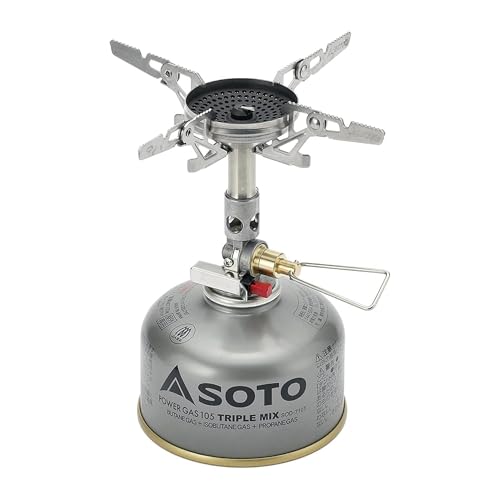
SOTO WindMaster
The standalone burner that keeps cooking when the breeze arrives: concave head, micro-regulator, no drama.
Field check: A concave burner head that shelters its own flame plus SOTO's micro-regulator for steady output as canisters chill and drain; the standalone stove built specifically for the windy real world.
Wind is where light stoves go to be humbled, and this stove was designed by people who accepted that. The name is the spec: the SOTO WindMaster sinks its flame into a concave burner head, so moving air passes over the bowl instead of through the fire, and it puts the pot close above the flame where a gust has the least room to work. The practical translation is the whole pitch: in breezes that visibly stagger a conventional open burner and stretch its boil into a fuel-eating slog, the WindMaster keeps working like the weather report was wrong.
The rest of the package is a proper ultralight burner: featherweight in the standalone class, a stealth-igniter in the stem, and SOTO's clever detachable pot support, which enables the tiny packed size but is also the annoyance, a separate small part you must not lose. At about $85 it costs a meaningful step over the PocketRocket 2, and in calm summer weather that step buys you little. But if your trips include exposed camps, ridgelines, and shoulder seasons, this is the standalone stove that keeps its promises when the air moves, and its cult following exists for exactly that reason.
- Valve
- Micro-regulator
- Listed weight
- 3.1 oz with 4Flex support
- Type
- Standalone canister stove, regulated
- Burner design
- Concave head shelters the flame
- Regulator
- Micro-regulator steadies output in cold and low fuel
- Igniter
- Stealth igniter (built in)
- Pot support
- Detachable (small separate part)
- Price
- about $70
What we like
- Keeps its flame in gusts that stagger open burners
- Micro-regulator holds power in cold and on low canisters
- Ultralight-class weight with a built-in igniter
- The deserved cult pick for exposed camps
Worth noting
- Detachable pot support is losable
- Costs well above the PocketRocket 2
- Advantages fade in calm, warm weather
Who should buy it: Buy the WindMaster if your camps are exposed and your seasons are long: alpine hikers, coastal and desert walkers, and shoulder-season regulars who have watched a breeze eat a canister. It is the standalone stove for weather the forecast underplayed.
What we don't like: The detachable pot support is a small separate part you must not lose, and at about $85 it costs well over the PocketRocket for advantages that calm-weather campers may rarely feel. Built-in igniters are also conveniences, not guarantees; carry a lighter regardless.
Bottom line: The WindMaster is the answer to the open-burner problem. Its concave burner head recesses the flame so gusts skate over it instead of stripping it, and SOTO's micro-regulator holds output steady as canisters cool and empty, the two failure points that make ordinary ultralight stoves miserable in real weather. It is what the PocketRocket owner upgrades to after one bad ridge-top dinner.
More gear worth comparing
Beyond this guide: the highest-rated gear across every category and budget, with a live price check on each.




As an Amazon Associate we may earn from qualifying purchases, at no cost to you.
Quick shop: every pick
Skip the scroll — the whole lineup, with a live price check on each.
- MSR PocketRocket 2Best OverallMSR · about $49Check price →
- Jetboil Flash 1.0LBest Boil SystemJetboil · about $116Check price →
- Jetboil MiniMoBest for Real CookingJetboil · about $117Check price →
- SOTO WindMasterBest in WindSOTO · about $70Check price →
How we chose
What we did: we shortlisted the canister stoves that show up on thru-hiker gear surveys and in the hands of people who backpack every month, pulled listed weight, boil time, valve type, igniter, and pot compatibility from each manufacturer, and cross-checked every ASIN, image, and price against the live Amazon listing in August 2026. We read long-term owner reports for the failures that matter: igniters dying (universal; carry a lighter), Jetboil cup-coating wear, WindMaster 4Flex supports going missing, and PocketRocket pot-support wobble with wide pots. Judgments about wind and simmer behavior come from our own use of these designs and consistent owner patterns.
What we did not do: we did not time boils with a stopwatch, measure fuel consumption per liter, or weigh the stoves. Listed boil times are optimistic by design; at altitude and in wind expect 30 to 100 percent longer. Prices are live Amazon figures at time of writing.
How we rank: versatility first for Our Pick (cook or boil, any pot), then weight, then wind and cold performance, then price. The PocketRocket wins because it does every job acceptably at 2.6 oz and $49; the others each do one job better.
Key terms
- Canister stove
- A stove that screws onto a sealed, self-pressurized can of blended fuel and lights instantly with no priming or pumping. The dominant three-season backpacking format, and the type every pick in this guide uses. The threaded canisters are a standard, so any brand's stove fits any brand's can.
- Integrated system
- A stove where the burner and an insulated heat-exchanger pot are designed as one unit, like the Jetboil Flash and MiniMo. Faster and more fuel-efficient than an open burner, especially in wind, at the cost of weight, price, and being committed to its own pot.
- Heat exchanger (FluxRing)
- The ring of corrugated metal fins on an integrated system's pot that captures flame heat an ordinary pot would let spill past. It is the engineering behind Jetboil's listed boil speeds and the fuel savings that let system users carry fewer canisters.
- Pressure regulator / micro-regulator
- A valve design that holds stove output steady as canister pressure drops in cold weather or as fuel runs low, instead of fading with it. The feature behind the SOTO WindMaster's and Jetboil MiniMo's cold-morning reputations, and the PocketRocket Deluxe's upgrade case.
- Simmer control
- The ability to hold a low, steady flame rather than toggling between roar and off. Irrelevant for boil-and-pour meals, essential for real cooking, and the defining difference between the boil-only Jetboil Flash and the cook-capable MiniMo.
- Piezo igniter
- A built-in push-button spark that lights the stove without matches. A genuine convenience on the Jetboils, the WindMaster, and the PocketRocket Deluxe, and a famously mortal component: every experienced hiker carries a lighter as backup regardless.
Questions, answered
What is the best backpacking stove overall in 2026?
Our pick is the MSR PocketRocket 2, at about $50. It weighs a listed 2.6 oz, packs small enough to vanish inside your mug, boils quickly per MSR's listed claims, and works with any pot you own, which keeps your kitchen flexible and your spending low. Its limits are wind sensitivity and rough simmer control. Hikers with cold mornings in their calendar should consider the PocketRocket Deluxe variant, which adds a pressure regulator and igniter.
Jetboil or PocketRocket: which should I buy?
Menu first. If trail dinner means boiling water for freeze-dried meals and coffee, the Jetboil Flash does that one job faster, more fuel-efficiently, and with far better wind composure; it is the better appliance. If you want the lightest pack, the lowest price, your choice of pots, or any real cooking flexibility, the PocketRocket 2 wins and costs less than half as much. Couples who actually cook should look at the Jetboil MiniMo, which adds genuine simmer control to the system formula.
How well do canister stoves work in wind?
Wind is the spec sheet's silent killer: a modest breeze strips heat from an open burner, stretching boil times and multiplying fuel burn dramatically. The design answers are the SOTO WindMaster, whose concave burner head shelters its own flame, and integrated systems like the Jetboils, whose heat-exchanger cups are inherently protected. Technique matters regardless: cook behind terrain, packs, or your body. Never fully enclose a canister stove with a windscreen, which can dangerously overheat the canister, and never cook inside a tent.
Do canister stoves work in cold weather?
Down to a point, with technique. Canister pressure falls as temperature drops, so an unregulated stove fades on frosty mornings and on low cans. The fixes: sleep with the canister in your sleeping bag, warm it in a jacket before breakfast, keep it off frozen ground, and choose a pressure-regulated stove, the SOTO WindMaster, Jetboil MiniMo, or PocketRocket Deluxe, which are built to hold output as pressure sags. For true deep-winter mountaineering, liquid-fuel stoves remain the specialist tool, a different category from this guide.
How long does a fuel canister last backpacking?
As a planning baseline, a small canister of roughly 100 grams of fuel yields on the order of ten liter-boils in calm conditions with an efficient setup, call it several days of solo boil-twice-a-day cooking, while wind and cold can cut that sharply on an unshielded burner. Efficient systems like the Jetboils stretch a can further per their listed claims. The habit that beats every estimate: weigh your canister before and after a trip, and you will know your personal burn rate within two outings.
Can I fly with a backpacking stove or fuel canister?
The stove yes, the fuel no. A clean, empty stove with no fuel residue is generally fine in checked or carry-on baggage, though rules vary by airline and country, so check yours. Fuel canisters are prohibited in both cabin and checked luggage, full stop. Plan to buy a canister at an outfitter, hardware store, or big-box retailer near your destination, and check availability in advance for remote trailheads; standard threaded canisters are the easiest format to find worldwide.
Is a stove with a built-in igniter worth it?
It is a convenience worth having and never worth trusting. Push-button piezo igniters, on the Jetboils, the WindMaster, and the PocketRocket Deluxe, make lighting effortless, especially with cold hands, but they are also the most failure-prone part on any stove that has one. The universal rule among experienced hikers: carry a lighter in the cook kit and another somewhere else, whatever your stove promises. A stove you cannot light is dead weight, and a mini lighter weighs nothing. Every ounce earns its place; that one earns it twice.
Filed under Buyer's Guide
Part of Best Hiking Gear
Keep reading
Jetboil Flash vs MSR PocketRocket 2
The integrated system against the 2.6 oz burner: boil or cook decides it.
The Best Backpacking Water Filters (2026)
Your stove's other job: boiling is the oldest water treatment. The filters that handle the rest, ranked.
Ultralight Backpacking 101
Where a 2.6-ounce stove fits in the larger project of a base weight that disappears.
The Best Backpacking Packs (2026)
The haulers that carry the kitchen, the shelter, and everything else, ranked.
The Ten Essentials
The complete safety framework, and why fire and extra food sit right beside your stove.