Our Pick: Helinox
Check price →The Best Backpacking Chairs & Camp Seats (2026)
The best backpacking chair is the Helinox Chair Zero: 1.1 lb listed, a real backrest, and the benchmark every clone still chases. Around it we ranked the eight other camp seats worth carrying in 2026, from a $10 foam pad to a reclining 2-pound throne, and did the ounces-versus-comfort math honestly at every rung.
By The WorldHike Gear Desk · ~18 min read · Updated 2026-08-07

Helinox Chair Zero
Helinox
The 1.1-pound listed chair that made real chairs backpack-viable, and still the benchmark.
Check price★ Our Top Pick
Best Overall
Helinox Chair Zero
The 1.1-pound listed chair that made real chairs backpack-viable, and still the benchmark.
Not sure yet? Compare all 9 picks below ↓
Let us answer the question in the first sentence: the best backpacking chair for most hikers is the Helinox Chair Zero, because at 1.1 lb listed it is the lightest genuinely good chair from a proven brand, and a decade of imitators has not produced a better answer. If you sit for hours in camp, upgrade to the reclining NEMO Moonlite; if you refuse to carry chair weight at all, carry the 2 oz Therm-a-Rest Z Seat and lean on a tree. That is the whole guide in three sentences. The other three thousand words explain when each of those answers is the right one, and rank the nine seats that survived our cut.
Here is a truth every long-trail hiker learns eventually: the misery that ends trips is rarely the miles. It is the hours after the miles, eaten standing up, perched on a wet log, or hunched on a sharp rock while your legs stiffen. Camp comfort is the cheapest morale multiplier in backpacking, and nothing in your pack buys more of it per ounce than something decent to sit on. The catch is that a camp seat is pure luxury weight, so this is the one category where our lens, every ounce earns its place, cuts hardest. The math runs on a simple ladder: a $10 foam pad at the bottom, the 2 oz Z Seat and the legless Crazy Creek in the middle, real chairs at the top, from the 1.1 lb (listed) Chair Zero to the high-backed and reclining 2-pound-plus loungers that turn a campsite into a living room.
One disclosure, up front and plainly: no brand paid for a spot in this guide, nobody placed a product, and no manufacturer saw it before publication. Some links go to Amazon; if you buy through one we may earn a small commission at no extra cost to you, and that never moves a pick up or down. Weights and capacities below are the manufacturers' listed figures, hedged as such every time, and prices are approximate street prices verified against live listings in August 2026, so always check the live listing.
The short version
- Our pick is the Helinox Chair Zero (about $140): at 1.1 lb listed it is the chair that made carrying a real chair defensible, and it is still the benchmark the clones chase.
- The premium tier is real now: the reclining NEMO Moonlite (about $170) is the most comfortable seat under 2 lb listed we know of, and the high-back Helinox Chair Two (about $130) finally gives your head somewhere to go.
- The weight-to-comfort ladder is the whole decision: 2 oz sit pad, roughly 1.3 lb legless chair, 1.1 lb real chair, about 2 lb comfort chair, about 2.5 lb high-back lounger. Pick the rung that matches how long you actually sit.
- The Helinox Chair One (about $110) is the value Helinox: roughly 2 lb listed buys a wider, taller, more relaxed seat for $30 less than the Zero, the right call when the sitting matters more than the carrying.
- If you are not sure you need a chair at all, spend $10 on the AceCamp sit pad or $35 on the Z Seat first. Most hikers discover the pad covers 80 percent of the problem for 10 percent of the weight.
| Seat | Best for | Listed weight | What you get | Approx. price |
|---|---|---|---|---|
| Helinox Chair Zero | Our Pick | 1.1 lb | A real chair at a carryable weight | ~$140 |
| NEMO Moonlite Reclining | Best Camp Comfort | 1 lb 15 oz | An adjustable recline, under 2 lb | ~$170 |
| Helinox Chair Two | Best High-Back | ~2 lb 7 oz | Head-height backrest, Helinox build | ~$130 |
| Big Agnes Skyline UL | Best Stability Under 2 lb | 1 lb 12 oz | Three-legged tripod stance, taller sit | ~$200 |
| Helinox Chair One | Best Value Helinox | ~2 lb | The original, wider and more relaxed | ~$110 |
| TREKOLOGY Ultralight Chair | Best Value Low Chair | Low-slung design | Stable low seat, kind price | ~$59 |
| Crazy Creek Original | The Legless Classic | ~1 lb 4 oz | Backrest with zero legs to break | ~$65 |
| Therm-a-Rest Z Seat | Best Ultralight Seat | 2 oz | Warm dry seat, ultralight answer | ~$35 |
| AceCamp Sit Pad | Best Cheap Sit Pad | A few ounces | The $10 no-brainer | ~$10 |
The 2026 camp-seat shortlist at a glance, top of the weight-to-comfort ladder to the bottom. Weights are the manufacturers' listed figures; prices are approximate street prices verified against live listings in August 2026.
01 · Best Overall
Our PickHelinox Chair Zero
The 1.1-pound listed chair that made real chairs backpack-viable, and still the benchmark.
Field check: 1.1 lb listed · full legged chair · the ultralight category benchmark
Every gear category has one number that changed it. For backpacking chairs, it is this one. The Chair Zero took the shock-corded pole-and-sling design Helinox pioneered and cut it to the bone: thinner poles, lighter fabric, a lower and smaller seat, and a packed size closer to a water bottle than a camp stool. The result is a genuine chair, four legs, a backrest, your whole body off the ground, at a weight that fits inside an ultralight spreadsheet without blowing it up.
What that 1.1 lb listed buys is the thing no pad can give you: a backrest and airspace. After a long day your hips and knees do not want to fold to ground level, and your back wants something to lean against that is not a tree you have to go find. The Chair Zero sits low and taut, more sports-car than recliner, and the low seat is the honest trade for the weight: getting out of it after a big-mile day involves some ceremony. Setup is a minute of shock-corded poles clicking into a hub, then working the seat corners over the pole tips, which is stiff when the chair is new and eases with use.
- Listed weight
- 1.1 lb
- Type
- Legged chair, shock-corded pole hub
- Packed size
- Small, close to a large water bottle
- Approx. price
- ~$140
What we like
- A real chair, backrest and all, at 1.1 lb listed
- Packs down small enough for ultralight setups
- The build quality the entire clone market imitates
- The best comfort-per-ounce ratio in the category
Worth noting
- About $140 is the price of admission, and it has crept up
- Low, snug seat is a perch, not a lounger
- Small feet sink into soft ground
Who should buy it: Buy the Chair Zero if you count ounces but refuse to be miserable in camp: weekend backpackers with lazy evenings, long-trail hikers who know a chair is their one luxury, paddlers and bikepackers squeezing gear into small hulls and bags. It is the chair for people who did the ladder math and decided a real chair is worth exactly one pound and not two.
What we don't like: It is about $140 for a small chair, up from roughly $100 a couple of seasons ago, which is real money for luxury weight. The low, taut seat is more perch than lounge, taller hikers will notice, and soft ground swallows the small feet unless you put something under them. And the light fabric and thin poles reward care: this is a chair you own gently, not one you toss to a heavy friend at a bonfire.
Bottom line: The Chair Zero is the reason this guide exists. Before it, a real chair was car-camping gear; at 1.1 lb listed, it dropped the price of admission low enough that weight-conscious backpackers stopped laughing and started buying. A decade of clones later it is still the one they copy, because the DAC-style pole structure, the seat tension, and the pack size remain the standard everyone else is chasing.
02 · Best Camp Comfort
Best Camp Comfort
NEMO Moonlite Reclining Camp Chair
The only pick here that reclines: an adjustable lean-back under 2 lb listed, and the most comfortable sit in the guide.
Field check: 1 lb 15 oz listed · adjustable recline · the premium comfort ceiling under 2 lb
Every hub-and-sling chair holds you at one angle forever. The Moonlite is the one that asks what angle you would like. The Moonlite hangs its seat from adjustable straps rather than fixed corners, so a quick tug moves you between sitting up to eat and leaning back to watch the light go off the ridgeline. It sounds like a gimmick until the first long evening, at which point it becomes the reason this chair does not get lent out. The mesh-backed sling breathes on hot nights, and the whole thing still packs down to the same water-bottle-class bundle as its fixed rivals.
The listed 1 lb 15 oz is the quiet headline. The comfort tier of this category has always cost about two pounds; NEMO spent those ounces on a mechanism instead of just more fabric, which makes the Moonlite the first chair where the premium buys a feature you feel every minute rather than an inch of extra seat. The trade-offs are the familiar sling-chair ones, small feet on soft ground and a build that rewards care, plus one of its own: straps and hardware are more to fiddle with than a fixed sling, and perfectionists will spend their first evening tuning it.
- Listed weight
- 1 lb 15 oz
- Type
- Reclining hub-and-sling chair
- Signature
- Adjustable recline via webbing straps
- Approx. price
- ~$170
What we like
- The only recline in the category done at a real backpacking weight
- Under 2 lb listed, lighter than most fixed comfort chairs
- Breathable mesh-backed sling for hot evenings
- NEMO build quality and warranty behind the hardware
Worth noting
- About $170: the most expensive seat in this guide
- More straps and hardware to adjust and care for
- Soft ground still swallows the feet
Who should buy it: Buy the Moonlite if camp comfort is the point of the trip: basecampers, paddlers, festival-and-fire-ring campers, stargazers, and anyone who has ever tried to slouch in a fixed sling chair and found the physics against them. It is also the premium gift chair: the one that makes the recipient audibly happy on first sit.
What we don't like: About $170 is the top of this guide's price ladder, real money for a luxury item. The strap-and-hardware recline is one more thing to adjust and one more thing to baby versus a fixed sling. And like every chair in its class, the small feet want firm ground or something flat under them on sand and duff.
Bottom line: The Moonlite answers the question every packable chair since the Chair One has ignored: what if you could lean back? Adjustable webbing lets the seat shift from upright dinner posture to a genuine stargazing recline, and NEMO did it at a listed 1 lb 15 oz, under the weight of a Chair One. At about $170 it is the most expensive chair in this guide and the one every tester fights over at the end of the night.
03 · Best High-Back
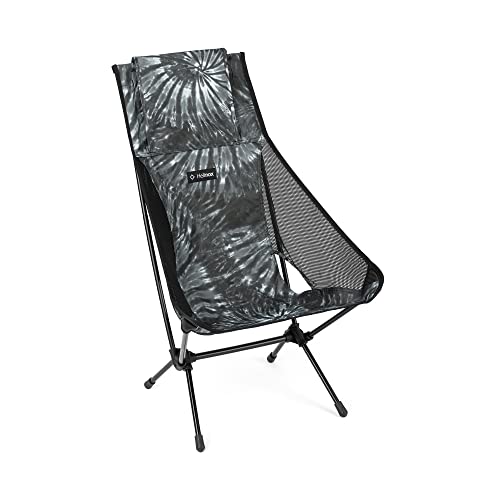
Helinox Chair Two
The Helinox with a backrest that reaches your head: the packable chair for people who actually want to lean back and stay a while.
Field check: About 2 lb 7 oz listed · high-back sling · full head-and-shoulder support
Every compact camp chair shares a dirty secret: the backrest ends exactly where you want to lean back. Standard slings stop mid-spine, which is fine for eating and fidgety for everything after. The Chair Two runs the sling up past your shoulders, and the difference is the difference between sitting and settling in: your neck relaxes, your head has somewhere to go, and the fire gets watched from an actual repose. It is the same shock-corded hub architecture as every Helinox, just grown a story taller.
The cost is honest: about 2 lb 7 oz listed and a bulkier packed bundle, which pushes it out of ultralight territory and into deliberate-luxury territory, the same shelf as the Moonlite. Against that rival the choice is clean. The Moonlite moves, reclining through angles, and saves you half a pound; the Chair Two stands still but supports more of you at once, costs about $40 less, and brings Helinox's hardware pedigree. Nappers and tall hikers tend to pick the Chair Two the moment they lean into it.
- Listed weight
- About 2 lb 7 oz
- Type
- High-back hub-and-sling chair
- Signature
- Backrest reaches shoulders and head
- Approx. price
- ~$130
What we like
- Head-and-shoulder support no standard sling offers
- Cheapest seat in the premium comfort tier at about $130
- Helinox hub hardware and build pedigree
- The tall hiker's answer in a category that ignores them
Worth noting
- Heaviest Helinox in this guide at about 2 lb 7 oz listed
- Tall back catches wind on exposed sites
- Bulkiest packed bundle of the brand's lineup here
Who should buy it: Buy the Chair Two if you want maximum lean-back for the money, if you are tall enough that standard slings end mid-back, or if your chair does double duty at campgrounds, sidelines, and beaches where its extra bulk rides in a car anyway. It is the premium-tier value play at about $130.
What we don't like: About 2 lb 7 oz listed is more than double the Chair Zero, so it needs a trip profile that earns it. The tall back catches wind like a small sail on exposed sites. And the packed bundle is the largest of the Helinox family here, a real consideration in a small pack.
Bottom line: The Chair Two is what happens when Helinox stops optimizing for the spreadsheet and starts optimizing for the evening. The tall sling supports your shoulders and head, not just your lower back, which changes what an hour in camp feels like more than any spec suggests. At about 2 lb 7 oz listed it is the heaviest Helinox here and the first one that feels like furniture, and at about $130 it undercuts both premium rivals in this tier.
04 · Best Stability Under 2 lb

Big Agnes Skyline UL Chair
A three-legged tripod design that sits taller and plants steadier than the four-foot crowd, at 1 lb 12 oz listed.
Field check: 1 lb 12 oz listed · tripod geometry · taller seat height than its weight class
Four tiny feet on uneven ground is a geometry problem no fabric can fix. Big Agnes changed the geometry. The Skyline UL plants on three points instead of four, and anyone who has steadied a wobbling table knows why that matters: three points always find a plane. On the lumpy, rooted, off-camber ground where real campsites live, the tripod stance settles where four-legged rivals rock, and the taller listed seat height means standing up is a motion rather than a project, the single most repeated compliment aging knees give this chair.
At 1 lb 12 oz listed it splits the Chair Zero and the comfort tier, and its price, about $200, tops this guide. What you are paying for is a specific set of problems solved: wobble, low-seat struggle, and the mid-back slouch of deep slings, addressed with aluminum poles and a more upright, supportive posture. What you are not getting is a recline, a high back, or the Chair Zero's water-bottle packed size. It is the engineer's chair in a category of loungers.
- Listed weight
- 1 lb 12 oz
- Type
- Tripod-frame sling chair
- Signature
- Three-point stance, taller seat height
- Approx. price
- ~$200
What we like
- Three-point tripod stance settles on ground that rocks four-leg chairs
- Taller seat makes standing up dramatically easier
- 1 lb 12 oz listed: lighter than the whole comfort tier
- Upright, supportive posture for eating and camp chores
Worth noting
- About $200: the priciest pick in this guide
- No recline, no high back: comfort is upright by design
- Virtues are subtle if your campsites are flat and firm
Who should buy it: Buy the Skyline UL if your campsites are rocky, rooted, or sloped, if getting out of low chairs has become a two-stage operation, or if you want the most upright, supportive sit in the packable class. It is the premium pick for hikers who value stability over lounging.
What we don't like: About $200 is the most expensive seat in the guide, and unlike the Moonlite's recline the virtues here are subtle until you camp on bad ground. The upright posture is better for eating and reading than for slouching. And the three-point stance, while stabler on lumps, still wants care on genuinely soft sand.
Bottom line: The Skyline UL rethinks the geometry instead of the materials: three legs in a tripod stance rather than four small feet, a taller seat, and a hubless pole layout. The payoffs are a chair that is easier to get out of after a long day, wobbles less on uneven ground, and still lists at 1 lb 12 oz. At about $200 it asks premium money for those virtues, which is exactly the right price for the hikers who have been burned by the alternatives and a poor deal for anyone else.
05 · Best Value Helinox

Helinox Chair One
The original packable chair: about 2 lb listed of genuinely relaxed sitting, $30 less than the Zero.
Field check: ~2 lb listed · the original Helinox design · wider, taller, more relaxed seat
Before Helinox made the lightest chair, it made the right one. The Chair One is the original of the entire genre, the design every $40 clone on Amazon is tracing, and sitting in one explains why. The seat is wider and hangs higher than the Zero's, the fabric has more structure, and the geometry holds you in an actual lounging posture instead of a compact tuck. If the Chair Zero is the chair you tolerate brilliantly, the Chair One is the chair you would pick with your eyes closed.
The cost is the pound. At about 2 lb listed, the Chair One is a deliberate choice for trips where camp is the point: basecamps you hike out of, canoe trips, short-mileage weekends with long evenings, shoulder seasons when you are in camp by four and the light lasts. It also moonlights as the best car-camping and sideline chair you own, which the Zero, with its gentler build, does less happily. That double life matters for the math: a chair you use forty days a year amortizes differently than one you use six.
- Listed weight
- ~2 lb
- Type
- Legged chair, shock-corded pole hub
- Seat
- Wider and taller than the Chair Zero
- Approx. price
- ~$110
What we like
- Noticeably more relaxed sit than any ultralight chair
- The original design, with the original build quality
- Cheapest Helinox in the guide at about $110
- Doubles as your car-camping and sideline chair
Worth noting
- About 2 lb listed is twice the Zero's carry
- Bulkier packed bundle in a small pack
- Fixed posture: the Moonlite reclines for similar weight
Who should buy it: Buy the Chair One if camp time outweighs trail time on your trips and $170 reclining chairs feel like more chair than you need: basecampers, paddlers, bikepackers with rack space, weekend hikers with short approaches, and anyone whose chair will pull double duty at trailheads and kids' games. It is the sensible middle of the whole guide.
What we don't like: About 2 lb listed is a real line item in a backpacking kit, double the Zero for the same category of comfort, and the packed bundle is noticeably chunkier in a small pack. Like all sling chairs its feet sink in sand and soft duff. And with the Moonlite reclining at only a few ounces more weight, the fixed-posture Chair One is no longer the automatic comfort pick; it is the value one.
Bottom line: The Chair One is the chair the Chair Zero was carved out of, and the carving removed real comfort along with the weight. At about 2 lb listed it is roughly twice the Zero's carry, and in exchange you sit higher, wider, and more relaxed, in a build that shrugs off the casual abuse the Zero asks you to avoid. At about $110 it is also the cheapest way into Helinox hardware, which surprises people every time.
06 · Best Value Low Chair

TREKOLOGY Ultralight Chair
A low-slung chair that solves the sinking-feet problem and undercuts the big names at about $59.
Field check: Low-slung stable design · about $59 street price · the soft-ground specialist
Every hub-and-sling chair has the same enemy, and it is not weight. It is soft ground. Standard four-foot chairs concentrate your whole load on four small tips, which is why the classic backcountry chair photo is someone sitting at a ten-degree list with one leg buried in sand. The TREKOLOGY attacks that directly: a lower seat and a wider, lower stance put less leverage on each foot, so it stays planted on beaches, river bars, and the loose duff of well-used campsites where taller chairs wobble and drill.
Low is also a posture choice, and it is more polarizing than specs suggest. Sitting closer to the ground is wonderful for lounging, fire-watching, and anyone who treats camp like a beach day; it is less wonderful for stiff knees at the end of a big-mile day, when standing up from a low seat becomes a two-stage operation. That makes this the right chair for trips where the sitting is long and the hiking is moderate, and the wrong chair for the fast-and-far crowd, who should stay with the Chair Zero or carry a pad and lean on a tree.
- Type
- Low-slung hub-and-sling chair
- Best surface
- Sand, gravel, soft duff
- Posture
- Low, relaxed, lounge-oriented
- Approx. price
- ~$59
What we like
- Low, wide stance stays planted where other chairs sink
- A real brand's build at well under Helinox money
- Genuinely relaxing lounge posture
- About $59 undercuts the big names by a wide margin
Worth noting
- Low seat is tough on stiff knees at day's end
- Not Helinox-grade hardware, and shouldn't be treated as such
- Packs bulkier than the ultralight chairs
Who should buy it: Buy the TREKOLOGY if your camps involve sand, gravel bars, lakeshores, or soft ground where standard chair feet sink, or if you simply like sitting low and lounging long. It is also the sweet spot for buyers who want a real chair without paying premium-tier money.
What we don't like: Low seats are hard on tired knees and hips, and getting up gracefully after a 15-mile day is not on the menu. It is a value brand, and while the build is sound, it is not Helinox hardware and should not be treated like it. And lounging geometry plus soft-ground stance means it is bulkier packed than its weight class suggests.
Bottom line: TREKOLOGY's low chair takes the packable-chair idea in the other direction: instead of chasing grams, it drops the seat height and widens the stance, which makes it the most stable sitter here on sand, gravel bars, and soft forest duff, the exact surfaces that swallow standard chair feet. At about $59 it costs less than half of any premium pick in this guide while doing something none of them does.
07 · The Legless Classic

Crazy Creek Original Chair
The 1987-vintage legless chair: a real backrest with nothing to snap, sink, or assemble.
Field check: ~1 lb 4 oz listed · legless clip-and-strap design · decades-proven, nothing to break
Some gear wins by adding; the Crazy Creek wins by refusing to. The Original is two stiffened panels, a hinge of fabric, and adjustable side straps: sit, clip, lean back, and the strap tension turns your own weight into a backrest. There are no poles to shock-cord together in the cold, no hubs to crack, no feet to drill into sand. It works identically on rock slabs, boat decks, snow, and the floor of a tent, which is a list no legged chair in this guide can match.
At about 1 lb 4 oz listed it sits between the Chair Zero and the foam pads on the weight ladder, and its comfort sits exactly there too. You are still on the ground, so it solves back support but not the fold-your-knees-to-ground-level problem, and lanky sitters will fidget in it more than compact ones. Its second job is quietly its best argument: opened flat it is a generous insulated seat for two at lunch, a nap pad, and a booster layer under a torso-length sleeping pad on cold nights. Multi-use is how a luxury item sneaks into a disciplined pack.
- Listed weight
- ~1 lb 4 oz
- Type
- Legless clip-and-strap chair
- Second job
- Insulated seat pad and under-pad booster
- Approx. price
- ~$65
What we like
- Nothing to snap, sink, or assemble, ever
- Works on snow, sand, rock, boats, and tent floors
- Doubles as lunch pad and sleeping-pad booster
- Decades of proof behind the design
Worth noting
- You are still on the ground: hips and knees still fold
- Heavier than the Chair Zero while delivering less chair
- Flat rolled bundle is awkward on some packs
Who should buy it: Buy the Crazy Creek if you want back support with total mechanical reliability: canoe and raft trips, winter camping, tent-bound weather days, and travel where the chair gets sat on hard and often. It is also the pick for anyone whose chair budget must buy a seat, a lunch pad, and sleeping-pad insurance in one item.
What we don't like: You are still sitting on the ground, and no strap tension changes what that asks of your hips and knees. At about 1 lb 4 oz listed it is heavier than the Chair Zero's whole chair while delivering less chair, which is an awkward rung of the ladder. And it rolls into a flat, wide bundle that some packs strap on more gracefully than others.
Bottom line: The Crazy Creek Original predates the entire pole-chair category and survives it for one stubborn reason: it cannot fail the way pole chairs fail. A stiffened pad, side straps, and buckles make a ground-level seat with genuine back support, about 1 lb 4 oz listed, no legs to snap or sink, nothing to assemble, and it doubles as extra padding under your sleeping pad. It is the chair for people who trust simple things.
08 · Best Ultralight Seat

Therm-a-Rest Z Seat
The 2-ounce answer: a warm, dry seat anywhere on earth for less weight than a candy bar.
Field check: 2 oz listed · closed-cell accordion foam · the ultralight community's default seat
Reduce the camp-seat problem to its physics and this is what remains. The ground steals heat by conduction, soaks you by moisture, and bruises you by geometry; a slab of closed-cell foam defeats all three at once. The Z Seat is that slab perfected: the same egg-crate foam as Therm-a-Rest's famous Z Lite sleeping pad, cut to seat size, folding flat in an instant against your pack.
Two listed ounces is the kind of number that ends arguments. It is a small fraction of a Chair Zero, a weight so small that carrying it requires no justification and skipping it saves nothing worth saving. What it will not do is hold your back: you still lean on trees, rocks, or your pack, and you still sit at ground level. But it works during the day in a way no chair does, whipped out at every snack break, summit lunch, and soggy log, not just at camp, and gear you use eight times a day has a different value than gear you use once each evening.
- Listed weight
- 2 oz
- Type
- Closed-cell accordion foam pad
- Failure modes
- None: cannot puncture or break
- Approx. price
- ~$35
What we like
- 2 oz listed: carrying it requires no justification
- Warm and dry on snow, rock, and soaked ground
- Deploys in one second, used at every break
- Cannot puncture, cannot break, no moving parts
Worth noting
- No backrest, and you are still at ground level
- Foam thins and scars over years of use
- $35 is premium pricing for foam
Who should buy it: Buy the Z Seat if you count ounces seriously, take frequent breaks, hike in wet or cold country, or want a first answer to the seat question before committing chair money. It belongs in nearly every pack in this guide's audience, including alongside a chair, because it covers the daytime breaks a camp chair never attends.
What we don't like: No backrest, no elevation: it improves the ground without excusing you from it. Closed-cell foam compresses and scars with years of use, gradually thinning where you sit most. And at about $35 it costs real money for a small piece of foam, which is why the $10 pad below exists.
Bottom line: The Z Seat is the bottom rung of the ladder and the strongest argument on it. Two listed ounces of accordion-folded closed-cell foam turn any rock, log, snowbank, or wet ground into a warm, dry, padded seat, and it cannot puncture, cannot break, and deploys in one second. For the hiker who rejects chair weight on principle, this is the principled alternative, and it is what most ultralighters actually carry.
09 · Best Cheap Sit Pad

AceCamp Foam Sit Pad
Ten dollars, a few ounces, zero decisions: the sit pad that should be in every pack you own.
Field check: ~$10 street price · closed-cell foam · the zero-deliberation entry to camp comfort
Somewhere below every gear debate is a price where the debate stops. For camp seating that price is about $10. The AceCamp pad is uncomplicated closed-cell foam, light enough that the question 'should I bring it' answers itself, cheap enough that losing it at a trailhead is a shrug. It does the same fundamental job as the Z Seat above, insulating you from cold, wet, and lumpy ground, with a bit less engineering polish in the foam and the fold.
Its best role is the ubiquity play. A dedicated chair lives in one pack and attends one kind of trip; a $10 sit pad can live in every bag you own, the daypack, the overnight pack, the car door pocket, and be the thing that makes a frosty trailhead bench, a wet lunch log, and a stadium bleacher all civilized. Day hikers, who would never carry a chair, arguably get more use from this than backpackers do. Pair it with our under-$25 gear roundup thinking: the cheapest items in your kit are often the most used.
- Type
- Closed-cell foam sit pad
- Weight
- A few ounces, light enough to forget
- Role
- One-per-pack ubiquity buy
- Approx. price
- ~$10
What we like
- About $10: removes every excuse
- Light enough to live in every bag you own
- Warm, dry seat on any surface
- Perfect group, gift, and spare purchase
Worth noting
- Foam quality a step below the Z Seat
- Bulkier fold for the same job
- No backrest, no elevation, same as any pad
Who should buy it: Buy the AceCamp if you want the cheapest possible entry to camp comfort, a pad for every pack in the house, or gifts for a scout troop's worth of hikers. It is the right first purchase for anyone still deciding how much they care about sitting, which is to say, it is the right first purchase for almost everyone.
What we don't like: The foam and fold are a grade below the Z Seat, and it shows in bulk and long-term wear. Like every pad it offers no backrest and no elevation. And budget foam varies batch to batch, so judge yours on arrival rather than assuming Therm-a-Rest consistency at AceCamp pricing.
Bottom line: The AceCamp is the Z Seat's thesis at a third of the price: a simple closed-cell foam rectangle that makes anywhere warm and dry to sit. It is not as refined as the Therm-a-Rest, the foam is a grade simpler and the fold less clever, but at about $10 it removes every excuse. This is the pick you buy in multiples: one per pack, one for the car, one for whoever forgot theirs.
More gear worth comparing
Beyond this guide: the highest-rated gear across every category and budget, with a live price check on each.




As an Amazon Associate we may earn from qualifying purchases, at no cost to you.
Quick shop: every pick
Skip the scroll — the whole lineup, with a live price check on each.
- Helinox Chair ZeroBest OverallHelinox · ~$140Check price →
- NEMO Moonlite Reclining Camp ChairBest Camp ComfortNEMO · ~$170Check price →
- Helinox Chair TwoBest High-BackHelinox · ~$130Check price →
- Big Agnes Skyline UL ChairBest Stability Under 2 lbBig Agnes · ~$200Check price →
- Helinox Chair OneBest Value HelinoxHelinox · ~$110Check price →
- TREKOLOGY Ultralight ChairBest Value Low ChairTREKOLOGY · ~$59Check price →
- Crazy Creek Original ChairThe Legless ClassicCrazy Creek · ~$65Check price →
- Therm-a-Rest Z SeatBest Ultralight SeatTherm-a-Rest · ~$35Check price →
- AceCamp Foam Sit PadBest Cheap Sit PadAceCamp · ~$10Check price →
How we chose
We judge camp seats on one axis with two ends: how good the sitting is, and what the sitting costs you in pack weight, pack volume, and dollars. That is the weight-to-comfort ladder this whole guide climbs. At the bottom, closed-cell foam pads (a few ounces, about $10 to $35) solve the wet-cold-sharp problem and nothing else. In the middle, legless chairs like the Crazy Creek add back support without legs to snap. At the top, real legged chairs lift you off the ground entirely: the Helinox Chair Zero's 1.1 lb listed weight defines the ultralight ceiling, and the new premium tier, reclining and high-back designs around 2 lb and up, defines how much living room a backpack can carry. Every listed weight and capacity below is the manufacturer's published figure, checked against our PA-API-verified dataset, and we say 'listed' every time because we mean it.
We also weight honesty about failure modes, because this category has a specific one: cheap chairs fail at the pole hubs and pocket corners, and they fail under exactly the person the weight rating said was fine. So each pick carries a clear 'who should buy' and an equally clear 'what we don't like,' the clone gets judged as a clone rather than graded on a curve, and no brand has bought a placement. Every ounce earns its place; a chair that quits earning it loses its spot.
Key terms
- Hub-and-sling chair
- The packable chair architecture Helinox pioneered: shock-corded poles click into a central plastic or alloy hub to form a frame, and a tensioned fabric sling becomes the seat. Light and compact, but the hubs and pole tips are the stress points, and in budget clones they are where failures start.
- Closed-cell foam
- Dense foam whose sealed cells cannot absorb water, used in the Z Seat and AceCamp pad. It insulates you from cold ground, stays dry no matter the surface, and cannot puncture, which is why the simplest seats in this guide are also the only unbreakable ones.
- Listed weight
- The manufacturer's published weight, which is what every figure in this guide is unless stated otherwise. Real-world weights can differ slightly with stuff sacks and production batches, which is why we hedge every spec as 'listed' rather than presenting it as our own measurement.
- Luxury weight
- Pack weight that serves comfort rather than safety or function: chairs, camp shoes, the second coffee mug. The discipline is not banning it but making it testify. A chair used for hours each evening is luxury weight well spent; one carried out of habit is just weight.
- Legless chair
- A chair design with a stiffened seat and back connected by adjustable straps, like the Crazy Creek Original: your own weight against the straps creates the backrest. Heavier per comfort than a foam pad, less comfort than a legged chair, but mechanically almost unbreakable and stable on any surface.
- High-back chair
- A packable chair whose sling extends past the shoulders, like the Helinox Chair Two, so your head and neck get support instead of ending mid-spine. The comfort difference is large and the weight cost real: high backs start around 2.5 lb listed and catch wind on exposed sites.
Questions, answered
What is the best backpacking chair?
For most hikers, the Helinox Chair Zero: at 1.1 lb listed it is the lightest genuinely good legged chair from a proven brand, it packs to the size of a large water bottle, and after a decade it is still the benchmark every budget copy imitates. If your trips are camp-heavy rather than mile-heavy, the reclining NEMO Moonlite (1 lb 15 oz listed, about $170) is the more comfortable answer; if you want a real chair for the least money from a credible brand, the Helinox Chair One at about $110 is the value pick.
Are backpacking chairs worth the weight?
Run one filter: how many hours will you actually sit? A pound of chair over three two-hour evenings is six hours of real rest per pound carried, which beats almost any other luxury item's ratio. But if you hike until dark and sleep, the chair rides all day and serves nobody. Our default advice for new backpackers: start with a 2 oz sit pad like the Z Seat, and if you spend a season resenting the missing backrest, buy the Chair Zero knowing exactly what the pound buys you.
Is the Helinox Chair Zero worth it?
If your trips include real camp time, yes, and it is not close. At 1.1 lb listed and about $140, the Chair Zero delivers a genuine chair, backrest, elevation, and all, at a weight no other quality legged chair matches. The pound pays for itself across long evenings, and the build outlasts the $40 clones by enough to justify the gap. It is not worth it for hike-to-dark itineraries where camp is just sleep; that hiker should carry the 2 oz Therm-a-Rest Z Seat and keep the pound.
Are Helinox camping chair knockoffs any good?
They work, and they are not equal, and we stopped ranking them. A $40 copy reproduces the hub-and-sling silhouette closely enough that nobody can tell from ten feet, but the differences hide in the tolerances: heavier poles seated loosely in their hubs, fabric a grade down, and roughly 2 lb listed, about double the Chair Zero they imitate. Treat the big claimed weight capacities as marketing, and remember that the failure mode is a hub letting go under a heavier sitter. If the Helinox price is the obstacle, we would rather point you at a real company's chair than a copy: the TREKOLOGY low chair at about $59, the legless Crazy Creek, or a 2 oz Therm-a-Rest Z Seat for $35.
What is the lightest backpacking chair?
Among real legged chairs from proven brands, the Helinox Chair Zero at 1.1 lb listed is the benchmark that defines the category's floor; the Big Agnes Skyline UL follows at 1 lb 12 oz listed with a taller, stabler tripod design, and a few boutique ultralight chairs shave slightly below the Zero at much higher prices and lighter-duty builds. Below the chair category entirely, the ladder continues: the legless Crazy Creek Original at about 1 lb 4 oz listed, and the Therm-a-Rest Z Seat foam pad at 2 oz listed, which is where the true gram-counters land.
Helinox Chair Zero vs Chair One vs Chair Two: which should I buy?
Buy for where the hours go. The Chair Zero (1.1 lb listed, about $140) wins when the pack is on your back: half the carry, smaller packed size, the pick for big-mile trips. The Chair One (about 2 lb listed, about $110) wins after the pack comes off: wider, taller, more relaxed, and tougher, and note that the more comfortable chair is the cheaper one, because with Helinox you pay for grams removed. The Chair Two (about 2 lb 7 oz listed, about $130) is for hikers who want the backrest to reach their head, especially tall ones; it is the most furniture-like of the three and the heaviest.
Is a foam sit pad enough, or do I really need a chair?
For most hikers, a pad covers about 80 percent of the problem for about 10 percent of the weight. A closed-cell pad like the Z Seat (2 oz listed, about $35) or the AceCamp (about $10) gives you a warm, dry, padded seat on any surface, at every break, all day. What it cannot give you is a backrest or elevation, and after back-to-back long days that missing backrest is exactly what a chair sells. Start with the pad; let a season of leaning against trees tell you whether to climb the ladder.
How much weight capacity do backpacking chairs really have?
Read capacity numbers skeptically, especially on budget chairs. Manufacturers publish listed capacities, and the premium brands' figures are conservative and well tested, but the no-name copy aisle loves printing huge claimed numbers that assume flat ground and a gentle sitter. The classic budget-chair failure is a pole hub letting go under a heavier hiker on uneven ground, well inside the printed rating. If you are near any chair's listed capacity, buy the proven brand, set the chair on firm level ground, and sit down rather than dropping in.
Do camp chairs work on sand and soft ground?
Standard hub-and-sling chairs struggle there: four small feet concentrate your whole weight, and they drill into sand, snow, and soft duff until you are sitting at a lean. Four fixes, in order of elegance: choose a low, wide-stance design like the TREKOLOGY, which is built for exactly those surfaces; take the three-legged Big Agnes Skyline UL, whose tripod stance settles where four feet rock; go legless with the Crazy Creek, which cannot sink because there is nothing to sink; or put anything flat, sticks, flat rocks, even the AceCamp pad, under a standard chair's feet as improvised snowshoes.
Filed under Buyer's Guide
Keep reading
The Best Backpacking Tents (2026)
The other half of a comfortable camp: the shelters we would actually pitch, benchmark to budget.
The Best Sleeping Bags (2026)
Where the rest of your camp-comfort budget should go: warmth-per-ounce, honestly ranked.
Ultralight Backpacking 101
The weight discipline behind this guide's ladder: no item banned, every item made to testify.
The Best Backpacking Packs (2026)
The pack that has to swallow the chair: our full-size haulers, from flagship to budget.
The Best Camp Shoes for Backpacking (2026)
The other camp luxury that earns its ounces: what your feet change into when the chair comes out.
The Best Hiking Gear Under $25
More cheap morale multipliers like the sit pad: small buys that punch far above their price.