Our Pick: Ruffwear
Check price →The Best Dog Hiking Gear (2026)
Your dog is the most enthusiastic hiking partner you will ever have, and the most honest: no complaints, no bailing at the trailhead, no opinions about your pace. The catch is that dogs also hide pain until it is a problem, so the safety work falls on you. We picked the seven pieces of dog trail gear we would actually clip on, from the benchmark Ruffwear Front Range harness to a $14 clip-on bowl, and the whole kit costs less than one emergency vet visit.
By The WorldHike Gear Desk · ~14 min read · Updated 2026-07-02

Ruffwear Front Range Harness
Ruffwear
The benchmark trail harness: padded, secure, and built to take leash force off the throat.
Check price★ Our Top Pick
Best Overall
Ruffwear Front Range Harness
The benchmark trail harness: padded, secure, and built to take leash force off the throat.
Not sure yet? Compare all 7 picks below ↓
Here is the thing about hiking with a dog: your dog will never tell you anything is wrong. A human partner says their feet hurt at mile four; a dog with pad damage keeps trotting on it, tail up, until the pad is raw, because dogs are wired to keep up with the pack and to hide pain while they do it. That single fact organizes this entire guide. Every pick below exists to solve a problem your dog cannot report: a harness that spreads leash force so a lunge does not hit the throat, boots and wax for ground that is hotter or sharper than paws were made for, water gear because dogs overheat faster than we do and cannot ask for a drink, and a first aid kit for the day something goes wrong five miles from the car.
The economics here are almost embarrassing. The seven items in this guide run from about $13 to about $60, roughly $250 if you buy every single one, and most dogs need four or five of them, not all seven. Set that against what a single emergency vet visit costs for heatstroke, a torn pad, or a paw laceration, and the math stops being interesting: the gear that keeps your dog safe on trail is the cheapest insurance you will ever buy for a family member. Our lens at WorldHike is the same for dogs as it is for humans, every ounce earns its place, and it applies double when somebody else is carrying it.
One disclosure, up front and plainly: no brand paid for a spot in this guide, nobody placed a product, and no manufacturer saw it before publication. Some links go to Amazon; if you buy through one we may earn a small commission at no extra cost to you, and that never moves a pick up or down. Prices shown are approximate street prices at publication, always check the live listing. And one more thing said early because it matters: nothing here replaces your vet. Before your dog starts carrying a pack, logging long miles, or hiking in heat, a quick conversation with your vet about age, joints, breed, and conditioning is the first piece of gear.
The short version
- Our pick is the Ruffwear Front Range harness (about $60): the benchmark padded trail harness, with a leash attachment that takes force off the throat and a handle-free, all-day-comfortable fit.
- The Ruffwear Approach pack (about $60) lets a fit, healthy dog carry its own water; loading is commonly recommended at roughly 10 to 25 percent of body weight, checked with your vet first.
- Paw protection is a two-tier system: Ruffwear Grip Trex boots (about $50) for rock, scree, and hot ground, and Musher's Secret wax (about $13) as the budget everyday layer.
- The two silent failure modes for trail dogs are paws and heat, and dogs will hide both; conservative rules (check pads, offer water often, skip the hottest hours) beat any single product.
- The full seven-item kit costs about $250; most dogs need four or five pieces of it, and every piece costs less than the vet visit it exists to prevent.
| Gear | Best for | What it solves | Approx. price |
|---|---|---|---|
| Ruffwear Front Range Harness | Our Pick | Leash force off the throat, all-day fit | ~$60 |
| Ruffwear Approach Dog Pack | Best Dog Pack | The dog carries its own water | ~$60 |
| Ruffwear Grip Trex Boots | Best Paw Protection | Rock, scree, and hot ground | ~$50 |
| Musher's Secret Paw Wax | Best Budget Paw Care | Everyday pad conditioning layer | ~$13 |
| Kurgo Collaps-A-Bowl | The Essential Bowl | Water breaks with zero excuses | ~$14 |
| Mendota Pet Check Cord | Best Long Line | Freedom to range, control retained | ~$28 |
| Adventure Medical Kits Trail Dog | The Kit You Hope Stays Closed | Trail injuries, miles from the car | ~$23 |
The 2026 dog hiking gear shortlist at a glance. Specs are the manufacturers' listed figures; prices are approximate street prices at publication, verified against our dataset in July 2026.
01 · Best Overall
Our PickRuffwear Front Range Harness
The benchmark trail harness: padded, secure, and built to take leash force off the throat.
Field check: Padded everyday trail harness (listed) · front + back leash attachment points · the category benchmark
Start here, because everything else clips to it. The Front Range is Ruffwear's everyday padded harness and the de facto standard for trail dogs, and the reason is anatomical, not aesthetic. A collar concentrates every lunge, every squirrel, every sudden sniff-stop into the throat. A well-fitted harness spreads that same force across the chest and shoulders, which matters on a trail where your dog will hit the end of the leash a hundred times a day with enthusiasm you did not authorize. The Front Range gives you two listed attachment points, a back clip for normal walking and a front chest clip that helps redirect a determined puller, plus padding where the straps sit so hour six feels like hour one.
Fit is the whole game with harnesses, and this is where the Front Range earns the benchmark title: it comes in a full size run, adjusts at four points (listed), and sits far enough behind the front legs to avoid the armpit chafe that kills cheaper harnesses on long days. It also has a light-colored ID pocket and reflective trim (listed) for the dawn starts. If your dog will ever wear a pack, learn its fit on this harness first; a dog comfortable in a Front Range takes to saddlebags faster. This is the one piece in the guide we would call non-negotiable for a trail dog.
- Type
- Padded everyday trail harness (listed)
- Leash points
- Back clip + front chest clip (listed)
- Adjustment
- Four points (listed)
- Extras
- Reflective trim, ID pocket (listed)
- Approx. price
- ~$60
What we like
- Moves leash force off the throat, onto chest and shoulders
- Front clip gives real control over pullers
- Padded and shaped for all-day comfort, no armpit chafe
- The proven benchmark: it simply lasts
Worth noting
- About $60 is premium money for a harness
- Not an escape-proof harness for reversing Houdinis
- Padding holds mud and water after swims
Who should buy it: Buy the Front Range if your dog hikes, full stop. It is the right first purchase for a new trail dog, the right upgrade from a collar-only setup, and the right harness for everything from a two-mile loop to an all-day ridge walk. If your dog pulls, the front clip alone justifies it over cheaper single-clip harnesses.
What we don't like: At about $60 it costs three or four times what a basic strap harness runs, and for a dog that only does the neighborhood block, that is real overkill. It is a harness, not a restraint system: escape-artist dogs who reverse out of gear need a more specialized fit. And like all padded harnesses, it holds water and mud, so swampy dogs will make you work at the sink.
Bottom line: The Front Range is the harness other trail harnesses get compared to, and for a boring, correct reason: it moves leash force from the throat to the chest and shoulders, fits well enough to wear all day, and holds up season after season. It is the first thing to put on any dog that hikes, before the pack, before the boots, before anything.
02 · Best Dog Pack
Best Dog Pack
Ruffwear Approach Dog Pack
Saddlebag pack that lets a fit dog carry its own water, loaded conservatively and fitted right.
Field check: Saddlebag dog pack (listed) · integrated harness chassis · load commonly recommended at ~10 to 25% of body weight for fit dogs, vet-checked
Dogs drink a lot of water, and water is heavy; the Approach makes that your dog's department. The Approach is Ruffwear's day-hiking saddlebag pack: two listed side pockets on a harness-style chassis, so the load rides balanced over the dog's strongest structure instead of hanging off a strap. On a hot-day hike where a medium dog can drink liters, moving the dog's water, collapsible bowl, and waste bags into the dog's own pack takes real weight out of yours, and most dogs, honestly, seem to enjoy having a job.
The number that matters is the one on the scale. The commonly recommended range for dog pack loads is roughly 10 to 25 percent of body weight for fit, healthy adult dogs, and we treat that as a ceiling, not a target: start near 10 percent, build up over multiple short hikes, and check with your vet before any of it, especially for puppies (whose joints are still growing), seniors, and long-backed or flat-faced breeds. Balance the two saddlebags to within a water bottle of each other, because a lopsided pack twists the harness and chafes. Fit it like the Front Range, snug enough to stay put, loose enough for a full stride, and take the first outing empty so the dog learns the width of its new self before it learns the weight.
- Type
- Saddlebag day pack on harness chassis (listed)
- Pockets
- Two side saddlebags (listed)
- Loading
- Commonly recommended ~10 to 25% of body weight, fit healthy dogs, vet-checked
- Approx. price
- ~$60
What we like
- Your dog carries its own water, bowl, and bags
- Saddlebag design keeps the load balanced and low
- Harness-style chassis fits like gear, not luggage
- Most dogs genuinely take to having a job
Worth noting
- Wrong for puppies, seniors, and dogs with joint issues
- Loading discipline is on you: conservative or not at all
- Careless fit or lopsided packing chafes quickly
Who should buy it: Buy the Approach if your dog is a fit, healthy adult that already handles real trail miles comfortably, and your vet is on board with it carrying a load. It is the right pack for day hikers tired of hauling dog water and for backpackers whose dogs can reasonably share the kit. Start light, build slowly.
What we don't like: It is not for every dog: puppies, seniors, and dogs with joint or breathing issues should not carry loads, which is exactly why the vet conversation comes first. Fitting takes patience, and a badly fitted or badly balanced pack chafes fast. And dogs in saddlebags are wider than dogs think they are, so expect some comedy at the first few gates and boulder squeezes.
Bottom line: The Approach turns your dog from cargo into crew: a saddlebag pack on a harness chassis that lets a fit, healthy dog carry its own water, bowl, and waste bags. Loaded conservatively, and that phrase is doing real work, it is the difference between you hauling an extra three liters and the whole pack sharing the weight.
03 · Best Paw Protection
Best Paw Protection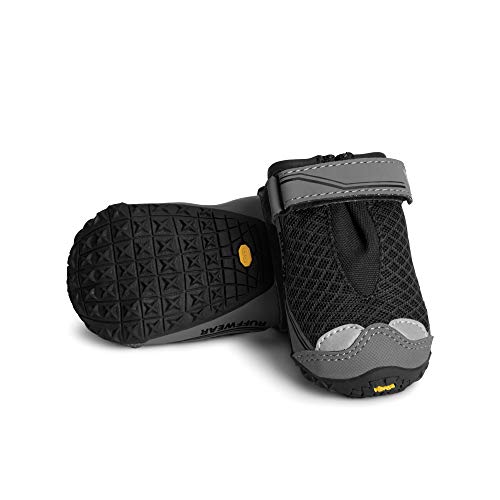
Ruffwear Grip Trex Dog Boots
Vibram-soled dog boots for the ground that beats paws: sharp rock, scree, and hot surfaces.
Field check: Vibram outsole (listed) · breathable mesh upper (listed) · for rock, scree, and hot ground
Paws are tough right up until they are not. Pads handle dirt and grass forever, but three surfaces defeat them: sharp rock and scree that slice, sun-heated rock and pavement that burn, and long abrasive days that sand pads down gradually, which a dog will hide until it limps at the car. The Grip Trex is the answer for that ground. The outsole is Vibram (listed), the same rubber family as serious human hiking footwear, over a breathable mesh upper (listed), with a cinch closure that solves the eternal dog boot problem of staying attached to a foot that was not designed for footwear.
Two pieces of honest technique matter more than any spec. First, measure: dog boots live or die on paw-width sizing, so use the listed size chart, not a guess. Second, acclimate: every dog does the high-step comedy walk for the first ten minutes, so put the boots on at home a few times before they ever see a trailhead, and check the fit at breaks, since a lost boot on talus is the failure you were paying to prevent. A useful common-sense heat test for any surface, booted or not: press the back of your hand on it for several seconds, and if you cannot hold it there comfortably, it is too hot for bare pads. On a hot day, that test plus these boots is the difference between a great hike and a vet visit.
- Outsole
- Vibram rubber (listed)
- Upper
- Breathable mesh with cinch closure (listed)
- Best
- Sharp rock, scree, hot surfaces, long abrasive miles
- Approx. price
- ~$50
What we like
- Vibram outsole: real traction rubber, not costume rubber
- Protects against the three pad-killers: cuts, heat, abrasion
- Secure cinch closure actually stays on, sized right
- Breathable upper for hot-weather wear
Worth noting
- Every dog needs an acclimation period, some need a long one
- Sizing must be measured, not guessed
- About $50, and fronts wear faster than rears
Who should buy it: Buy the Grip Trex if your trails include talus, slickrock, lava, long paved approaches, or summer heat, or if your dog has already come home with a worn or cut pad once. Also the right call for post-injury protection on vet advice. For soft-surface hikers, the wax below covers most needs at a quarter of the price.
What we don't like: Acclimation is real: some dogs take days to accept boots, and a few never fully do. Fit is unforgiving, since a loose boot rotates or disappears into the scree. And at about $50 for a set, plus the reality that dogs wear through front boots faster than rears, it is a genuine investment for terrain some dogs rarely see.
Bottom line: The Grip Trex is what happens when a real outsole company meets the dog boot problem: a Vibram-soled (listed) trail boot for the terrain that genuinely damages pads, sharp talus, hot rock, and long abrasive miles. Dogs do not love boots at first, nobody's dog does, but for the ground that hurts, this is the protection that actually stays on.
04 · Best Budget Paw Care
Budget Pick
Musher's Secret Paw Wax
The sled-dog paw wax standard: a $13 conditioning layer for the miles that do not need boots.
Field check: Wax-based paw barrier (listed) · the long-running sled-dog standard · everyday conditioning layer
Most trail days do not need boots; they need maintenance. The gap between bare pads and full boots is enormous, and Musher's Secret fills it. It is a wax-based barrier balm (listed) that you work into the pads and between the toes before you head out: it conditions the pad, adds a slick barrier against packed snow, ice-melt salt, sand, and dry abrasive dirt, and helps keep pads from cracking through dry seasons and hard-water winters. The name is the provenance: this is the stuff developed for working sled dogs, which remains the most demanding paw use-case there is.
Know its honest lane. Wax is a conditioning and barrier layer, not armor: it will not stop a talus cut and it will not make blazing pavement safe, which is what the Grip Trex above is for, alongside the common-sense rules, the back-of-hand heat test and skipping the hottest hours of a summer day. The right mental model is a two-tier system: wax as the everyday default on normal trail days, boots reserved for the terrain that genuinely calls for them. Application takes about a minute per hike, dogs tolerate it infinitely better than boots, and one tin lasts a season. Per ounce of prevention, nothing else in the guide comes close.
- Type
- Wax-based paw barrier balm (listed)
- Heritage
- Developed for sled dogs (listed)
- Best
- Everyday conditioning: dryness, salt, sand, mild abrasion
- Approx. price
- ~$13
What we like
- About $13 for a season of paw protection
- The proven sled-dog standard, decades running
- Dogs tolerate it far better than boots
- Covers the huge everyday middle of trail conditions
Worth noting
- Not armor: no help against cuts or truly hot ground
- Waxy paws collect dirt right after application
- Toe-handling is a daily diplomacy exercise with some dogs
Who should buy it: Buy Musher's Secret if your dog hikes at all; it is the rare product with no real disqualifier. It is the whole answer for soft-to-moderate trails, dry-season pad cracking, winter salt, and sandy ground, and the everyday layer even for dogs that own boots. At about $13, it belongs in the kit before you finish this sentence.
What we don't like: It is a barrier, not protection: sharp rock and truly hot surfaces are beyond its pay grade, and it would be easy to over-trust it in summer. Freshly waxed paws pick up dirt and track a little grease on hardwood for the first few minutes. And some dogs regard having their toes handled as a negotiation, every time.
Bottom line: Musher's Secret is the everyday half of the paw system: a wax-based barrier (listed) rubbed into the pads before a hike, born in sled-dog country and still the default answer for the huge majority of trail days that are hard on pads without being boot-hard. At about $13 a tin, it is the cheapest meaningful protection in this guide.
05 · The Essential Bowl
The Essential
Kurgo Collaps-A-Bowl
Fourteen dollars of clip-on collapsible bowl from a real dog-travel brand: the item that removes every excuse between your dog and a water break.
Field check: Collapsible food-grade bowl (listed) · integrated carabiner clip (listed) · from the dog-travel specialist behind two decades of car and trail gear
Dogs overheat faster than people, and they cannot ask for water. A dog's cooling system is mostly panting, which is dramatically less effective than sweating, and a working dog on a warm trail is running a heat deficit its owner cannot feel. The fix is not clever, it is frequent: offer water often, at every break, before the dog looks thirsty, because visible flagging, heavy drooling-panting, or wobbling are late signs, and if you ever see them the right response is shade, water, and cooling the belly and paws with water immediately, then calling it a day, and calling the vet if the dog does not bounce back fast. Heatstroke in dogs is a genuine emergency, which is exactly why the boring habit of constant small water breaks matters so much.
That habit needs a bowl with zero friction, and that is the entire genius of the Kurgo Collaps-A-Bowl: a food-grade collapsible bowl (listed) that folds flat to nearly nothing, clips to your pack or the dog's Approach pack with its carabiner (listed), and deploys in one second with one hand. Kurgo has built dog travel gear since the early 2000s, and it shows in the small things: a bowl that holds its shape while a dog drinks, a clip that survives seasons of banging on a pack strap. At about $14 it is still the best money-per-safety ratio in the guide; hikers who run food and water on overnights just buy two.
- Type
- Collapsible food-grade bowl (listed)
- Carry
- Integrated carabiner clip (listed)
- Best
- Frequent trail water breaks; buy two for overnights
- Approx. price
- ~$14
What we like
- About $14: the best safety-per-dollar in the guide
- Folds flat and clips on, so it is never left behind
- One-hand, one-second deployment keeps water breaks frequent
- Two decades of Kurgo dog-travel pedigree behind it
Worth noting
- Light enough to tip when empty
- Soft sides can fold under a very enthusiastic drinker
- One bowl: overnighters carrying food and water need two
Who should buy it: Everyone with a dog that leaves the house. Day hikers, backpackers, road trippers, the works: at about $14, this is not a purchase decision, it is a box to tick. Clip it to your daypack or the dog's pack and never think about it again; overnighters should carry two, one for water and one for food.
What we don't like: It is a collapsible bowl and behaves like one: light enough to tip when empty, and a very enthusiastic drinker can fold any soft-sided bowl occasionally. One bowl means overnighters carrying food and water buy a second. The clip is convenience-grade, not climbing hardware. None of this matters at the price.
Bottom line: The Collaps-A-Bowl is the cheapest item in this guide and arguably the most important after the harness, because hydration is a frequency problem and this removes the friction. One collapsible bowl (listed) that folds flat, clips to any pack with its carabiner (listed), and comes from Kurgo, the dog-travel brand that has been making exactly this kind of gear for two decades. There is no version of a trail dog kit without one.
06 · Best Long Line
Best Long Line
Mendota Pet Check Cord
The original long line, from a Wisconsin leash maker: real ranging freedom for the dog, real control retained for you.
Field check: Braided rope check cord, listed made in the USA · the recall-training and trail-freedom standard
Freedom on a trail is not a leash question, it is a control question. Most managed trails require a leash, and even where they do not, an off-leash dog is one deer away from demonstrating exactly how trained it is not. The long line is the honest middle path: clipped to the back of a Front Range harness, never a collar, a long line gives the dog real room to range, sniff, and be a dog, while you keep physical control the whole time. It is also the standard tool for training the recall that might eventually earn genuine off-leash trust, which makes it gear and curriculum in one purchase.
Provenance is why this specific line. A long line lives a hard life, dragged through mud, soaked in creeks, stopped hard by a sixty-pound dog that spotted a squirrel, and the failure point is always the same: hardware and splice. The Mendota check cord comes from a company that has been building leads for field and sporting dogs for decades and sells them through pet specialty and sporting retail rather than a listing, at about $28 for a 50-foot braided rope lead listed as made in the USA. Long line technique is its own small skill, manage the slack, never loop it around fingers, drop it and step on it in a pinch, but the payoff is the best version of a trail day: a dog moving like a dog, and an owner holding the other end of the worst-case scenario.
- Material
- Braided rope check cord (listed)
- Length
- 50 ft (listed)
- Use
- Trail ranging freedom + recall training, harness back-clip
- Approx. price
- ~$28
What we like
- A real sporting-dog leash maker, not an Amazon nameplate
- Real ranging freedom with physical control retained
- Doubles as the standard recall-training tool
- Listed made in the USA, 50 ft of working length
Worth noting
- Line management is a genuine learned skill
- Wrong tool in dense brush and tight switchbacks
- Rope soaks water and mud; hang it to dry
Who should buy it: Buy the Mendota check cord if your dog's recall is a work in progress (whose isn't), if your trails require leashes but your dog deserves room, or if you are training toward off-leash reliability the responsible way. Clip it to a harness back-clip, not a collar: a running stop at the end of a long line belongs on the chest, never the throat.
What we don't like: A long line is a skill, and the learning curve involves at least one comedic self-wrapping. Long lines snag in dense brush and tight switchbacks, where a standard 6-foot leash is simply the right tool. And rope is not coated webbing: it soaks up creek water and mud, so expect to hang it to dry rather than wipe it clean, and 50 feet is a lot of line to manage if your trails are tight.
Bottom line: The check cord solves the tension every trail dog owner lives with: your dog wants to range, most trails require a leash, and off-leash is only as safe as a recall that wildlife will absolutely test. Mendota Pet has been making leads for sporting dogs for decades, and its check cord is the tool field trainers have used for exactly this job long before the Amazon long-line aisle existed, listed as made in the USA in a 50-foot length.
07 · The Kit You Hope Stays Closed
Trail Safety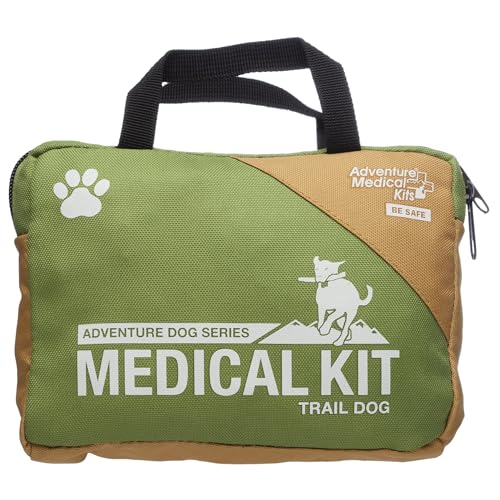
Adventure Medical Kits Trail Dog Medical Kit
The first-aid category leader's dog-specific trail kit: about $23 between a bad moment and a bad day.
Field check: Dog-oriented trail first aid kit with instruction manual (listed) · from the brand behind the standard backcountry human kits · the last line, not the first
Everything else in this guide is prevention; this is what happens when prevention loses one. Dogs get hurt on trails the way dogs do everything, suddenly and without a plan: a pad sliced on rock the boots were at home for, a barbed seed head between the toes, a scrape from an argument with a deadfall. Miles from the car, the difference between a manageable moment and a genuinely bad afternoon is whether you can clean and wrap a wound well enough to walk out. The Trail Dog kit packs the dog-relevant supplies plus an instruction manual (listed) into one pouch, and it comes from the brand that has spent decades building the backcountry kits human hikers already carry, which matters here for one practical reason above all: wrapping a paw is its own art, and having the right materials with real instructions beats improvising with human bandages that fur and paw-shape defeat.
Be clear about what a first aid kit is: the last line, not the first, and never a substitute for a vet. The honest protocol for anything beyond a minor scrape is stabilize and walk out, then call your vet, and it is worth having your vet's number and the nearest emergency animal hospital saved in your phone before the season starts, because that is the one piece of trail prep that costs nothing. Toss the kit in the bottom of your pack, or the dog's Approach pack, restock whatever you use, and let it ride there unopened for years. That is the kit doing its job.
- Type
- Dog-oriented trail first aid kit (listed)
- Format
- Compact pouch with instruction manual (listed)
- Role
- Stabilize and walk out; the vet is always the real answer
- Approx. price
- ~$23
What we like
- Dog-relevant supplies and instructions in one grab-it pouch
- From the first-aid brand backcountry hikers already trust
- About $23 against a very expensive alternative afternoon
- Light enough to live in the pack permanently
Worth noting
- A starting point: customize for your dog and learn to use it
- No kit substitutes for the vet call
- One more item in the pack, if a light one
Who should buy it: Buy the Trail Dog kit if your dog hikes beyond an easy walk from the car, which is the point of everything else in this guide. It is the right add for day hikers going remote, backpackers, and anyone whose dog has already demonstrated a talent for finding the one sharp thing on a soft trail.
What we don't like: Like every pre-built kit, it is a starting point: you should add your dog's specifics (any medications your vet recommends, a spare bootie for a wrapped paw) and actually learn basic paw-wrapping before you need it, because the pouch does not include competence. It is also one more thing in the pack, though at this weight the ounce-math argues for it.
Bottom line: The Trail Dog kit is the item in this guide you buy hoping to never open: a compact, dog-oriented first aid kit (listed) from Adventure Medical Kits, the company whose Ultralight/Watertight kits are the default answer in human backcountry first aid. It is built around the injuries trail dogs actually get, cut pads, scrapes, splinters, and ships with a dog-specific instruction manual (listed). At about $23 it is the cheapest version of being the prepared person five miles from the trailhead.
More gear worth comparing
Beyond this guide: the highest-rated gear across every category and budget, with a live price check on each.




As an Amazon Associate we may earn from qualifying purchases, at no cost to you.
Quick shop: every pick
Skip the scroll — the whole lineup, with a live price check on each.
- Ruffwear Front Range HarnessBest OverallRuffwear · ~$60Check price →
- Ruffwear Approach Dog PackBest Dog PackRuffwear · ~$60Check price →
- Ruffwear Grip Trex Dog BootsBest Paw ProtectionRuffwear · ~$50Check price →
- Musher's Secret Paw WaxBest Budget Paw CareMusher's Secret · ~$13Check price →
- Kurgo Collaps-A-BowlThe Essential BowlKurgo · ~$14Check price →
- Mendota Pet Check CordBest Long LineMendota Pet · ~$28Check price →
- Adventure Medical Kits Trail Dog Medical KitThe Kit You Hope Stays ClosedAdventure Medical Kits · ~$23Check price →
How we chose
We judge dog gear the way dog gear actually fails: silently, on the animal that cannot complain. That means we start from the two failure modes that end trail days, paws and heat, and work backward to the gear that prevents each one. A harness earns its place by where it puts leash force (chest, not throat) and whether it chafes on hour three. Boots earn theirs by staying on, which is the entire unsolved problem of dog boots. A pack earns its place by fit and by whether its saddlebag design keeps a load balanced when the dog does dog things. Specs and materials below are the manufacturers' listed figures, and we say 'listed' every time; approximate prices come from our July 2026 verified dataset, not from memory.
We also weight conservatism, deliberately. Dogs vary by breed, age, coat, and conditioning far more than humans vary in a boot review, so where the honest answer is a range, we give the range and tell you to confirm it with your vet, particularly on pack loading and heat. No brand has bought a placement, and a product that stops earning its spot in our own trail kit loses its spot in the guide. Every ounce earns its place, including the ounces your dog carries.
Key terms
- Front-clip harness
- A harness with a leash attachment on the chest in addition to the back. Leash tension at the chest turns a pulling dog gently sideways instead of letting it lean into its full weight, which is why trainers reach for it. The Ruffwear Front Range has both clips (listed).
- Pack loading (dogs)
- How much weight a dog carries in a pack, commonly recommended at roughly 10 to 25 percent of body weight for fit, healthy adult dogs, built up gradually from the low end and confirmed with a vet first. Puppies, seniors, and dogs with joint or breathing issues should not carry loads.
- Biothane
- Coated webbing used for leads and long lines: waterproof, wipe-clean, tangle-resistant, and flexible in cold, where rope and nylon absorb water and knot. The material that makes a trail long line practical.
- Back-of-hand test
- The common-sense surface heat check: press the back of your hand on the rock or pavement for several seconds, and if you cannot hold it there comfortably, it is too hot for bare pads. Boots or a different route, not a tougher dog.
- Paw wax
- A wax-based barrier balm (Musher's Secret is the long-running standard) worked into pads before a hike to condition them and shield against salt, sand, dryness, and mild abrasion. A maintenance layer, not armor: cuts and hot ground are boot territory.
Questions, answered
What gear does my dog actually need for hiking?
Four things cover most dogs: a real harness (the Ruffwear Front Range, about $60), a collapsible water bowl (about $14), paw protection matched to your terrain (Musher's Secret wax at about $13 for everyday trails, Grip Trex boots at about $50 for rock and heat), and a leash or long line where required. Add a dog first aid kit (about $23) once your hikes get remote, and a dog pack (about $60) once your vet signs off on your dog carrying its own water. The full seven-item kit in this guide runs about $250, and most dogs need four or five pieces of it.
How much weight can a dog carry in a hiking pack?
The commonly recommended range is roughly 10 to 25 percent of the dog's body weight, for fit, healthy adult dogs, and the responsible reading of that range is conservative: start near 10 percent, increase gradually over multiple hikes, and treat 25 as a ceiling few dogs need to visit. Check with your vet before your dog carries anything, especially for puppies (growing joints), seniors, giant and long-backed breeds, and flat-faced breeds. Balance the saddlebags evenly, and do the first outing with the pack empty.
Does my dog need boots for hiking?
Only for specific ground: sharp rock and scree, hot surfaces (desert, summer pavement, dark slickrock), snow and ice-melt salt, or very long abrasive days. For everyday dirt-and-duff trails, a wax barrier like Musher's Secret covers pad care at a quarter of the price and none of the acclimation drama. A useful common-sense check for heat: hold the back of your hand on the surface for several seconds, and if you cannot, your dog needs boots or a different plan. If you do buy boots, measure the paws against the size chart and practice at home first.
How do I keep my dog from overheating on a hike?
Prevention is scheduling plus water: hike early or late rather than through midday heat, offer water at every break before the dog seems thirsty (dogs cool mostly by panting, which is inefficient, and they will not ask), and rest in shade. Watch for heavy panting, thick drool, weakness, or wobbling; those are late warnings, and the response is immediate: shade, water, cool water on the belly and paws, end the hike, and call your vet if your dog does not recover quickly, because heatstroke in dogs is a genuine emergency. Flat-faced breeds, thick coats, seniors, and unfit dogs overheat fastest.
What is the best dog harness for hiking?
Our pick is the Ruffwear Front Range (about $60). It moves leash force off the throat and onto the chest and shoulders, has both back and front-chest leash clips (listed) so it handles trained dogs and pullers alike, adjusts at four points (listed), and is padded well enough to wear all day without chafing. It is the piece of dog trail gear we would call non-negotiable, and the platform the rest of the kit (long line, and pack skills) builds on.
Should I use a long line or let my dog off leash on trails?
Default to the long line. Most managed trails require a leash, and even where rules allow off-leash, it is only as safe as your dog's recall under the worst temptation it will ever face, which the trail will eventually provide. A long line (the Mendota Pet check cord, about $28) is the honest middle: real room to range and sniff, physical control retained, and it doubles as the standard tool for training toward genuine recall reliability. Always clip a long line to a harness back-clip, never a collar; a running stop at the end of a line belongs on the chest, not the throat.
What should be in a dog first aid kit for hiking?
Start with a dog-oriented pre-built kit like the Adventure Medical Kits Trail Dog (about $23) and treat it as a base: the trail injuries dogs actually get are cut pads, scrapes, splinters, and seed heads between toes, so paw-wrapping materials matter most, and a spare dog bootie is a smart add for protecting a wrapped paw on the walk out. Add anything your vet specifically recommends for your dog. The kit's job is stabilize-and-walk-out, never treatment: save your vet's number and the nearest emergency animal hospital in your phone before the season starts.
Can any dog go hiking?
Most healthy adult dogs can hike, but fitness is built, not assumed: start with short outings and grow distance gradually, exactly as you would for yourself. Talk to your vet first for puppies (long miles and any pack load can stress growing joints), seniors, flat-faced breeds (heat and breathing limits), and any dog with joint, heart, or weight issues. Match the trail to the dog in front of you, not the breed description, and let the dog's behavior on trail, lagging, lying down, heavy panting, veto the plan at any time.
Filed under Buyer's Guide
Keep reading
The Ten Essentials
Your half of the safety kit: the classic list every dog owner should carry before adding the dog's gear on top.
The Best Daypacks for Hiking (2026)
The pack that carries the human share of the water, the first aid kit, and the clipped-on dog bowl.
The Best Water Filters (2026)
Long days with a thirsty dog mean filtering on trail; the filters we trust for the whole pack, two-legged and four.
The Best Hiking Socks
Your paws matter too: the socks that keep the human half of the team blister-free.
The Best Hikes in the World
Somewhere to point all this enthusiasm: the trails worth planning a whole trip around.