Our Pick: Black Diamond
Check price →The Best Hiking Gear for Bad Knees (2026)
Bad knees do not end hiking careers; unmanaged descents do. We built the six-piece kit that attacks downhill load from every direction, shock-absorbing poles, compression, a patella strap, a supportive insole, and a max-cushion shoe, from a ~$14 strap to a ~$155 HOKA, and explain the load math that makes each piece earn its place.
By The WorldHike Gear Desk · ~12 min read · Updated 2026-07-02

Black Diamond Trail Pro Shock
Black Diamond
Shock-absorbing aluminum poles from the category benchmark brand: the highest-leverage knee purchase in hiking.
Check price★ Our Top Pick
Best Overall
Black Diamond Trail Pro Shock
Shock-absorbing aluminum poles from the category benchmark brand: the highest-leverage knee purchase in hiking.
Not sure yet? Compare all 6 picks below ↓
Here is the thing about hiking with bad knees: the mountain does not hurt you on the way up. Climbing is cardio; descending is impact. Every downhill step asks your knees to catch your body weight plus your pack, over and over, for the entire descent, and biomechanics literature commonly puts the compressive forces involved at several times body weight per step. That is the actual problem to solve, and it is why 'my knees are fine until the way down' is the most common sentence in trailhead small talk. The good news is that downhill load is exactly the kind of problem gear can blunt, because you can attack it from three directions at once: absorb some of it before it arrives (shock-absorbing poles, cushioned shoes), share some of it with your arms (poles again, which is why they lead this guide), and support the joint that takes the rest (compression sleeves, patella straps, supportive insoles).
This is a kit guide rather than a single-category roundup, because no one product carries the whole job. The six pieces below stack, and the full set costs less than one premium boot: from the ~$17 MUELLER patella strap and ~$21 MUELLER compression sleeve, through ~$60-and-change poles and insoles, to the ~$95 Black Diamond shock poles that lead the guide and the ~$155 HOKA Speedgoat at the top of the ladder. One honesty note before any of it, and we mean it: this is gear, not medicine. Everything here is framed as how the equipment mechanically works plus what hikers widely report, not as treatment. Persistent, sharp, or worsening knee pain deserves a professional evaluation before you buy anything, and nothing in this guide replaces that.
And the standing disclosure, plainly: no brand paid for a spot in this guide, and no manufacturer saw it before publication. Some links go to Amazon; if you buy through one we may earn a small commission at no extra cost to you, and that never moves a pick up or down. Prices are approximate street prices at publication, and specs are the manufacturers' listed figures. Always check the live listing.
The short version
- Our pick is the Black Diamond Trail Pro Shock (about $95): aluminum poles with a built-in shock-absorbing suspension, the single highest-leverage purchase for downhill knee comfort.
- The math favors poles first: trekking-pole biomechanics research commonly cites meaningful reductions in knee joint load on descents when poles are used actively, and poles help before the impact happens rather than after.
- The budget stack is real: a ~$14 patella strap, ~$25 compression sleeves, and ~$65 Cascade Mountain Tech carbon poles cover three of the six roles for a hair over $100 total.
- Cushion is the shoe's job: the HOKA Speedgoat 6 (about $155) is the max-cushion benchmark, softening what your soles hand your knees on every step.
- This is gear, not treatment: everything here manages load and support. Persistent knee pain belongs in front of a professional first.
| Gear | Role in the kit | How it helps | Approx. price |
|---|---|---|---|
| Black Diamond Trail Pro Shock | Our Pick: shock poles | Shares load to arms + absorbs impact at the grip | ~$95 |
| Cascade Mountain Tech Carbon | Best Budget Poles | Same load-sharing job at a third the flagship price | ~$65 |
| MUELLER Open Patella Knee Sleeve | Best Compression Sleeve | Warmth, compression, and joint awareness on descents | ~$21 |
| MUELLER Jumper's Knee Strap | Best Patella Strap | Targeted pressure on the patellar tendon below the kneecap | ~$17 |
| Superfeet Hike Cushion | Best Insole | Support and cushion where the impact chain starts | ~$60 |
| HOKA Speedgoat 6 | Best Max-Cushion Shoe | Max-cushion midsole softens every footstrike | ~$155 |
The 2026 bad-knees kit at a glance. Specs are the manufacturers' listed figures; prices are approximate street prices at publication, verified against our dataset in July 2026.
01 · Best Overall
Our PickBlack Diamond Trail Pro Shock
Shock-absorbing aluminum poles from the category benchmark brand: the highest-leverage knee purchase in hiking.
Field check: Aluminum trekking poles with built-in shock-absorbing suspension (listed)
If bad knees get one purchase, it is poles, and if it is poles, make them these. The physics is the point: on a descent, your knees are the brakes, catching your weight plus your pack on every step. Plant a pole and some of that catch routes through your arms and shoulders instead, before the knee ever sees it. Trekking-pole biomechanics research commonly cites meaningful reductions in lower-limb joint load on descents when poles are planted actively, with published figures often landing in the range of roughly ten to twenty-five percent depending on grade and technique. Hedge that number as the range it is; the direction of the effect is why physical therapists keep recommending poles to hikers, and why the Trail Pro Shock leads this guide.
What the Shock version adds is the suspension: a spring-damped mechanism in the shaft (listed) that compresses slightly on each plant, softening the jolt that otherwise travels up a rigid pole into your wrists and elbows, and letting you plant harder and lean on the poles with more commitment on long descents. The rest is Black Diamond doing what it does: sturdy aluminum shafts that shrug off the rock strikes that end carbon poles, secure external locks, and comfortable grips built for hours of real weight-bearing. At about $95 it is a mid-priced pole with flagship execution. If the budget is tighter, the Cascade Mountain Tech carbon poles below do the core load-sharing job for about $65; the head-to-head after this card settles which to buy.
- Material
- Aluminum shafts (listed)
- Suspension
- Built-in shock absorption (listed)
- Role
- Load sharing + impact absorption
- Approx. price
- ~$95
What we like
- Attacks knee load twice: shares it to the arms and damps each plant
- Sturdy aluminum from the category's benchmark brand
- Encourages committed pole plants on long, hard descents
- Mid-tier price for flagship execution
Worth noting
- Shock system adds weight and moving parts
- Softened plant feel is not for everyone
- Only helps if you use them actively
Who should buy it: Buy the Trail Pro Shock if descents are where your knees complain and you want the single highest-leverage fix in this guide. It suits day hikers and backpackers alike, and especially heavier hikers and heavy-pack carriers, who have the most load to share. If you already own poles you trust, put the money into the shoe or insole instead; if you own none, start here.
What we don't like: Shock mechanisms add a little weight and complexity over a rigid pole, and a minority of hikers dislike the slightly soft feel on flat ground (many shock systems can be locked out; check the listing for the current design). Aluminum is sturdier than carbon but heavier. And poles only help when you actually plant them with intent; carried like decorations, they share nothing.
Bottom line: The Trail Pro Shock is the first thing we hand a hiker whose knees dread descents. It does the two most valuable jobs in this guide at once: poles shift a share of every downhill catch from your knees to your arms, and Black Diamond's built-in shock suspension (listed) takes the sting out of each pole plant on hard ground. Sturdy aluminum, secure locks, and the brand that defines the category, for about $95.
02 · Best Budget Poles
Best Budget Poles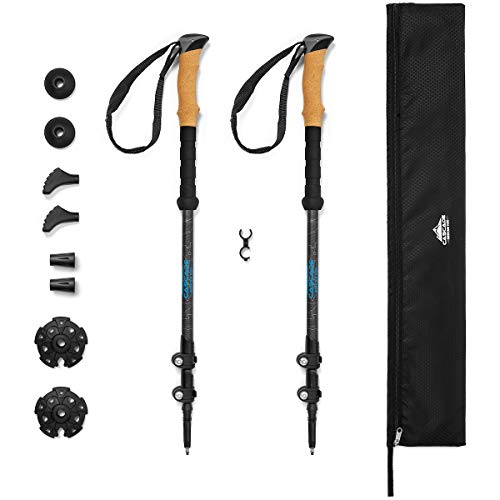
Cascade Mountain Tech Carbon Fiber
The Costco-famous carbon poles: the same knee-sparing load transfer for about $60.
Field check: Carbon fiber poles (listed) · the famous value benchmark of the category
Most of a pole's knee benefit comes from being a pole. The load-sharing mechanics that make our top pick valuable, routing part of each downhill catch through your arms, require only a stiff shaft, a decent grip, and your commitment to planting it. The Cascade Mountain Tech carbons supply exactly that, minus the suspension, minus the flagship refinement, and minus about $35. They earned their folk-hero status the honest way: light carbon fiber shafts (listed) at a price that used to buy one aluminum pole, sold in bulk to a nation of Costco members who then took them up actual mountains and found they held.
The honest ledger: the locks and grips are workable rather than luxurious, carbon tolerates rock strikes less gracefully than our top pick's aluminum, and there is no shock system to damp the plant, so more of each impact reaches your wrists on hard surfaces. None of that changes the core arithmetic. If ~$95 poles mean you skip poles, buy these instead, plant them with intent on every descent, and bank the load transfer; put the $35 you saved toward the patella strap and most of the compression sleeve below and you have covered three roles in the kit for roughly the flagship poles' price alone.
- Material
- Carbon fiber shafts (listed)
- Suspension
- None
- Role
- Load sharing on a budget
- Approx. price
- ~$60
What we like
- The core knee benefit of poles at a category-famous price
- Light carbon shafts that make you actually bring them
- Frees budget to cover the rest of the kit
- Proven by an enormous installed base
Worth noting
- No shock system: plants sting more on hard ground
- Hardware is workable, not refined
- Carbon is less forgiving of rock strikes than aluminum
Who should buy it: Buy the Cascade Mountain Tech carbons if you are pole-curious, budget-bound, or building the whole bad-knees kit at once and want to spread the money. They are also a sane second set to keep in the car. Heavy hikers, heavy packs, and rocky terrain that punishes carbon argue for the aluminum Black Diamonds instead.
What we don't like: No shock absorption, so hard-surface plants sting more; locks and grips are serviceable, not premium; and carbon shafts fail suddenly rather than bending when they finally meet the wrong rock. At about $60 those are trades, not flaws.
Bottom line: The Cascade Mountain Tech carbons are the value legend of trekking poles, light carbon shafts, workable locks and grips, and a price that removes every excuse. They have no shock suspension; what they have is the part that matters most, two extra contact points sharing your downhill load, at a price where 'should I buy poles' stops being a question.
03 · Best Compression Sleeve
Best Compression Sleeve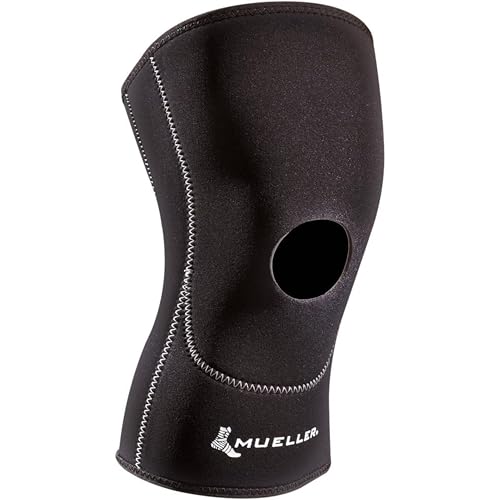
MUELLER Sports Medicine Open Patella Knee Sleeve
A sports-medicine compression sleeve with an open-patella cutout: warmth, support, and joint awareness for ~$21.
Field check: Knit compression sleeve, open-patella cutout (listed)
Compression is the most honest 'it just feels better' purchase in hiking. A sleeve does three things nobody disputes: it applies gentle, even pressure around the joint, it keeps the knee warm, and it heightens proprioception, your body's positional sense of the joint, by giving the skin constant feedback. Hikers with cranky knees widely report that this combination makes descents feel steadier and less achy, which is the claim we can stand behind: widely reported experience plus plausible mechanics, not medicine. The MUELLER Open Patella sleeve earns the slot for equally honest reasons: a comfortable knit that stays put, a real size run, an open-patella cutout that keeps direct pressure off the kneecap itself, and a sports-medicine company behind it rather than a listing. It is sold per knee, so budget about $42 if both knees want one.
Practical notes from the trail: fit is everything with sleeves, so measure per the listing rather than guessing, because a too-tight sleeve turns into a tourniquet on mile eight and a loose one migrates down your calf. Wear it on descents and long days rather than around camp. And know what a sleeve is not: it is uniform compression, not the targeted tendon pressure of the MUELLER strap below, and the two solve different complaints, which is why plenty of hikers wear both. If your issue is a general ache or a knee that feels loose and untrustworthy downhill, start with the sleeve; if it is a specific point of pain right below the kneecap, start with the strap.
- Type
- Knit compression sleeve, open-patella cutout
- Quantity
- Sold per knee
- Role
- Warmth, compression, joint awareness
- Approx. price
- ~$21
What we like
- Sports-medicine brand with sixty-plus years behind it
- Warmth, gentle pressure, and steadier-feeling descents
- Comfortable knit that stays in place when sized right
- The cheapest full-coverage experiment in the kit
Worth noting
- Feels-better support, not mechanical correction
- Sizing is unforgiving; measure first
- Sold singly, so two knees means two purchases
Who should buy it: Buy the MUELLER sleeve if your knees ache generally on descents, feel unstable, or simply feel better with warmth and pressure, a pattern enormous numbers of hikers report. It is the obvious first soft-goods experiment, and the open-patella cut suits hikers who find closed sleeves press uncomfortably on the kneecap. Measure carefully against the size chart before ordering.
What we don't like: Compression is comfort and support, not correction: it will not fix a mechanical problem, and the benefit disappears when the sleeve comes off. Sizing misses are the most common complaint in the category, and knit sleeves run warm in summer heat. If pain is sharp, localized, or persistent, that is a professional's question, not a sleeve's.
Bottom line: MUELLER has been making sports-medicine soft goods since 1959, which is the reason this sleeve is here instead of one of the interchangeable two-for-$25 knits that dominate the category. It is a snug knit compression sleeve with an open-patella cutout, listed for knee pain relief and support, for hikers whose knees feel better wrapped. What compression demonstrably provides is gentle pressure, warmth, and a constant sense of where your joint is; what hikers widely report is steadier-feeling, less achy descents. At about $21 per knee it costs a little more than the no-name aisle and comes from a company you could actually call.
04 · Best Patella Strap
Best Patella Strap
MUELLER Sports Medicine Jumper's Knee Strap
The ~$17 downhill standby: targeted pressure on the tendon below the kneecap, from a sports-medicine brand.
Field check: Adjustable patellar tendon strap, one size (listed)
Some knee complaints are general; this is for the specific one. If your downhill pain concentrates at a fingertip-sized spot just below the kneecap, along the patellar tendon, the strap is the classic gear-aisle response. Mechanically it is easy to state: a padded band cinched over the tendon applies focused compression that slightly changes how the tendon loads and tensions across its span. That mechanism is why straps like this have been a standby among runners and hikers for decades, and users with exactly that complaint widely report descents feel more manageable with one on. Stated plainly and conservatively: it is targeted pressure, widely reported to help that pattern, and it is not a diagnosis or a cure. The MUELLER strap is the credible-brand version of that idea, adjustable, padded, one size, and about $17.
Its virtues are its size and its price. It weighs nothing, packs nowhere, and adjusts in seconds mid-trail, so the sane pattern is to carry it always and cinch it when the long descent starts. It pairs cleanly under or alongside the MUELLER sleeve, since one is targeted and the other is general. The equally plain caveat: pain sharp or persistent enough that you are structuring purchases around it has earned a professional look. A strap is a $17 comfort tool, and it is excellent at being that; it is not an evaluation.
- Type
- Adjustable patellar tendon strap
- Quantity
- Single, one size (listed)
- Role
- Targeted below-kneecap pressure
- Approx. price
- ~$17
What we like
- About $17: the cheapest experiment in the guide
- Weightless insurance that lives in a hip-belt pocket
- Adjusts in seconds when the descent starts
- The classic standby for the below-kneecap downhill ache
Worth noting
- Helps one specific pain pattern, not knees generally
- Takes a hike or two to dial placement and tension
- No substitute for getting real pain evaluated
Who should buy it: Buy the MUELLER strap if your complaint is that specific ache just below the kneecap on descents, or if you want a zero-weight insurance item living in your pack for the day a knee starts barking mid-hike. At about $17 it is the cheapest experiment in all of hiking gear.
What we don't like: It addresses one pain pattern, not knees in general; hikers with different complaints will feel nothing and should start with the sleeve or poles. Placement and tension take a hike or two to dial in, and an over-cinched strap trades one discomfort for another. And the standing line applies double here: persistent localized pain is a professional's question first.
Bottom line: MUELLER's Jumper's Knee Strap is the smallest, cheapest item in this guide and the one most likely to live permanently in a hip-belt pocket. It is a simple padded band that applies targeted pressure across the patellar tendon just below the kneecap, a long-running standby for the specific below-the-kneecap ache that shows up on descents, and it is listed for patellar tendinitis and Osgood-Schlatter's, the two complaints that pattern usually belongs to. At about $17 the cost of trying it rounds to zero.
05 · Best Insole
Best Insole
Superfeet Hike Cushion Insoles
A hike-specific supportive insole that upgrades the flimsy liner your boots shipped with.
Field check: Hike-specific cushioned support insole (listed) · replaces the stock foam liner
Open your boot and pull out the insole the factory gave you. That flimsy sheet is what stands between the trail and your skeleton. Stock liners in even expensive boots are usually thin die-cut foam, and replacing one with a structured insole is the closest thing footwear has to a free upgrade. The Superfeet Hike Cushion is the hiking-specific entry from the best-known name in the category: a supportive shaped heel cup and arch structure with a cushioned top layer tuned for trail miles (listed). The mechanical story is straightforward: a stable, supported foot strikes and rolls more consistently, and cushioning at the footbed takes the first edge off each impact before it travels up the chain, which is exactly the chain hikers with cranky knees care about.
We frame the benefit conservatively, because insoles attract overclaiming: what a structured insole verifiably does is support the foot and add cushion where the load enters; better-feeling knees downstream is what many hikers report, and foot mechanics vary enough that a professional fitting beats any blanket promise. Two practical notes. First, insoles need a break-in of a few short hikes, and structured arches feel assertive at first if you have lived on flat foam. Second, this pairs naturally with the Speedgoat below rather than replacing it; one is support inside the shoe, the other is cushion under it, and hikers with genuinely troublesome feet or knees should ask a professional about custom options before assuming any over-the-counter insole is the answer.
- Type
- Structured support insole with cushion layer
- Focus
- Hiking-specific (listed)
- Role
- Support + first-contact cushioning
- Approx. price
- ~$60
What we like
- Upgrades every boot you already own
- Structured heel and arch support under a cushioned top layer
- Works on every step, both directions, all day
- From the most established name in the category
Worth noting
- About $60 for an invisible part
- Structured support takes a short adaptation period
- Not a substitute for a professional fitting when feet are the problem
Who should buy it: Buy the Hike Cushion if your boots still carry their factory foam liner and your knees or feet grumble on long days; it is the cheapest meaningful change you can make to boots you already own. It suits hikers who want support and cushion without buying new footwear. Distinct foot conditions deserve a professional fitting instead of a guess.
What we don't like: About $60 is real money for a part nobody sees, structured arches take adaptation, and fit varies by boot volume, so it may take trimming and a test hike to settle in. Insoles also cannot fix a boot that is fundamentally wrong for your foot; get the shoe right first.
Bottom line: The impact chain that ends at your knee starts at your footbed, and most boots ship with a liner that does nothing about it. Superfeet's Hike Cushion swaps that throwaway foam for a structured insole with real heel support and hiking-specific cushioning (listed). It is the quiet upgrade of the kit: invisible, unglamorous, and working on every single step of the day.
06 · Best Max-Cushion Shoe
Best Max-Cushion Shoe
HOKA Speedgoat 6
The max-cushion trail benchmark on Vibram Megagrip: the soft landing your knees have been requesting.
Field check: Max-cushion trail shoe · Vibram Megagrip outsole (listed)
Every impact your midsole absorbs is one your joints do not. That is the whole HOKA thesis, and the Speedgoat 6 is its trail flagship: a maximal stack of soft foam underfoot that turns hard landings into muffled ones, which is exactly the transaction a hiker with tender knees wants to make on every one of a descent's thousands of steps. The mechanics are plain rather than magical, cushioning spreads each impact over a longer moment, taking the peak off the jolt, and hikers who switch to max-cushion shoes widely report their knees feel noticeably better at the end of long downhill days. We state it as that, mechanism plus widely reported experience; bodies differ, and no shoe is a prescription.
The rest of the shoe keeps the promise honest. The listed Vibram Megagrip outsole is the gold-standard rubber for wet rock and hardpack, which matters because confidence in your footing is itself knee protection: hesitant, braced descending loads joints worse than smooth rolling steps. The trade-offs are the max-cushion classics: a tall, soft platform mutes trail feel and asks slightly more of your ankles on off-camber ground, and plush foam is a consumable that packs out with high mileage. Pair it with the Superfeet insole above if you want support inside the cushion, and with the poles that started this guide, because the pieces stack, and that stack is the point of the kit.
- Type
- Max-cushion trail shoe
- Outsole
- Vibram Megagrip (listed)
- Role
- Impact absorption at the source
- Approx. price
- ~$155
What we like
- The benchmark max-cushion platform on trail
- Listed Vibram Megagrip: real grip on wet rock
- Widely reported end-of-day knee relief from cushioned stacks
- Stacks cleanly with the insole and poles in this kit
Worth noting
- Muted trail feel and softer lateral stability
- Cushion packs out; the midsole is a consumable
- No ankle structure for heavy loads or chaos terrain
Who should buy it: Buy the Speedgoat 6 if long descents leave your knees throbbing and you are ready to change the biggest underfoot variable there is. It suits day hikers, distance hikers, and anyone who has decided boots are optional; a GTX version exists for wet climates. If you need ankle structure or carry very heavy loads, cushion this soft may not be your platform.
What we don't like: Tall, soft stacks trade away ground feel and a little lateral stability, which some hikers on technical, off-camber terrain never make peace with. The plush midsole is also a wear item, and at about $155 you will eventually buy it again. It is a trail runner, not a boot; load and ankle expectations should match.
Bottom line: The Speedgoat is the shoe that made maximal cushioning respectable on trail, and it remains the benchmark: a deep, soft midsole that blunts every footstrike, on a listed Vibram Megagrip outsole that grips wet rock like the sole cost extra. For hikers whose knees tally every impact of a long descent, it is the biggest underfoot change money buys, at about $155.
More gear worth comparing
Beyond this guide: the highest-rated gear across every category and budget, with a live price check on each.




As an Amazon Associate we may earn from qualifying purchases, at no cost to you.
Quick shop: every pick
Skip the scroll — the whole lineup, with a live price check on each.
- Black Diamond Trail Pro ShockBest OverallBlack Diamond · ~$95Check price →
- Cascade Mountain Tech Carbon FiberBest Budget PolesCascade Mountain Tech · ~$60Check price →
- MUELLER Sports Medicine Open Patella Knee SleeveBest Compression SleeveMUELLER · ~$21Check price →
- MUELLER Sports Medicine Jumper's Knee StrapBest Patella StrapMUELLER · ~$17Check price →
- Superfeet Hike Cushion InsolesBest InsoleSuperfeet · ~$60Check price →
- HOKA Speedgoat 6Best Max-Cushion ShoeHOKA · ~$155Check price →
How we chose
We picked this kit the way the load travels: from the ground up and from the hands down. Each piece had to attack downhill knee load through a mechanism we can state plainly, load sharing to the arms, impact absorption before the joint, or external support at the joint, and each had to be the standout in its own category, not just knee-adjacent. Specs and materials are the manufacturers' listed figures, hedged as listed throughout, and where we cite load numbers we use commonly published figures from trekking-pole and gait biomechanics literature, stated as ranges rather than promises, because grade, technique, pack weight, and bodies all vary.
We also held a harder honesty line than usual, because knee pain is a health topic and this is a gear publication. Benefits are framed as how the equipment mechanically works plus what hikers widely report, never as treatment or prevention claims, and every pick carries its real limitations. No brand has bought a placement. And once more for the record: gear manages load; it does not diagnose anything. See a professional about persistent pain first, then come back and build the kit.
Key terms
- Eccentric (braking) load
- The work muscles do while lengthening under load, which is what quadriceps do on every downhill step as they brake your descent. It is the reason knees that climb comfortably can ache on the way down: descending is a long series of braking events, each commonly published at several times body weight at the knee.
- Shock-absorbing (anti-shock) poles
- Trekking poles with a spring-damped suspension in the shaft (as on the Black Diamond Trail Pro Shock, listed) that compresses slightly on each plant. The suspension softens the jolt reaching your wrists and elbows, encouraging the committed, weight-bearing plants that actually share load with your arms.
- Proprioception
- Your body's sense of where a joint is in space. Compression sleeves heighten it by giving the skin around the knee constant feedback, one plausible reason hikers widely report feeling steadier and more confident on descents while wearing one.
- Patellar tendon strap
- A padded band cinched across the tendon just below the kneecap, applying focused pressure that slightly changes how the tendon loads. A decades-old standby among runners and hikers for the specific below-the-kneecap downhill ache; a comfort tool, not a treatment.
- Max-cushion (maximal) shoe
- Footwear built around an unusually tall, soft midsole stack, the design HOKA popularized. Cushioning spreads each impact over a longer moment, taking the peak off the jolt that travels up toward the knee, at the cost of ground feel and some lateral stability.
Questions, answered
Do trekking poles help knees downhill?
Yes, and they are the most-supported claim in this guide. Poles give you two extra contact points, so part of every downhill catch routes through your arms and shoulders instead of your knees; trekking-pole biomechanics research commonly cites reductions in lower-limb joint load on descents, with published figures often in the range of roughly ten to twenty-five percent depending on grade and technique. The effect requires actually planting the poles with weight on them. Our pick is the shock-absorbing Black Diamond Trail Pro Shock (about $95); the Cascade Mountain Tech carbons (about $60) do the core job on a budget.
Are knee sleeves good for hiking?
Many hikers swear by them, and the honest version of why is threefold: a sleeve provides gentle compression, keeps the joint warm, and heightens your sense of where the knee is (proprioception), and hikers widely report that descents feel steadier and less achy with one on. It is comfort and support, not correction, and the benefit ends when the sleeve comes off. The MUELLER Open Patella sleeve (about $21) is our pick; measure against the size chart, because fit makes or breaks a sleeve.
What are the best shoes for hiking with bad knees?
The pattern hikers with knee complaints gravitate to is maximal cushioning, and the benchmark is the HOKA Speedgoat 6 (about $155): a deep, soft midsole that blunts each footstrike, on a listed Vibram Megagrip outsole whose wet-rock traction keeps your descending smooth rather than braced and hesitant. Mechanically, cushion spreads each impact over a longer moment; experientially, max-cushion converts widely report better-feeling knees after long downhill days. Bodies vary, so treat it as a strong starting point, not a prescription.
Do patella straps work for hiking?
For one specific complaint, the ache concentrated just below the kneecap along the patellar tendon, straps are a decades-old standby, and users with that exact pattern widely report descents feel more manageable wearing one. The mechanism is targeted pressure that slightly changes how the tendon loads. For general knee ache the strap does little; that is the compression sleeve's territory. At about $17 for the MUELLER Jumper's Knee Strap, it is the cheapest experiment in hiking, but persistent localized pain should see a professional before it sees more gear.
Should I hike with bad knees at all?
That is genuinely a question for a professional who has looked at your knees, and we mean that as the first step, not a disclaimer. What we can say is that many hikers with cranky knees keep hiking comfortably for decades by managing downhill load: poles planted with intent, cushioned footwear, supportive extras like sleeves or straps where they help, lighter packs, shorter downhill strides, and routes chosen with descents in mind. Gear manages load; it does not diagnose. Get the evaluation, then build the kit around what you learn.
Do insoles help knee pain when hiking?
The conservative, accurate answer: a structured insole like the Superfeet Hike Cushion (about $60) verifiably supports the foot and adds cushioning at the point where impact enters the body, and a stable foot strikes and rolls more consistently. Many hikers report their knees feel better downstream of that change; foot mechanics vary enough that results genuinely differ, and distinct foot problems deserve a professional fitting rather than an off-the-shelf guess. As a replacement for the flat factory foam in your boots, it is the cheapest meaningful upgrade to footwear you already own.
Is one trekking pole enough, or do I need two?
For knee relief, two. A single pole helps balance and gives one arm a share of the work, but the load-sharing that pole research measures comes from planting with each stride, which needs a pole in each hand and a rhythm that alternates with your steps. Two poles also keep the assistance symmetrical, so one knee does not quietly become the favorite. Every pole pick in this guide is sold and priced as a pair.
How can I protect my knees hiking downhill without buying anything?
Technique is the free layer of this kit and it stacks with everything in it. Shorten your stride on descents so each step drops less, keep your knees soft rather than locked, slow down on the steepest pitches, zigzag where the trail allows instead of plunging straight down, and cut pack weight, since every carried pound rides the same joints. Train the brakes too: stronger quadriceps, hips, and glutes are the muscles that do downhill's work. Then add poles first when you do spend, because they are the biggest purchasable lever.
Filed under Buyer's Guide
Keep reading
The Best Trekking Poles (2026)
The full poles field beyond the two in this kit: benchmark to budget, and how to choose.
The Best Trail Running Shoes (2026)
Where the Speedgoat lives among its rivals: the cushioned, fast half of trail footwear.
Hiking Boots vs Trail Runners
The support-versus-cushion decision underneath this guide's footwear pick, argued in full.
The Best Hiking Boots (2026)
If your knees want structure instead of maximal cushion: the boots we would actually lace up.
The Best Daypacks for Hiking (2026)
Pack weight rides your knees on every descent; a pack that carries on the hips helps the whole chain.
The Best Hiking Socks
The cheapest comfort upgrade in hiking, and the base layer of every footwear fix in this guide.