Our Pick: Black Diamond
Check price →The Best Trekking Poles (2026)
Four lever-lock poles from $30 to $110 with listed pair weights from 15.6 oz to 1 lb 4 oz. The Black Diamond Trail Cork is our pick; the table says when the $65 Cascade carbon or the $30 Cascade aluminum is the smarter buy, and why twist locks are disqualified.
By The WorldHike Gear Desk · ~12 min read · Updated 2026-08-23

Black Diamond Trail Cork
Black Diamond
Cork grips, bombproof FlickLock levers, and aluminum that survives abuse: the benchmark pole.
Check price★ Our Top Pick
Best Overall
Black Diamond Trail Cork
Cork grips, bombproof FlickLock levers, and aluminum that survives abuse: the benchmark pole.
Not sure yet? Compare all 4 picks below ↓
Short answer: buy the Black Diamond Trail Cork (about $102 at time of writing). Aluminum shafts, cork grips, FlickLock external lever locks, listed about 1 lb 3 oz per pair, 100 to 140 cm usable length. It is the pole that pitches trekking-pole tents, survives being wedged in talus, and is still adjustable after five seasons, which is the whole reason to pay $100 instead of $30. If you hike groomed trails and want to save swing weight, the Cascade Mountain Tech Carbon (about $65, listed about 15.6 oz per pair) is the value carbon pole the warehouse-club crowd discovered years ago. If $30 is the budget, the Cascade Mountain Tech Aluminum (about $30, listed about 1 lb 4 oz per pair) is the pole that makes poles a default purchase rather than a luxury. LEKI's Legacy Lite (about $110) is the aluminum alternative if the Trail Cork grip does not fit your hand.
What decides it: lock type first, because a lock that slips under body weight on a descent is worse than no pole, and every pick here uses an external lever lock rather than a twist lock. Then shaft material: aluminum bends and keeps working, carbon is 2 to 4 oz lighter per pair and snaps without warning when levered sideways between rocks. Then grip: cork manages sweat and molds to your hand over a season; EVA foam is lighter and fine for cool climates. Weights and lengths here are the manufacturers' listed figures cross-checked against the live Amazon listings in August 2026; we did not weigh these poles.
Disclosure: no brand paid for a place here; links go to Amazon and we earn a commission on purchases. It does not change the order.
The short version
- Our pick: Black Diamond Trail Cork, about $102. Aluminum, cork grip with foam extension, FlickLock levers, listed about 1 lb 3 oz per pair, 100 to 140 cm, collapses to about 64 cm. Women's version (about 95 to 125 cm, smaller grip) is linked on the card.
- Value carbon: Cascade Mountain Tech Carbon, about $65. Three-section carbon, cork grips, flip locks, listed about 15.6 oz per pair, 26 to 54 in (66 to 137 cm). Lightest pole here; the trade is carbon's failure mode.
- Budget: Cascade Mountain Tech Aluminum, about $30. Aircraft-grade aluminum (listed), EVA grips, flip locks, listed about 1 lb 4 oz per pair, 26 to 54 in, tip kit included. Heavier and less refined than the Trail Cork; not less safe.
- Aluminum alternative: LEKI Legacy Lite, about $110. Aluminum, LEKI's Aergon-style grip with a long extension, Speed Lock levers, listed about 1 lb 2 oz per pair, 100 to 135 cm. The pick if you have small hands or prefer a rounded grip top.
- Length rule: with the tip on the ground beside your foot, your elbow should sit at 90 degrees. Most people 5 ft 4 in to 6 ft 1 in land between 110 and 130 cm; shorten 5 to 10 cm for sustained climbs, lengthen for descents.
- Carbon versus aluminum in one line: if you ever lever a pole sideways between rocks or use it as a tent pole, buy aluminum.
- Flying: poles are not allowed in carry-on by TSA; check them or ship them.
| Pole | Best for | Shaft | Grip | Lock | Listed weight (pair) | Length range | Price (Aug 2026) |
|---|---|---|---|---|---|---|---|
| Black Diamond Trail Cork | Our Pick | Aluminum | Cork + foam extension | FlickLock lever | about 1 lb 3 oz | 100 to 140 cm | about $102 |
| Cascade Mountain Tech Carbon | Value carbon | Carbon fiber | Cork | Flip lever | about 15.6 oz | 66 to 137 cm | about $65 |
| Cascade Mountain Tech Aluminum | Budget | Aluminum (listed aircraft-grade) | EVA foam | Flip lever | about 1 lb 4 oz | 66 to 137 cm | about $30 |
| LEKI Legacy Lite | Aluminum alternative | Aluminum | LEKI ergonomic, long extension | Speed Lock lever | about 1 lb 2 oz | 100 to 135 cm | about $110 |
Listed manufacturer specs, cross-checked against the live Amazon listings in August 2026. Pair weights vary slightly by size and basket. Prices are what the linked listings showed at time of writing.
01 · Best Overall
Our PickBlack Diamond Trail Cork
Cork grips, bombproof FlickLock levers, and aluminum that survives abuse: the benchmark pole.
Field check: Cork-grip aluminum benchmark: Black Diamond's FlickLock external lever locks hold under full body weight, and the aluminum shafts bend rather than shatter when the trail wins a round.
Every category has a default that earned it, and in poles it is this one. The Black Diamond Trail Cork gets the three things that matter exactly right. The grips are genuine cork, which matters more than it sounds: cork manages sweat instead of getting slick, stays comfortable in heat and cold, and gradually takes the shape of your own hands, so the poles feel more yours every season. The locks are Black Diamond's FlickLock levers, external cam locks you can see, operate with gloves on, and tighten with a screw in the field. And the shafts are aluminum, the material that bends and keeps working where carbon can crack and quit.
The downsides are short. At about $110 at current street price the Trail Cork costs more than three times the budget pair below it, and aluminum gives up some swing weight to carbon, a difference you notice mostly on long, fast days. But this is also the pole you can lean on for a pole-pitched shelter, jam into a scree slope, or hand to a heavier hiker without a second thought. A women's version with the same build is sized for smaller hands and shorter lengths, linked as the Trail Cork women's model. If you want one pair of poles to end the question, this is the pair.
- Length
- 100 to 140 cm usable, about 64 cm collapsed
- Listed weight
- about 1 lb 3 oz per pair
- Shaft
- Aluminum
- Grip
- Cork with foam extension
- Locks
- FlickLock external levers
- Sizing
- Adjustable; women's version available
- Price
- about $102
What we like
- Cork grips manage sweat and mold to your hands
- FlickLock levers hold under full body weight
- Aluminum bends rather than snapping under abuse
- Field-adjustable locks, glove-friendly operation
Worth noting
- Priciest pole in this guide
- Heavier in the swing than carbon rivals
- No headline features, just the fundamentals
Who should buy it: Buy the Trail Cork if you hike regularly and want poles that will still be trustworthy years from now: rough-terrain hikers, backpackers who pitch trekking-pole shelters, and anyone who has been burned by a slipping lock on a cheap pair. It fits hikers who see poles as safety equipment, because that is how it is built.
What we don't like: At about $110 at current street price it is still the most expensive pick in this guide, and aluminum carries a bit more swing weight than the carbon options, which you feel late on long days. It is also, deliberately, unexciting: you are paying for reliability rather than any headline feature.
Bottom line: The Trail Cork is the pole we measure every other pole against. Cork grips wick sweat and slowly mold to your hands, Black Diamond's FlickLock levers are the external locks the rest of the industry imitates, and the aluminum shafts take the kind of abuse, wedged in talus, leaned on hard, flexed across a stream, that ends carbon poles. It is the buy-once answer at a fair price.
02 · Best Value Carbon
Best Value Carbon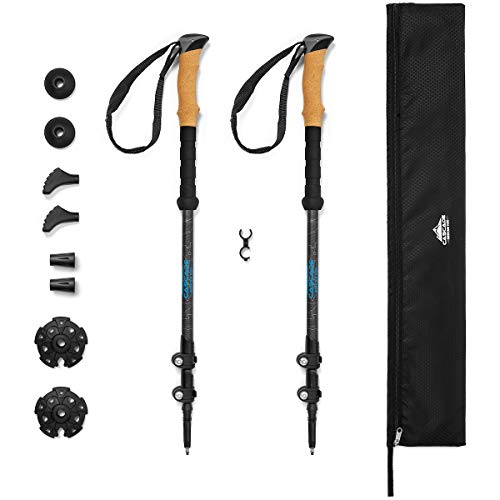
Cascade Mountain Tech Carbon Fiber
Real carbon shafts and cork grips at half the big-brand price: the famous warehouse-club sleeper.
Field check: Genuine carbon-fiber shafts with cork grips and quick-lock levers at roughly $65, the price-to-performance outlier that built a word-of-mouth following far beyond its marketing budget.
Some products earn a cult by advertising; this one earned it by price tag. The Cascade Mountain Tech Carbon Fiber poles became famous through warehouse-club shelves and trailhead word of mouth, and the pitch has not changed: real carbon-fiber shafts, which cut the swing weight your arms feel over ten thousand pole plants, plus cork grips and external lever locks, for about $65. That combination simply did not exist at this price before these poles, and the mainstream brands have never quite answered it.
The carbon question deserves a straight answer too: carbon fiber is stiff and light but does not bend gracefully, so when a carbon pole fails, wedged between rocks and levered, or crushed under a pack, it tends to fail suddenly. On maintained trails, where poles mostly plant and push, that risk is small and the swing-weight savings are real. On talus, off-trail, or under a heavy hiker, the aluminum Trail Cork or the Cascade aluminum pair is the more forgiving bet. As a first carbon pole, and as sheer value, this pair is very hard to argue with.
- Length
- 26 to 54 in (66 to 137 cm)
- Listed weight
- about 15.6 oz per pair
- Shaft
- Carbon fiber
- Grip
- Cork with foam extension
- Locks
- External flip levers
- Sizing
- Adjustable
- Price
- about $65
What we like
- Genuine carbon shafts at an outlier price
- Cork grips at half the big-brand cost
- Noticeably light in the swing over long days
- A deserved word-of-mouth reputation
Worth noting
- Locks and small parts need occasional attention
- Thinner warranty and spares support than flagships
- Carbon fails suddenly under hard abuse
Who should buy it: Buy the Cascade Mountain Tech carbons if you want carbon's light swing without carbon's usual price: high-mileage hikers on maintained trails, budget-minded upgraders, and anyone curious whether lighter poles are worth it to them. It is the lowest-risk way to find out.
What we don't like: Lock hardware and small parts are a refinement grade below the big brands and reward periodic tightening, and support and spares are thinner. Carbon itself fails suddenly rather than bending when truly abused, so hard off-trail use favors the aluminum picks.
Bottom line: The Cascade Mountain Tech carbons are the worst-kept secret in hiking: genuine carbon-fiber shafts, cork grips, and workable lever locks for about $65, roughly half of what the big brands ask for the same recipe. The refinement is a notch below, but the fundamentals are there, and that is why these poles show up on trail after trail.
03 · Best Budget
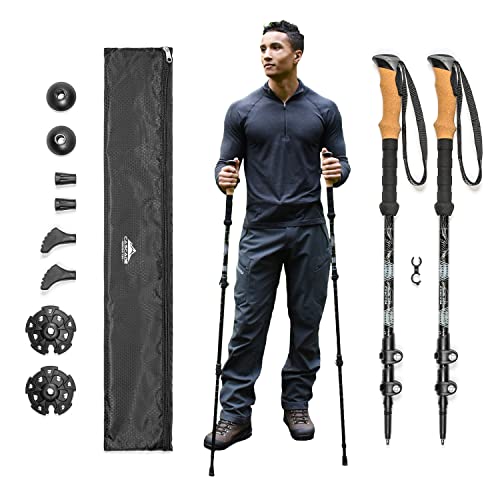
Cascade Mountain Tech Aluminum Trekking Poles
Aircraft-grade aluminum, flip locks, and a tip kit for about $30: the budget default.
Field check: Aircraft-grade aluminum shafts (listed) with flip locks, an extended down grip, and a tip kit included, for around $30 a pair.
The bottom of a gear category is usually a minefield, and this is the safe path through it. Most sub-$40 poles come from sellers whose entire identity is one listing, and they cut the corner that matters most: the lock. The Cascade Mountain Tech aluminum pair does not. It is the entry rung of the same pole line that made this brand famous through warehouse-club shelves, with listed aircraft-grade aluminum shafts and external flip locks you can see, work with gloves on, and trust with body weight. That is the entire recipe for a budget pole that behaves like a real one.
What $30 does not buy is refinement. The grips are foam rather than natural cork, these are the heaviest poles in this guide, and the small parts are built to the price. None of that undermines the core: sound shafts, trustworthy locks, a brand you can return them to. If you develop a pole habit and start counting swing weight, the Cascade carbons are the natural next step, and the Trail Cork is the endgame. But as a first pair, or a loaner pair, or a glovebox pair, this is the easiest $30 in hiking.
- Length
- 26 to 54 in (66 to 137 cm)
- Listed weight
- about 1 lb 4 oz per pair
- Shaft
- Aircraft-grade aluminum (listed)
- Grip
- Foam with extended down grip
- Locks
- External flip levers
- Extras
- Tip kit included
- Price
- about $30
What we like
- A real, retail-shelf brand at bargain-listing money
- Flip locks instead of bargain-tier twist locks
- Extended down grip for steep sidehill traverses
- The cheapest pole here that deserves body weight
Worth noting
- Heaviest pick in this guide
- Foam grips, not cork
- Fit and finish match the price
Who should buy it: Buy these if you are new to poles, buying for occasional hikes, or outfitting a family without spending benchmark money four times over. They are also the right loaner pair and the right car-kit pair: cheap enough to lend, sound enough to trust.
What we don't like: They are the heaviest pick in the guide, the grips are foam rather than true cork, and fit and finish are built to the price. Frequent hikers will eventually want lighter poles, though the locks and shafts rarely give them a reason sooner.
Bottom line: This is what a budget pole should be: aluminum shafts from a company with actual shelf presence, flip locks instead of the twist locks that plague the price tier, an extended down grip for sidehilling, and a tip kit in the box. It is the pair to buy when you are not yet sure poles are your thing, and the pair many people never end up replacing.
04 · Best Aluminum Alternative
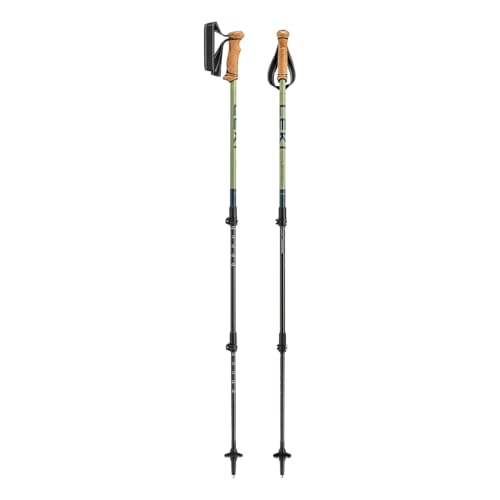
LEKI Legacy Lite
The German pole specialist's accessible aluminum model, with the grip ergonomics LEKI is famous for.
Field check: LEKI's accessible aluminum pole: the company has built poles and only poles for decades, and the Legacy Lite carries its signature grip shaping and lever locks at a mid-tier price.
Some brands make poles as a product line; LEKI makes poles as the entire point. The German company has spent decades on almost nothing else, and that focus shows up where your body meets the gear: LEKI grips are sculpted with an attention to hand shape that generic handles cannot match, and its adjustable-strap systems are a quiet reference standard. The Legacy Lite is the accessible route into that pedigree, an adjustable aluminum pole with the brand's lever locks at about $100.
Positioned against our top pick, the comparison runs close: both are adjustable aluminum poles with trustworthy external locks from serious manufacturers, the Trail Cork leads on its natural cork grip material, and the Legacy Lite answers with LEKI's shaping and a price about $30 friendlier. Neither will let you down; hands and budgets break the tie. What the Legacy Lite is not is a featherweight, it is a durable aluminum workhorse, and hikers chasing minimum swing weight should look at the Cascade carbons instead. As a lifetime-brand pole at a mid-tier price, it is an easy pick to respect.
- Length
- 100 to 135 cm
- Listed weight
- about 1 lb 2 oz per pair
- Shaft
- Aluminum
- Grip
- LEKI ergonomic grip with strap system
- Locks
- Speed Lock external levers
- Sizing
- Adjustable
- Price
- about $110
What we like
- LEKI's famous grip shaping at an accessible price
- Specialist pole maker with decades of focus
- Durable aluminum with trustworthy lever locks
- The best answer when other grips do not fit
Worth noting
- Not a lightweight; gram counters look elsewhere
- Close enough to benchmark price to force a choice
- LEKI's flashiest tech stays in pricier models
Who should buy it: Buy the Legacy Lite if you want specialist-brand build quality at a mid-tier price, or if Black Diamond's grips have never quite fit your hands: LEKI's shaping is the most common cure. It suits committed hikers who want aluminum durability with European pole pedigree.
What we don't like: It is a workhorse, not a featherweight, so gram counters will look elsewhere, and at about $100 it sits close enough to the benchmark that the choice comes down to grip feel more than value. LEKI's premium features stay upmarket in pricier models.
Bottom line: The Legacy Lite is the alternative benchmark. LEKI is the century-old German company that makes poles the way some companies make watches, and this is its accessible aluminum model: the brand's famously shaped grips and secure lever locks without flagship pricing. If the Trail Cork's grip does not fit your hand, this is the pole most likely to.
More gear worth comparing
Beyond this guide: the highest-rated gear across every category and budget, with a live price check on each.




As an Amazon Associate we may earn from qualifying purchases, at no cost to you.
Quick shop: every pick
Skip the scroll — the whole lineup, with a live price check on each.
- Black Diamond Trail CorkBest OverallBlack Diamond · about $102Check price →
- Cascade Mountain Tech Carbon FiberBest Value CarbonCascade Mountain Tech · about $65Check price →
- Cascade Mountain Tech Aluminum Trekking PolesBest BudgetCascade Mountain Tech · about $30Check price →
- LEKI Legacy LiteBest Aluminum AlternativeLEKI · about $110Check price →
How we chose
What we did: we shortlisted the poles that experienced hikers and thru-hikers actually keep buying, excluded everything with twist locks or internal anti-shock springs on principle, pulled shaft material, grip, lock type, listed pair weight, and length range from each manufacturer, and cross-checked every ASIN, image, and price against the live Amazon listing in August 2026. We read long-term owner reports for the failures that matter: lever locks loosening, carbon shafts splitting at the joint, grips delaminating, and tips wearing through. Judgments about how grips and locks feel come from our own use of these designs and consistent owner patterns.
What we did not do: we did not weigh the poles, load-test the locks to failure, or cycle them through a durability rig. Listed weights are per pair without baskets unless stated. Prices are live Amazon figures at time of writing.
How we rank: locks, then durability, then grip, then weight, then price. Weight is last on purpose; a 3 oz saving does not matter if the pole fails at the moment you are relying on it.
Key terms
- FlickLock / lever lock
- An external cam lever that clamps pole sections at your chosen length. Visible, glove-friendly, field-adjustable, and far more trustworthy under body weight than internal twist locks, which is why every pole in this guide uses some form of it. FlickLock is Black Diamond's name for the design the industry copies.
- Twist lock
- The older internal expander mechanism that tightens by rotating pole sections. Cheaper to make and notorious for slipping under load or seizing with grit, it is the main reason to distrust bargain poles that still use it. None of our picks do.
- Aluminum alloy grade
- Pole shafts are aluminum alloys of varying strength, and grade is one of the few spec-sheet lines at the budget end that matters: stronger alloys bend and recover where softer ones take a permanent set. Makers usually publish this as an alloy number or as "aircraft-grade"; treat either as the manufacturer's listed claim rather than a measured figure.
- Cork grip
- A grip made of natural cork, which wicks sweat, insulates against heat and cold, and gradually molds to the shape of your hand. The touch-point upgrade you feel most, and the reason both benchmark poles here lead with it. Budget poles often substitute a synthetic cork-look material.
- Swing weight
- How heavy a pole feels in motion, dominated by weight in the lower sections rather than the total on a scale. It is why carbon poles feel fresher over ten thousand plants a day, and the main comfort argument for paying carbon prices.
- Trekking-pole shelter
- A tent or tarp that uses your trekking poles as its structure instead of dedicated tent poles, a staple of ultralight backpacking. It makes your poles structural equipment, which is the strongest argument for aluminum shafts and locks you would trust in a storm.
Questions, answered
What are the best trekking poles overall in 2026?
Our pick is the Black Diamond Trail Cork, at about $110 at current street prices. It combines the three things that decide this category: natural cork grips that manage sweat and mold to your hands, FlickLock external lever locks that hold under full body weight and adjust in the field, and aluminum shafts that bend rather than snap when the trail wins. A women's version covers smaller hands and shorter lengths. It is the buy-once pole we measure the rest of the market against.
Are expensive trekking poles actually worth it over $40 ones?
Sometimes, and the difference is specific: you are paying for lock quality, grip material, and lighter shafts, roughly in that order. The $30 Cascade aluminum pair covers the fundamentals, sound aluminum shafts and external flip locks, which is why it is our budget pick. The roughly $110 Trail Cork adds true cork grips, more refined and durable hardware, and a stronger support ecosystem. Occasional hikers lose little going budget; frequent hikers feel the upgrade every mile, mostly in their hands.
Should I choose carbon or aluminum trekking poles?
Choose by terrain and by how hard you are on gear. Aluminum bends when overloaded and usually stays usable, which makes it the pick for rocky terrain, off-trail travel, heavier hikers, and anyone pitching a trekking-pole shelter. Carbon is lighter in the swing, which your arms appreciate over a long day, but it can fail suddenly when wedged or levered hard. On maintained trails the Cascade Mountain Tech carbons are a great light option; for everything rougher, the aluminum Trail Cork or Legacy Lite is the more forgiving bet.
Do trekking poles really help your knees?
Yes, and descents are where it shows most. Planting poles ahead of you on the way down lets your arms absorb a share of each step's impact before your knees take it, and across thousands of downhill steps that adds up to a difference many hikers describe as transformative. Poles also add two points of contact for balance on crossings and loose ground, and set a rhythm that helps on climbs. The technique matters: use the straps properly and plant deliberately, and the benefit roughly doubles.
How long should my trekking poles be?
Set the length so your elbow bends at roughly a right angle when the tip is on the ground beside your foot. That is the baseline; then adjust by terrain, a few centimeters shorter for sustained climbs so you can push through the straps, a few longer for long descents so the poles reach the ground early and take load before your knees do. All four poles in this guide adjust with external levers precisely so you can make those changes mid-hike in seconds.
Can I take trekking poles on a plane?
Not in the cabin: security screening in the US and most countries treats trekking poles as prohibited carry-on items, and they are confiscated at checkpoints regularly. Pack them in checked luggage, collapsed and ideally with tips capped. If you are traveling carry-on only, the practical options are shipping poles ahead, buying inexpensive poles at your destination, or renting locally. Always check your specific airline and country rules before you fly.
One trekking pole or two?
Two, for almost every hiking purpose. The knee-saving load sharing on descents, the balance on crossings, and the climbing rhythm all come from alternating plants with a pair; a single pole gives you a walking staff, which helps balance but delivers a fraction of the benefit. The main exceptions are casual walks and situations where one hand must stay free. Trekking-pole shelters typically require two anyway. If budget is the constraint, a $40 pair beats a $130 single every time.
Filed under Buyer's Guide
Part of Best Hiking Gear
Keep reading
Black Diamond vs LEKI Trekking Poles
The brand question answered through the Trail Cork and the Legacy Lite: cork against foam, 140 against 135 cm.
The Best Backpacking Packs (2026)
Poles save your knees; the right pack saves your shoulders. The haulers we trust, ranked.
Ultralight Backpacking 101
Where poles fit in a lighter kit, including the shelters that use them as tent poles.
The Ten Essentials
The complete safety framework every pack should carry, poles or no poles.
The Best Headlamps for Hiking (2026)
The other piece of gear that earns its place on every single trip, ranked.