Our Pick: Black Diamond
Check price →The Best Headlamps for Hiking (2026)
Four lamps that cover every honest use case: the AAA classic that never leaves you stranded, the hybrid that runs on either battery type, the sub-50-gram ultralight, and the flat-front design that finally killed headlamp bounce. Ranked on the things that matter at 9 p.m. on a trail: light quality, battery reality, and weight. Plus the camp lantern that lights the table while the headlamp lights the trail.
By The WorldHike Gear Desk · ~12 min read · Updated 2026-07-25

Black Diamond Spot 400
Black Diamond
400 listed lumens, an IPX8 rating, and AAA power you can restock at any gas station on earth.
Check price★ Our Top Pick
Best Overall
Black Diamond Spot 400
400 listed lumens, an IPX8 rating, and AAA power you can restock at any gas station on earth.
Not sure yet? Compare all 5 picks below ↓
A headlamp is the piece of gear you buy for the trip you did not plan: the summit that took two hours longer than the map suggested, the camp chore that outlasted the sunset, the 4 a.m. alpine start. It is on every version of the Ten Essentials for a reason, and the reason is blunt: hiking out by phone light, with your navigation and emergency line draining in your hand, is how small delays become real problems. A dedicated lamp on your head, hands free, is cheap insurance that doubles as a camp luxury.
The 2026 market has quietly sorted itself around one question: how do you want to feed it? Rechargeable lamps are cheaper to run and top up from the power bank you already carry, but a dead cell mid-trip needs a charger. AAA lamps are refillable at any gas station on earth but cost more per hour of light. The best designs now hedge, with hybrid lamps that take either, and the picks below cover every position honestly: an AAA classic with a rechargeable twin, a true hybrid, a featherweight USB-C lamp, and a design that fixes the oldest annoyance in the category, bounce.
Our standard disclosure, plainly: no brand paid to be here, nobody placed a pick, and no manufacturer saw this guide before publication. Some links go to Amazon, and if you buy through one we may earn a small commission at no extra cost to you; it never moves a ranking. Lumen counts, weights, and ratings are the manufacturers' listed figures from our verified dataset, hedged as listed throughout, because a lumen claim is a marketing number until someone independent measures it, and we did not. Every ounce earns its place, even the ones on your forehead.
The short version
- Our pick is the Black Diamond Spot 400 (about $50): 400 lumens listed, an IPX8 water rating, and AAA power you can restock anywhere, with a rechargeable 400-R twin if you would rather top up than swap.
- The Petzl Actik Core (about $85) is the have-it-both-ways lamp: it ships with Petzl's rechargeable CORE battery and also runs on plain AAAs, so a dead battery is an inconvenience, never a crisis.
- The Nitecore NU25 UL (about $37) is the ultralight pick: around 45 g with its headband listed, 400 lumens listed, and USB-C charging, the lamp gram-counters stopped arguing about.
- The BioLite Dash 450 (about $60) fixes bounce: its flat-front design hugs the forehead instead of cantilevering off it, which trail runners and fast hikers feel on the very first downhill.
- Batteries decide more than lumens: rechargeable is cheaper per hour, AAA is rescuable anywhere, and hybrids hedge. Whatever you buy, always carry spares or a top-up plan, and check the lamp before every trip.
| Headlamp | Best for | Power | Max output (listed) | Approx. price |
|---|---|---|---|---|
| Black Diamond Spot 400 | Our Pick | 3x AAA (400-R: rechargeable) | 400 lumens | about $50 |
| Petzl Actik Core | Best Hybrid Power | CORE rechargeable or AAA | 650 lumens | about $85 |
| Nitecore NU25 UL | Best Ultralight | Built-in, USB-C | 400 lumens | about $37 |
| BioLite Dash 450 | Best No-Bounce | Rechargeable | 450 lumens | about $60 |
| Black Diamond Apollo Lantern (not a headlamp) | Best Camp Lantern Add-On | Rechargeable (USB) | 250 lumens | about $40 |
The 2026 shortlist at a glance. Lumens and weights are the manufacturers' listed figures from our verified dataset; prices are approximate street prices as of July 2026.
01 · Best Overall
Our PickBlack Diamond Spot 400
400 listed lumens, an IPX8 rating, and AAA power you can restock at any gas station on earth.
Field check: 400 lumens listed with an IPX8 water rating, running on three AAAs you can buy anywhere; a rechargeable 400-R twin exists for hikers who prefer topping up to swapping.
Buy once, restock anywhere: that is the Spot's whole argument, and it is a good one. The Black Diamond Spot 400 puts out a listed 400 lumens at full power, dims to a moonlight-low for tent chores, adds red night vision that preserves your dark adaptation and your tentmate's patience, and carries an IPX8 water rating, which in plain language means rain is simply not a concern. The beam mixes a distance spot with close flood, the PowerTap feature jumps to full brightness with a touch on the housing, and a lockout mode keeps it from burning itself alive in your pack.
If your habits run the other way, Black Diamond makes this exact lamp with a rechargeable battery as the Spot 400-R, same output, top up from your power bank instead of swapping cells; choose by temperament. The honest knocks on the Spot are minor: the multi-function button takes a trip to learn, AAA cost adds up for nightly users, and lamps like the Actik Core below throw more maximum light for more money. But as the balance of brightness, weatherproofing, price, and get-out-of-trouble battery logistics, the Spot 400 is still the one to beat.
- Max output
- 400 lumens (listed)
- Power
- 3x AAA (400-R variant: rechargeable)
- Water rating
- IPX8 (listed)
- Modes
- Spot, flood, red, dimming, strobe; lockout
- Price
- about $50
What we like
- AAA power is restockable literally anywhere
- IPX8 rating makes rain a non-issue
- Useful mode spread, from moonlight-low to 400 listed lumens
- Rechargeable 400-R twin for top-up hikers
Worth noting
- One-button interface takes learning
- Battery costs add up with nightly use
- Brighter lamps exist for more money
Who should buy it: Buy the Spot 400 if you want one dependable lamp for hiking, camping, and the emergency kit: weekend backpackers, family campers, and anyone who values being rescuable by gas-station batteries. Pick the 400-R twin instead if you always travel with a power bank and prefer topping up to swapping.
What we don't like: The single multi-function button has a learning curve, and heavy nightly use makes AAA costs add up compared to a rechargeable. Maximum output also trails pricier lamps like the Actik Core, though the listed 400 lumens covers almost all real hiking needs.
Bottom line: The Spot 400 is the headlamp default, and it defends the title the boring way: 400 listed lumens with a genuinely useful mode spread, an IPX8 rating that shrugs off storms, and AAA power, which means an empty lamp is fixed at any gas station, trailhead store, or hiking partner's spares bag. For about $50 it is the lamp we would hand almost anyone.
02 · Best Hybrid Power
Best Hybrid
Petzl Actik Core
Runs on its rechargeable CORE battery or plain AAAs: the lamp that refuses to strand you.
Field check: Petzl's hybrid system: ships with the rechargeable CORE battery and accepts three AAAs in the same compartment, with 650 lumens listed on the current version.
Every battery philosophy fails somewhere; this lamp is built on that admission. The Petzl Actik Core runs day to day on the included CORE rechargeable battery, the cheap-per-hour, top-up-from-your-power-bank workflow that suits weekenders perfectly. Then comes the trick that defines it: pop the CORE out and the same compartment accepts three ordinary AAAs. Dead battery at 9 p.m., three days from an outlet? Borrow cells from any partner or gas station and keep moving. No other lamp in this guide recovers from failure that gracefully.
The light itself earns the price too: the current version lists 650 lumens, the strongest figure in this roundup, with Petzl's typically smooth flood-plus-spot beam, red modes for camp courtesy, and the refined, obvious controls the brand is known for. The honest ledger: it costs about $85, it is not the lightest lamp here, and spare CORE batteries are a proprietary accessory at proprietary prices. But if you want one headlamp to cover everything from car camps to genuinely remote trips, this is the most failure-proof way to do it.
- Max output
- 650 lumens (listed, current version)
- Power
- CORE rechargeable (included) or 3x AAA
- Modes
- Flood, spot, red; multiple brightness levels
- Charging
- CORE battery charges via USB
- Price
- about $85
What we like
- Runs on rechargeable CORE or plain AAAs
- Strongest listed output in this guide at 650 lumens
- Field-recoverable from a dead battery anywhere
- Petzl's refined beam and controls
Worth noting
- Priciest pick in the roundup
- Spare CORE batteries are proprietary
- Overkill for casual weekend campers
Who should buy it: Buy the Actik Core if your trips run longer than a weekend or farther than a road: thru-hikers, international trekkers, and anyone who wants rechargeable economics with a AAA escape hatch. It is the pick when a dead headlamp would be a real problem rather than an annoyance.
What we don't like: At about $85 it is the priciest lamp in this guide, spare CORE batteries are proprietary and not cheap, and it is heavier than the ultralight pick. The hybrid flexibility is the feature you are paying for, and casual weekend campers may never use it.
Bottom line: The Actik Core ends the rechargeable-versus-AAA argument by refusing to pick a side. It ships with Petzl's CORE battery, which tops up over USB like any modern lamp, and the same compartment takes three plain AAAs the moment the CORE runs dry in the field. Add the strongest listed output in this guide at 650 lumens and you get the most flexible serious headlamp here.
03 · Best Ultralight
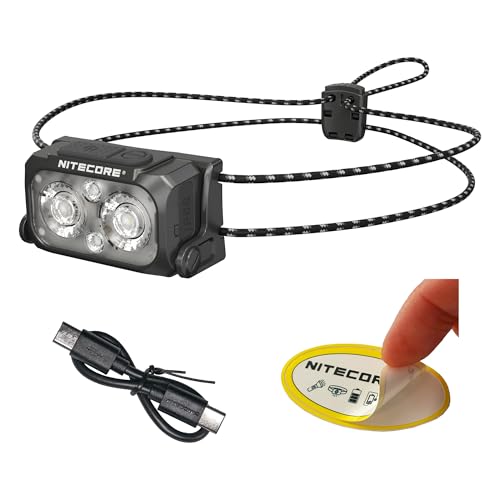
Nitecore NU25 UL
Around 45 grams with headband listed, 400 listed lumens, USB-C: the gram-counter consensus lamp.
Field check: About 45 g with its minimalist headband (listed) while still producing a listed 400 lumens, with modern USB-C charging; the rare ultralight choice that sacrifices almost nothing.
Ultralight gear usually asks a sacrifice; this lamp mostly does not. The Nitecore NU25 UL weighs about 45 g with its headband per the listed spec, less than half of what traditional lamps weigh, achieved with a minimalist shock-cord band instead of a heavy elastic strap. The number that makes it interesting is the other one: a listed 400 lumens maximum, matching our overall pick, with usable mid and low modes, a red mode, and separate flood and spot beams. On a scale and on a spreadsheet, nothing here touches its weight-to-light ratio.
The trades are real but small. The built-in battery cannot be swapped in the field, so on long dark stretches your power bank is the lifeline, and hikers who want a fallback should look at the Actik Core's hybrid design. The shock-cord headband, while lighter and less sweaty than elastic, holds less securely when you are moving fast, where the Dash 450 below is the better tool. And runtime at maximum output is modest, as it is on every lamp this size; the listed figures are burst numbers, not all-night settings. As the lamp for counted-gram kits and as a brilliant $37 backup for anyone, it is an easy recommendation.
- Max output
- 400 lumens (listed)
- Weight
- about 45 g with headband (listed)
- Power
- Built-in battery, USB-C charging
- Modes
- Flood, spot, red; multiple levels
- Price
- about $37
What we like
- Around 45 g listed, with real 400-lumen listed output
- USB-C charges from the cable you already carry
- Lowest price in the guide
- The gram-counter consensus on the long trails
Worth noting
- No field battery swap; power bank required for recovery
- Shock-cord band less secure at speed
- Modest runtime at maximum output
Who should buy it: Buy the NU25 UL if you count grams or want the best cheap second lamp in the business: thru-hikers, fastpackers, and anyone building an ultralight kit around a power bank. At about $37 it is also the smart backup light for every other hiker in this guide.
What we don't like: The built-in battery cannot be swapped in the field, so your power bank is the only recovery from empty. The minimalist shock-cord band is less secure at a run than a full strap, and like all small lamps its maximum output is a burst mode, not an all-night setting.
Bottom line: The NU25 UL is what happens when ultralight stops meaning underpowered. At a listed weight around 45 g with its shock-cord headband it simply disappears on your head, yet it still lists 400 lumens, real mode options, and USB-C charging, at the lowest price in this guide. It has become the default lamp of the gram-counting long trails, and it earned that the honest way.
04 · Best No-Bounce

BioLite Dash 450
A flat-front lamp that hugs the forehead instead of bouncing off it: built for moving fast in the dark.
Field check: BioLite's flat-front, moisture-wicking band design keeps the housing flush against the forehead, engineered specifically against bounce, with 450 lumens listed.
If you have ever run a switchback in the dark, you already know the problem this solves. A conventional headlamp is a box on a strap, and at any pace above a walk the box bounces, the beam jitters, and you end up cinching the strap headache-tight to fight it. The BioLite Dash 450 is built flat: its slim housing sits flush against the forehead inside a soft, moisture-wicking fabric band, moving the mass against your head instead of hanging it off your head. The result is a lamp you can wear at a trail-run pace without the beam pogoing, and without the vise-grip strap tension that traditional designs demand.
The spec sheet holds its own: 450 lumens listed, the second-strongest figure in this guide, with multiple modes including red, and rechargeable power in keeping with its running-gear DNA. The trades are the category's usual ones: the built-in battery means no field swap, so treat your power bank as part of the system, and the soft band, while wonderful against skin, wants a wash now and then like any piece of athletic fabric. Between our featherweight pick and this one, choose by motion: the NU25 UL wins on the scale, the Dash wins the moment you start to run.
- Max output
- 450 lumens (listed)
- Design
- Flat-front housing, moisture-wicking band
- Power
- Rechargeable
- Modes
- Multiple levels including red
- Price
- about $60
What we like
- Flat-front design genuinely kills headlamp bounce
- Comfortable soft band without vise-grip tension
- 450 lumens listed, second-strongest here
- Built for running pace, great at any pace
Worth noting
- No field battery swap
- Fabric band needs occasional washing
- Walkers pay for stability they may not need
Who should buy it: Buy the Dash 450 if your lamp gets used in motion: trail runners, dawn-patrol hikers, and big-mile walkers who finish days at a jog in the dark. It is the pick when beam stability and comfort at pace matter more than the absolute lowest weight.
What we don't like: The built-in battery rules out field swaps, so a power bank is part of the system on longer trips. The fabric band needs occasional washing like any running gear, and hikers who never move faster than a walk are paying for bounce control they will not use.
Bottom line: The Dash 450 attacks the oldest annoyance in headlamps: bounce. Traditional lamps cantilever a battery box off your forehead, and every running step turns it into a tiny hammer. BioLite's flat-front design spreads the lamp flush against the head in a soft wicking band, and the difference on a jogging descent is immediate. With 450 lumens listed, it is the mover's pick.
05 · Best Camp Lantern Add-On

Black Diamond Apollo Lantern
Not a headlamp, and that is the point: a 250-lumen (listed) rechargeable lantern that lights the whole table while the headlamp lights the trail.
Field check: Rechargeable camping lantern, 250 lumens listed · the area-light companion to every headlamp above
Every headlamp above shares one blind spot: it only lights what you are looking at. Point your face at the stove and the table goes dark; look up at a question and you strobe your whole camp. The Black Diamond Apollo is the fix for the hours when light should belong to the space instead of a forehead: a compact lantern with a listed 250 lumens of frosted, all-around glow, a dimmer to run it from full-table brightness down to a level that does not murder anyone's night vision, and fold-out legs plus a hang loop so it stands on the table or swings from the tent ceiling.
The honest notes. Two hundred fifty listed lumens is area light, not a searchlight, and anyone expecting a floodlight for a group site should look at bigger basecamp lanterns; what this is optimized for is a tent, a table, and a pack that has to carry it. It is rechargeable, which is a feature if your kit is already all USB and a drawback if you hate managing charge levels, in which case pair it with the AAA-powered Spot 400 and split the difference. And it earns zero grams of headlamp forgiveness: you still need one of the four picks above for anything that moves. But as the second light that turns a headlamp kit into a camp lighting system, from a brand that will warranty it, it is the easiest add-on in this guide.
- Max output
- 250 lumens (listed)
- Type
- Camping lantern (not a headlamp)
- Power
- Rechargeable (listed)
- Extras
- Dimmer, fold-out legs, hang loop
- Price
- about $40
What we like
- Floods the tent and camp table the way no headlamp can
- Recharges from the power bank you already carry
- Black Diamond build and warranty behind a camp accessory
- The second light that completes any kit above
Worth noting
- Not a headlamp: useless for hands-free movement
- Tent-and-table output, not a big-group floodlight
- One more battery charge level to manage
Who should buy it: Buy the Apollo if your evenings involve a camp table, a tent with company, or a family that keeps borrowing your headlamp: car campers, basecampers, and backpackers willing to carry a shared light for group trips. It slots neatly into a USB-C kit that already includes a power bank. It is an add-on to the picks above, not a replacement for any of them.
What we don't like: It is not a headlamp and cannot pretend to be one: no hands-free trail use, and it stays in the pack while you are moving. Two hundred fifty listed lumens is tent-and-table light rather than a floodlight for a big group site. And a rechargeable battery means one more charge level to manage before every trip.
Bottom line: Let us be plain: the Apollo is a lantern, not a headlamp, and it earns its slot here precisely because the two solve different problems. A headlamp is a personal beam that goes where your face points; a lantern floods the whole cook table, tent, or picnic bench so nobody is blinding anybody. With a listed 250 lumens of area light, a dimmer, fold-out legs, and a rechargeable battery for about $40, it is the second light that completes the kit, from the same company that builds our top-ranked headlamp.
More gear worth comparing
Beyond this guide: the highest-rated gear across every category and budget, with a live price check on each.




As an Amazon Associate we may earn from qualifying purchases, at no cost to you.
Quick shop: every pick
Skip the scroll — the whole lineup, with a live price check on each.
- Black Diamond Spot 400Best OverallBlack Diamond · about $50Check price →
- Petzl Actik CoreBest Hybrid PowerPetzl · about $85Check price →
- Nitecore NU25 ULBest UltralightNitecore · about $37Check price →
- BioLite Dash 450Best No-BounceBioLite · about $60Check price →
- Black Diamond Apollo LanternBest Camp Lantern Add-OnBlack Diamond · about $40Check price →
How we chose
We rank headlamps on the hours after the spec sheet stops mattering. Lumens sell lamps, but max output is a burst figure on most designs, so we weigh the whole system: how usable the mid and low modes are, since that is where ninety percent of real camp and trail time happens, how the beam balances flood for close work against spot for finding the next marker, and whether the controls can be worked with cold fingers and without memorizing a manual. Red-light modes, lockout functions that stop pocket activation, and honest water ratings all count.
Battery philosophy gets equal billing, because a dead lamp is zero lumens no matter what the box said: we classify each pick by how it recovers from an empty battery in the field, swap, top-up, or hybrid, and we treat that as a primary spec. Weights, outputs, and ratings are the manufacturers' listed figures from our PA-API-verified dataset, hedged as listed because we did not put these on a photometric bench. No brand pays for placement, and each card prints its honest weaknesses next to its strengths.
Key terms
- Lumens
- The measure of total light output a lamp produces. Useful for comparison but easily oversold: most lamps hold their maximum only briefly before stepping down for heat and battery, so mid-mode quality and runtime predict your real experience better than the box's headline number. All figures in this guide are the manufacturers' listed values.
- IPX8
- A water-resistance rating indicating the device is protected against continuous immersion per the manufacturer's test conditions. On a headlamp like the Spot 400 it means rain, splashes, and drops in puddles are simply not a concern, a meaningful step above the light splash ratings on many budget lamps.
- Hybrid power
- A lamp that accepts both a rechargeable battery and standard disposables in the same compartment, like the Petzl Actik Core with its CORE battery and AAA fallback. It pairs rechargeable running costs with the anywhere-availability of disposables, the most failure-resistant design in the category.
- Red mode
- A low-intensity red light setting that preserves your eyes' dark adaptation and avoids blinding companions. The most-used mode on many hikers' lamps for tent chores, map checks, and star watching; its absence is a red flag on any lamp sold for the backcountry.
- Lockout
- A control setting that disables the power button so the lamp cannot switch itself on while jostling in a pack. It is the cure for the classic failure of arriving at camp with a lamp that has been quietly burning in your bag all day.
- Beam pattern (flood vs. spot)
- Flood spreads light wide and close, ideal for cooking, camp chores, and anything within arm's reach; spot throws a tight beam far, for route finding and trail markers. The best hiking lamps, including every pick here, offer both rather than forcing a choice.
Questions, answered
What is the best headlamp for hiking in 2026?
Our overall pick is the Black Diamond Spot 400, at about $50. It lists 400 lumens with a genuinely useful spread of modes including red, carries an IPX8 water rating that makes weather irrelevant, and runs on three AAAs, which means a dead lamp is fixed at any gas station or from any partner's spares. Hikers who prefer recharging over swapping can buy the same lamp as the Spot 400-R with a rechargeable battery. It is the best balance of light, durability, price, and battery logistics we know of.
How many lumens do I actually need for hiking?
Fewer than the marketing suggests. Camp chores and tent life happen comfortably under 50 lumens, walking a clear trail at night is pleasant around 100 to 200, and the 300-plus range earns its keep for route finding, fast movement, and picking out markers at distance. The 400 to 650 listed lumens our picks offer is ample headroom, and maximum modes are burst settings on most lamps anyway. Prioritize good middle modes and honest runtime over the biggest number on the box.
Are rechargeable headlamps better than AAA battery ones?
They are different failure modes, not better and worse. Rechargeables cost less per hour of light and top up from the power bank you likely already carry; their weakness is a dead cell with no outlet in reach. AAA lamps cost more to feed but can be revived anywhere batteries are sold, which is nearly everywhere on earth. Weekenders with power banks do great with rechargeable; remote and long-trip hikers lean AAA or, best of all, hybrid designs like the Petzl Actik Core that accept both.
What is the best ultralight headlamp?
The Nitecore NU25 UL, at about $37. It weighs around 45 g with its shock-cord headband per the listed spec, roughly half a traditional lamp, yet still lists 400 lumens with flood, spot, and red modes, and charges by USB-C from the cable you already carry. It has become the consensus lamp of the gram-counting long trails. The honest trades are a non-swappable built-in battery and a minimalist band that is less secure at a run, where the BioLite Dash 450 takes over.
Why does my headlamp bounce when I run, and what fixes it?
Traditional headlamps hang a rigid housing and battery off the front of your head, and at running pace that cantilevered mass oscillates: the beam jitters and the strap has to be uncomfortably tight to fight it. The fix is architecture, not tension. Flat-front designs like the BioLite Dash 450 spread a slim housing flush against the forehead in a soft wicking band, so there is far less mass swinging on a lever arm. The difference is obvious within the first hundred meters of a jogging descent.
Do I really need a headlamp if I only hike during the day?
Yes, and this is one of the least negotiable items in a pack. A light source is on every version of the Ten Essentials because benighted day hikers are a rescue-report staple: a wrong turn, a slow mile, or a twisted ankle puts sunset behind you fast. A phone light is a poor substitute that drains your navigation and emergency line at the moment you need both. A small lamp like the 45-gram, $37 Nitecore NU25 UL removes the entire problem for less than the weight of a candy bar.
How do I keep my headlamp from dying in cold weather?
Cold saps batteries of every chemistry: a lamp that reads healthy at dusk can sag badly after a freezing night. The fixes are simple. Sleep with the lamp, or at least its batteries, inside your sleeping bag so they start the day warm. Carry spares warm in a pocket rather than in the pack lid. Use lockout mode so the lamp cannot drain itself in transit. And on winter trips, favor lamps with swappable batteries or hybrid power like the Actik Core, because a warm spare set is instant recovery.
Filed under Buyer's Guide
Part of Best Hiking Gear
Keep reading
The Best Satellite Communicators & PLBs (2026)
The full rescue-electronics shelf ranked: the price-dropped inReach Mini 2, the budget two-ways, and the no-subscription PLBs.
The Ten Essentials
Illumination is essential number four; here is the full safety system and why each piece earns its place.
Ultralight Backpacking 101
How a 45-gram headlamp fits the bigger project of a pack that disappears on your back.
The Best Backpacking Water Filters (2026)
The other safety-critical gear pick every hiker has to get right, ranked with the same honesty.
The Best Trekking Poles (2026)
For the descents your headlamp lights up: the poles that save your knees on the way down.