Our Pick: Kahtoola
Check price →The Best Microspikes & Winter Traction (2026)
The difference between a winter hiker and a fair-weather hiker is about $26 to $85 of steel. We ranked the five traction systems worth strapping to a boot on the ladder that actually decides the purchase: coils for sidewalks and flat packed snow, spikes for real trails and ice, and full crampons for the steep mountaineering that none of these are, with listed spike counts doing the honest talking.
By The WorldHike Gear Desk · ~13 min read · Updated 2026-07-02

Kahtoola MICROspikes
Kahtoola
The traction benchmark: 12 stainless spikes per foot listed, and the name the whole category borrowed.
Check price★ Our Top Pick
Our Pick
Kahtoola MICROspikes
The traction benchmark: 12 stainless spikes per foot listed, and the name the whole category borrowed.
Not sure yet? Compare all 5 picks below ↓
Every winter, the same quiet trade happens on trailheads across the snow belt: hikers who own traction keep hiking, and hikers who do not own it stop until April. That is the real product being sold here, months of hiking season, and it is absurdly cheap. A set of microspikes costs less than a tank and a half of gas, weighs about as much as a sandwich in your pack, and converts the icy, boot-polished trails that cause most winter falls into ordinary walking. It is also injury insurance with a better premium than any urgent-care copay: the classic winter hiking accident is not an avalanche, it is a slip on refrozen boilerplate a mile from the car.
The buying decision is one ladder with three rungs, and this whole guide climbs it. On the bottom rung, coils: the Yaktrax Pro (about $26) wraps steel coils under your boot, which bite packed snow beautifully and are the honest pick for sidewalks, snowy neighborhood miles, and flat packed trails, but coils are not spikes and glare ice will find them out. The middle rung is where real trail traction lives: actual spikes under your foot, from the Kahtoola MICROspikes (about $84), the benchmark with 12 heat-treated stainless-steel spikes per foot listed, to the lighter Kahtoola EXOspikes (about $60 at current street price) with 12 tungsten-carbide tips listed for running and mixed terrain, to Hillsound's chunkier Trail Crampon (about $85, 11 carbon-steel spikes listed with a ratchet strap) and the aggressive Trail Crampon Ultra (about $60, 18 spikes listed) for steep hardpack. The top rung, genuine mountaineering crampons for steep, technical, consequential terrain, is deliberately not in this guide, because nothing here is a crampon no matter what Hillsound's product names imply, and knowing that boundary is part of buying well.
One disclosure, up front and plainly: no brand paid for a spot in this guide, nobody placed a product, and no manufacturer saw it before publication. Some links go to Amazon; if you buy through one we may earn a small commission at no extra cost to you, and that never moves a pick up or down. Spike counts, materials, and weights below are the manufacturers' listed figures, hedged as such every time, and prices are approximate street prices at publication, so always check the live listing.
The short version
- Our pick is the Kahtoola MICROspikes (about $84): 12 heat-treated stainless-steel spikes per foot listed on an elastomer harness, the benchmark every other trail traction gets measured against.
- The traction ladder is the whole decision: coils for sidewalks and flat packed snow, spikes for real trails and ice, crampons for steep mountaineering. Buy the rung that matches your worst regular surface, and know that nothing in this guide is a crampon.
- The Kahtoola EXOspikes (about $60 at current street price) are the runner's answer: 12 tungsten-carbide tips listed in a lighter, lower-profile package that tolerates bare-ground stretches better than steel spikes.
- Hillsound's Trail Crampon (about $85, 11 spikes listed, ratchet strap) and Trail Crampon Ultra (about $60, 18 spikes listed) are the aggressive strap-ons for steep hardpack, still not mountaineering gear.
- The Yaktrax Pro (about $26) is the honest budget entry, and honesty is the point: coils grip packed snow well and glare ice poorly. If your winter includes real ice, spend up a rung.
| Traction | Best for | Bite (listed) | What you get | Approx. price |
|---|---|---|---|---|
| Kahtoola MICROspikes | Our Pick | 12 stainless spikes/foot | The trail-traction benchmark | ~$84 |
| Kahtoola EXOspikes | Best for Running & Mixed Trail | 12 tungsten-carbide tips/foot | Lighter, lower-profile, bare-ground friendly | ~$60 |
| Hillsound Trail Crampon | Best Aggressive Strap-On | 11 carbon-steel spikes/foot | Plate-and-spike build, ratchet strap | ~$85 |
| Hillsound Trail Crampon Ultra | Best for Steep Hardpack | 18 spikes/foot | Maximum bite short of a real crampon | ~$60 |
| Yaktrax Pro | Best Budget Coils | Steel coils, no spikes | Packed-snow grip at a $26 entry | ~$26 |
The 2026 winter-traction shortlist at a glance, bottom rung of the traction ladder to the top. Spike counts and materials are the manufacturers' listed figures; prices are approximate street prices at publication, verified against our dataset in July 2026.
01 · Our Pick
Our PickKahtoola MICROspikes
The traction benchmark: 12 stainless spikes per foot listed, and the name the whole category borrowed.
Field check: 12 heat-treated stainless spikes/foot (listed) · elastomer harness · the category benchmark
When a brand name becomes the category's noun, the product usually earned it. Ask at any snowy trailhead what someone is stretching over their boots and the answer is 'microspikes' whether or not Kahtoola made them, the way tissues are Kleenex. The original MICROspikes earned that with a formula the copies still chase: a tough elastomer harness that stretches over almost any boot or trail shoe in seconds, stainless chains, and real spikes where coils would merely be texture.
The 12 listed spikes per foot are the working end, heat-treated stainless steel in roughly the centimeter class of bite, spread under forefoot and heel so there are points in the ice at every phase of your stride. That geometry is the difference between spikes and coils: on the glassy, boot-polished luge run that a popular trail becomes by February, coils skate and spikes simply walk. The elastomer harness is the other half of the win, no buckles, no ratchets, no cold-finger origami, just stretch, seat, and go, and the whole set stuffs into a pocket-size lump when the trail turns bare.
- Bite (listed)
- 12 heat-treated stainless-steel spikes per foot
- Harness
- Stretch-on elastomer, no buckles
- Ladder rung
- Spikes: real trails and ice, not mountaineering
- Approx. price
- ~$84
What we like
- 12 listed stainless spikes per foot, benchmark bite on trail ice
- Elastomer harness fits boots and trail runners in seconds
- The proven original the whole category imitates
- Packs to pocket size when the trail goes bare
Worth noting
- About $84 is the premium entry to the spike rung
- Steel spikes wear faster on long bare-rock stretches
- Elastomer can shift a touch on extended sidehills
Who should buy it: Buy MICROspikes if you hike real trails in real winter: packed snowpack, refrozen ice, boot-polished popular routes, icy creek crossings. They are the right first traction purchase for almost everyone, the set that fits boots and trail runners alike, and the benchmark to return to if a cheaper experiment disappoints. One pair per hiker in the household ends the who-gets-the-spikes negotiation.
What we don't like: At about $84 they cost three of the budget coils, which stings until the first glare-ice descent. Steel spikes on long bare-rock and pavement stretches wear faster and feel clattery, exactly the case the EXOspikes below were built for, so mixed-condition hikers should read on. And elastomer harnesses, all of them, can shift slightly on long sidehill traverses, worth a mid-hike glance to reseat.
Bottom line: MICROspikes is a Kahtoola product name that became the generic word for the entire category, and that almost never happens by accident. Twelve heat-treated stainless-steel spikes per foot (listed), hung on chains under a stretch-on elastomer harness, turn boot-polished ice and refrozen snowpack back into ordinary trail. It is the set the rest of this guide is measured against, and the right default buy for winter hikers.
02 · Best for Running & Mixed Trail
Best for Running & Mixed Trail
Kahtoola EXOspikes
12 tungsten-carbide tips listed in a lighter, lower package built for moving fast over mixed ground.
Field check: 12 tungsten-carbide tips/foot (listed) · lighter, lower-profile build · the mixed-terrain specialist
The MICROspikes' one real weakness is a winter that cannot make up its mind. South-facing bare dirt, then shaded ice, then a plowed road walk, then refrozen snowpack: full-size steel spikes handle the ice beautifully and clatter grumpily through everything else, wearing as they go. The EXOspikes are Kahtoola's answer to exactly that winter, with 12 listed tips per foot made of tungsten carbide, the famously hard stuff of drill bits and studded tires, set in a lower-profile, lighter chassis that feels closer to an aggressive outsole than a set of chains.
The trade is deliberate and worth understanding. Shorter tips penetrate deep, soft, or chunky ice less than the MICROspikes' longer steel points, so on pure boilerplate the classic set still wins. In exchange, the EXOspikes run quieter and smoother on firm ground, weigh less on the foot where weight matters most, and the carbide tips keep their edge across the bare stretches that round off steel. Runners feel the difference immediately: less underfoot hardware, less stride interference, no temptation to take them off at every bare patch, which is precisely when people fall, on the one icy corner they crossed during the off phase.
- Bite (listed)
- 12 tungsten-carbide tips per foot
- Build
- Lower-profile, lighter than full spikes
- Ladder rung
- Spikes, tuned for mixed and bare-ground stretches
- Approx. price
- ~$60
What we like
- 12 listed tungsten-carbide tips hold their edge on rock and pavement
- Lighter and smoother underfoot, built for running cadence
- The right answer for patchy freeze-thaw winters
- Stays on across bare stretches instead of riding in the pack
Worth noting
- Less bite than full steel spikes on deep or glassy ice
- Not the pick for big stiff boots on sustained boilerplate
- Only about $10 cheaper than the benchmark it complements
Who should buy it: Buy the EXOspikes if you run through winter, hike fast on rolling terrain, or live where freeze-thaw keeps trails patchy: ice, dirt, pavement, and snow in the same outing. They are also the right pick for anyone who found full spikes clattery and left them home once too often, because the traction you actually wear beats the traction in the closet.
What we don't like: Lower-profile tips mean less penetration on deep, glassy, or chunky ice, where the MICROspikes' longer steel points are simply better. They are a running-adjacent design, so hikers in big stiff winter boots on sustained ice are shopping one card up or one card down from here. And about $60 is real money for the second-most-aggressive tool in a two-Kahtoola household, which is an argument some spouses will make.
Bottom line: The EXOspikes are what happens when Kahtoola designs for the hiker who runs, or the winter where the trail keeps alternating between ice, packed snow, and bare dirt. Twelve tungsten-carbide tips per foot (listed) sit lower than the MICROspikes' steel points, trading a little deep-ice bite for a smoother stride, less weight, and tips that shrug off the rock and pavement stretches that eat steel spikes. For mixed conditions, it is the smarter tool.
03 · Best Aggressive Strap-On
Best Aggressive Strap-On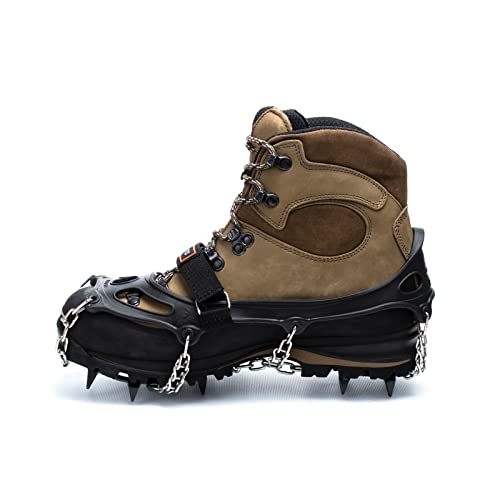
Hillsound Trail Crampon
A burlier plate-and-spike build with a ratchet strap that locks it to the boot, name notwithstanding, still not a crampon.
Field check: 11 carbon-steel spikes/foot (listed) · plate-and-spike build · ratchet strap lockdown
Somebody at Hillsound looked at the classic chain-and-elastomer design and asked what it would take to make it feel permanent. The answer on the Trail Crampon is two structural changes. First, the 11 listed carbon-steel spikes per foot mount through plate sections, which spreads load and keeps the points oriented instead of letting them roll on their chain links underfoot. Second, a ratcheting strap cinches over the midfoot like a snowboard binding, so the harness cannot creep sideways on a mile-long sidehill the way pure elastomer sometimes does. The result feels less like an accessory stretched over a boot and more like part of the boot.
That solidity has a natural constituency: heavier hikers, hikers in stiff insulated winter boots, snowshoers who spike up for the icy approach, and anyone whose local trails feature long, committing frozen descents where a shifted spike set is a genuine problem. The bill is modest but real: more hardware than the Kahtoola sets, a bit more weight and bulk in the pack, and a ratchet that takes a few more seconds with gloves than a pure stretch harness, seconds you happily spend when the payoff is zero mid-hike readjustment.
- Bite (listed)
- 11 carbon-steel spikes per foot
- Build
- Plate-and-spike with ratcheting midfoot strap
- Ladder rung
- Aggressive trail spikes, not a mountaineering crampon
- Approx. price
- ~$85
What we like
- Ratchet strap ends harness drift on long traverses
- Plate-mounted spikes keep points planted and oriented
- Confidence-inspiring under heavy hikers and big boots
- Glove-friendly to secure in real cold
Worth noting
- Heaviest and bulkiest of the spike sets here
- Top of the price ladder at about $85
- The 'crampon' name invites a dangerous misreading
Who should buy it: Buy the Trail Crampon if you are a bigger hiker, wear stiff or insulated winter boots, or log long icy descents where you want traction that locks down and stays put. It is also the right set for cold-handed hikers who prefer a glove-friendly ratchet they trust over an elastomer they have to reseat, and for snowshoers who want serious spikes for the frozen approach miles.
What we don't like: It is the heaviest, bulkiest carry of the spike rung here, and at about $85 it sits at the top of the price list too. The plate-and-ratchet build is overkill for light trail runners and gentle terrain, where the Kahtoolas disappear underfoot better. And the name will keep misleading a fraction of buyers no matter how many guides italicize the correction, so hear it once more: not a mountaineering crampon.
Bottom line: Hillsound's Trail Crampon is the spike rung built like furniture: 11 carbon-steel spikes per foot (listed) mounted through plates rather than hung purely on chains, plus a ratcheting strap over the midfoot that ends elastomer drift entirely. It is the set for heavier hikers, bigger boots, and long icy descents where you want hardware that feels bolted on. The name oversells one thing, so we will say it plainly: this is aggressive trail traction, not a mountaineering crampon.
04 · Best for Steep Hardpack
Best for Steep Hardpack
Hillsound Trail Crampon Ultra
18 spikes per foot listed: the most bite you can buy before the conversation becomes about real crampons.
Field check: 18 spikes/foot (listed) · the step-up Hillsound for steep hardpack · maximum trail bite
Spike count is not a vanity number: it is contact patch. On flat ice, a dozen points bite plenty. Tip the trail up, though, and each footstep loads fewer of them at odd angles, which is when sparser sets start to smear. The Trail Crampon Ultra attacks that with 18 listed spikes per foot distributed across the sole, so that on a steep, boot-hammered hardpack staircase there are always several points doing work no matter how your foot lands. For the fall-line descents and icy staircase trails of steep country, that redundancy is the whole product.
It shares the family's harness pragmatism, an elastomer body with strap security, and it packs down closer to the Kahtoolas than to its plate-built sibling above. The price is the pleasant surprise: at about $60 street at publication, the highest spike count in the guide undercuts both the benchmark MICROspikes and its own Trail Crampon stablemate, a rare case where the aggressive option is not also the expensive one. The honest limits remain: more points underfoot means more hardware to feel on bare-ground stretches, and steep hardpack confidence is not license to take trail spikes onto genuinely technical snow and ice.
- Bite (listed)
- 18 spikes per foot
- Role
- Steep hardpack and icy staircase trails
- Ladder rung
- Ceiling of trail spikes, still not a crampon
- Approx. price
- ~$60
What we like
- 18 listed spikes per foot, the most bite in this guide
- Points stay engaged on angled hardpack where sparser sets skate
- Undercuts the benchmark sets on street price at publication
- Packs closer to the Kahtoolas than its plate-built sibling
Worth noting
- Clattery on bare ground between the icy stretches
- Aggressive feel tempts misuse on genuinely technical terrain
- Dense spikes can ball up sticky spring snow
Who should buy it: Buy the Ultra if your winter trails are steep: fall-line descents, boot-packed staircases, icy summit cones on hiking, not mountaineering, peaks. It is the right set for hikers in steep country like the Northeast's harder winter trails, and for anyone who found a 12-spike set skating on angled hardpack and wants the most traction the rung offers.
What we don't like: Eighteen points underfoot is glorious on ice and clattery on the bare, rocky stretches between ice, so pure mixed-condition hikers may be happier on the EXOspikes. Like every set in this guide it has no front points and no business on technical terrain, and its aggressive personality makes that temptation slightly more real. And spike-dense sets collect sticky spring snowballs underfoot in warm afternoons, worth a periodic tap with a pole.
Bottom line: The Trail Crampon Ultra is Hillsound's answer for the hiker whose winter is steeper than average: 18 spikes per foot (listed), the highest count in this guide, spread to keep points engaged on angled hardpack where fewer, sparser spikes start to skate. At about $60 street at publication it is also, pleasantly, not the most expensive set here. Same disclaimer in the same bold: the ceiling of the spike rung is still not a crampon.
05 · Best Budget Coils
Best Budget Coils
Yaktrax Pro
Steel coils, not spikes, at $26: honest packed-snow grip for sidewalks and flat trails.
Field check: Steel-coil design, no spikes · ~$26 street price · the packed-snow and sidewalk specialist
Judge gear by its rung and the Yaktrax Pro is genuinely good; judge it one rung up and it fails, which is how it earns both its fans and its lawsuits of public opinion. The Pro wraps steel coils around a rubber skeleton under the whole foot, and on packed snow the physics work beautifully: the coils bite the compressible surface at dozens of small contact lines, grip in every direction, and roll quietly through the stride in a way pointy hardware never does. Over a boot on a snowy sidewalk, a plowed rail-trail, or a flat snowshoe-packed path, it is comfortable, secure, and about $26.
Then comes the boilerplate, the refrozen sheet with nothing to compress, and coils reveal what they are: texture, not penetration. A spike concentrates your weight on a point and punches into ice; a coil lies against it and hopes for friction. Every honest coil review converges on the same finding, great on snow, sketchy on hard ice, and the Pro's strap-over-the-midfoot upgrade (the reason to buy this over the basic Yaktrax) keeps the harness planted but adds no bite. Coils also lead harder lives than spikes: the failure mode is a snapped coil or a torn rubber junction after a season or two of frequent use, so inspect them each fall.
- Bite (listed)
- Steel coils, no spikes
- Harness
- Elastomer with midfoot strap
- Ladder rung
- Coils: sidewalks and flat packed snow
- Approx. price
- ~$26
What we like
- About $26, the cheapest real traction on this page
- Coils grip packed snow smoothly in all directions
- Quiet, comfortable stride on plowed and packed surfaces
- Perfect car-kit and dog-walk insurance
Worth noting
- No spikes means no real bite on glare ice
- Coils and rubber junctions wear faster than spike sets
- Chronically miscast as cheap microspikes, then blamed for it
Who should buy it: Buy the Yaktrax Pro if your winter surface is packed snow rather than glare ice: sidewalks, neighborhood loops, plowed paths, flat packed trails, and the car-kit pair for icy parking lots. It is the right $26 for walkers, commuters, and dog owners, and the wrong $26 for anyone whose trails tilt or shine.
What we don't like: Coils simply do not bite hard ice, and no strap or marketing changes that physics. Durability under frequent, heavy use trails the spike sets, with coil breakage the known long-term failure mode. And because it looks like trail traction, it keeps getting bought as trail traction, so the category's most common disappointment is really a ladder-rung mismatch, which is exactly why this guide leads with the ladder.
Bottom line: The Yaktrax Pro is the bottom rung of the traction ladder, and this review will not pretend otherwise: coils are not spikes. Steel coils wrapped under an elastomer harness grip packed snow remarkably well, walk quietly on plowed surfaces, and cost about $26, which makes them the right tool for winter dog walks, snowy neighborhood miles, and flat packed trails. On true glare ice there are no points to penetrate, and that is not a flaw to forgive, it is the spec to shop by.
More gear worth comparing
Beyond this guide: the highest-rated gear across every category and budget, with a live price check on each.




As an Amazon Associate we may earn from qualifying purchases, at no cost to you.
Quick shop: every pick
Skip the scroll — the whole lineup, with a live price check on each.
- Kahtoola MICROspikesOur PickKahtoola · ~$84Check price →
- Kahtoola EXOspikesBest for Running & Mixed TrailKahtoola · ~$60Check price →
- Hillsound Trail CramponBest Aggressive Strap-OnHillsound · ~$85Check price →
- Hillsound Trail Crampon UltraBest for Steep HardpackHillsound · ~$60Check price →
- Yaktrax ProBest Budget CoilsYaktrax · ~$26Check price →
How we chose
We judge winter traction on the ladder, because the ladder is what buyers actually get wrong. Rung one, coils: steel wrapped under the forefoot and heel, superb on packed snow, honest sidewalk-and-easy-trail gear, and outmatched on true glare ice because there is no point to penetrate it with. Rung two, spikes: real points, roughly a centimeter class of bite, joined to an elastomer harness or strap system, which is what turns icy hiking trails back into hiking trails. Rung three, crampons: rigid or semi-rigid frames with much longer points, front points included, for steep and technical snow and ice, and we say clearly that nothing in this guide occupies that rung, including the products with 'crampon' in their names. Buy for your worst regular surface, not your average one, because the worst surface is where falls happen.
Within the spike rung we weigh the numbers that are actually listed and comparable: spike count per foot, spike material (heat-treated stainless, carbon steel, tungsten carbide), harness design (elastomer versus ratchet strap), and weight. Then we sanity-check against how each system fails: elastomer harnesses can shift on mixed ground, chains wear at their links, tungsten tips trade a little ice bite for far better durability on bare rock stretches. Every figure below is the manufacturer's listed spec, hedged as such, and prices are street prices at publication. No brand has bought a placement, and the budget pick gets judged by what it honestly is, coils, not graded on a curve against spikes.
Key terms
- The traction ladder
- The three-rung framework this guide runs on: coils (steel wrapped under the boot, for sidewalks and flat packed snow), spikes (real points in the centimeter class, for trails and ice), and crampons (rigid frames with long points and front points, for steep mountaineering). Buy the rung matching your worst regular surface; nothing in this guide is rung three.
- Microspikes
- Originally Kahtoola's product name, now the generic word for chain-and-spike trail traction stretched over a boot with an elastomer harness. Real spikes distinguish them from coils; the lack of front points and rigid frames distinguishes them from crampons.
- Tungsten carbide
- The extremely hard material of the EXOspikes' listed tips, the same family used in drill bits and studded tires. It holds an edge across bare rock and pavement far longer than steel, which is why carbide-tipped traction suits mixed and patchy winters where steel spikes wear and clatter.
- Boilerplate
- Hiker slang for hard, refrozen, often boot-polished ice with nothing left to compress. It is the surface that separates the ladder's rungs: coils slide on it, spikes bite it, and steep expanses of it belong to actual crampons.
- Listed spec
- A manufacturer's published figure, which is what every spike count, material, and weight in this guide is unless stated otherwise. We hedge them as 'listed' because we report them rather than lab-verify them, and production revisions can shift details.
Questions, answered
Are microspikes worth it for winter hiking?
If you hike at all between December and April, they are among the best dollars-per-outing purchases in the sport. Roughly $60 to $85 buys months of additional hiking season and meaningful insurance against the most common winter accident, a slip on refrozen or boot-polished ice. The Kahtoola MICROspikes (12 stainless spikes per foot listed) are the benchmark buy; the honest alternative question is only which rung of the traction ladder your terrain needs, coils for flat packed snow, spikes for real trails and ice.
Kahtoola MICROspikes vs EXOspikes: which should I get?
Decide by terrain and pace. MICROspikes (about $84, 12 stainless-steel spikes listed) bite deeper and win consistently icy hiking trails, boot-polished descents, and refrozen snowpack. EXOspikes (about $60, 12 tungsten-carbide tips listed) are lighter, lower-profile, and far happier across bare dirt and pavement stretches, which makes them the pick for runners and for patchy freeze-thaw winters. Count your last ten outings: mostly white and icy means MICROspikes, mostly mixed surfaces or running means EXOspikes.
What is the difference between microspikes and crampons?
Rungs of the ladder. Microspikes are trail traction: short spikes in roughly the centimeter class on a flexible harness, made for walking on icy and snow-packed trails. Crampons are mountaineering equipment: rigid or semi-rigid frames, much longer points, and front points for kicking into steep snow and ice, used with an ice axe and self-arrest skills. Nothing in this guide is a crampon, including the Hillsound sets with 'crampon' in the name, and taking trail spikes onto steep, consequential terrain is the category's most dangerous mistake.
Do Yaktrax work on ice?
On packed snow, yes, genuinely well; on hard glare ice, no, and it is physics rather than a quality problem. The Yaktrax Pro uses steel coils, which grip by friction and texture against compressible snow but have no points to penetrate a refrozen sheet. That makes them a great $26 answer for sidewalks, dog walks, and flat packed trails, and the wrong tool for icy hiking trails, where you want actual spikes like the Kahtoola or Hillsound sets. Buy coils for coil terrain and they earn five stars; miscast them and they earn the one-star reviews you have read.
Can you wear microspikes with trail runners?
Yes, and plenty of winter hikers and runners do exactly that. Elastomer-harness sets stretch over trail runners as easily as boots; the EXOspikes are explicitly built with running in mind, and MICROspikes fit trail runners fine for hiking paces. Two caveats: size the traction to the shoe you will actually wear, since a set sized for a bulky insulated boot can run loose on a low-volume runner, and remember the shoe does not add warmth, so deep-winter outings in runners are their own separate judgment call.
How steep is too steep for microspikes?
The honest line is consequence, not angle: the moment a slip would turn into a slide you cannot stop, you have left trail-traction territory regardless of what is on your feet. Within trail terrain, more spikes help as the grade tips up, which is the Hillsound Ultra's whole argument with 18 listed spikes per foot for steep hardpack. But no set here has front points, and steep couloirs, hard open slopes, and glacier travel call for real crampons, an ice axe, and practiced self-arrest. If you are asking this question about a specific objective, that is usually the answer arriving.
How long do microspikes last?
Quality spike sets commonly serve for years of regular winter use; the wear points are the spikes themselves, which shorten with miles on rock and pavement, the chain links, and eventually the elastomer harness in cold-cracking or stretch. Tungsten-carbide tips like the EXOspikes' listed tips hold their edge on abrasive surfaces far longer than steel. Habits that stretch lifespan: take them off for long bare stretches, rinse road salt after urban use, dry them before storage, and inspect elastomer and links each fall. Coil designs like Yaktrax generally lead shorter working lives under heavy use, with coil breakage the known failure mode.
Should I get traction devices or snowshoes?
They solve different snow. Traction devices handle the hard problem: packed, refrozen, icy surfaces where flotation is unnecessary and grip is everything, which describes most established winter trails. Snowshoes handle the soft problem: deep, unconsolidated snow where you sink without flotation. Many winter hikers carry spikes on every outing and add snowshoes only after fresh storms or off the beaten pack; on popular trails that consolidate within days, spikes alone cover most of the season. If you must buy one first, buy the spikes, they cost a third as much and earn use ten times as often.
Filed under Buyer's Guide
Keep reading
The Ten Essentials, Explained
The safety system that backs up your traction: the ten categories every winter pack must cover.
The Best Hiking Boots (2026)
The boots your spikes stretch over: our full ranking, benchmark to budget.
The Best Headlamps (2026)
Winter days are short and ice hides in shadow: the lights we trust after dusk.
The Best Backpacking Packs (2026)
Where the spikes ride between icy stretches: haulers with the pockets and patience for winter kit.
The Best Hikes in the World
The trails all this traction points toward, in every season worth hiking them.