Our Pick: BearVault
Check price →Bear Bag vs Bear Canister: Which Should You Carry?
A hard canister weighs 2 lb 1 oz to 2 lb 9 oz and is required in Yosemite, SEKI, the Adirondack High Peaks, and much of the JMT. A Kevlar Ursack weighs about 7.6 oz and is accepted in most of the rest of the country. A PCT-hang bag weighs 2 oz and works where trees and skill allow. The permit decides first; the weight math decides second.
By The WorldHike Gear Desk · ~12 min read · Updated 2026-08-23

BearVault BV500 Journey
BearVault
700 cu in, 2 lb 9 oz, IGBC-certified, tool-free lid. The canister the Sierra runs on.
Check price★ Our Top Pick
Canister zones, 5+ nights
BearVault BV500 Journey
700 cu in, 2 lb 9 oz, IGBC-certified, tool-free lid. The canister the Sierra runs on.
Not sure yet? Compare all 4 picks below ↓
Short answer: if your permit zone requires a hard-sided canister, carry the BearVault BV500 (about $100, 2 lb 9 oz listed, 700 cu in) for trips of five nights or more and the BV450 (about $90, 2 lb 1 oz, 440 cu in) for weekends, and stop reading the weight comparisons, because a Kevlar sack is not compliant there and rangers check. If your zone accepts IGBC-certified soft containers, the Ursack Major (about $165, about 7.6 oz per Ursack, 10.65 L listed) saves roughly 2 lb over the BV500 and ties to a tree instead of sitting on the ground. If your zone requires only that food be stored away from bears and you camp where trees allow a proper hang, an 8 L dry bag (about $30, about 2 oz) on a PCT hang is the lightest legal answer and the one that fails most often in practice.
The order of operations matters. Bear storage is regulated by the land manager, not by preference, and the rules are specific to the unit: Yosemite, Sequoia-Kings Canyon, Rocky Mountain's backcountry, the Adirondack High Peaks Wilderness, Olympic's coast, parts of the Sierra on the JMT and PCT, and a growing list of others require an approved hard canister in some or all of their backcountry. Many national forests and the Appalachian Trail outside a few hot spots accept an Ursack or a hang. The only reliable source is the current rule for your exact permit; the list below is a starting point, and it is dated. Check before the trailhead, because a ranger's opinion of your Ursack is the only one that counts.
Disclosure: no brand paid for a place here. Links go to Amazon, where we earn a commission if you buy. It does not change the advice.
The short version
- Canister required (verify current rules): Yosemite wilderness, Sequoia-Kings Canyon, most of the JMT corridor, Adirondack High Peaks (May to November), Rocky Mountain NP backcountry, Olympic coast and some Olympic zones, Denali, and a growing list of Sierra and Cascades units. Ursack is not accepted in most of these.
- Ursack accepted (verify): much of the national forest system, Glacier (with conditions), most of the Appalachian Trail outside local hot spots, Grand Teton backcountry for the Ursack AllMitey in some zones. Rules differ by unit and year.
- Weight: BV500 2 lb 9 oz, BV450 2 lb 1 oz, Ursack Major about 7.6 oz per Ursack, dry-bag hang about 2 oz plus 50 ft of cord (about 2 oz). Canister to Ursack saves about 1.5 to 2 lb; Ursack to hang saves about 4 oz.
- Capacity: BV500 700 cu in (11.5 L), about 6 to 7 days for one; BV450 440 cu in (7.2 L), about 3 to 4 days; Ursack Major 650 cu in (10.65 L listed), about 5 to 6 days; an 8 L dry bag about 4 days.
- What each protects against: a canister resists bears, rodents, and ravens and needs no tree. An Ursack resists bears when tied correctly; rodents can chew it unless you add a liner, and a bear can crush the contents. A hang protects only as well as the hang, and most hangs are bad.
- The BV500 doubles as a camp stool and the Ursack doubles as a pillow. Neither is a reason to buy one.
| Option | Listed weight | Capacity | Days (1 person) | Needs a tree | Where accepted | Price (Aug 2026) |
|---|---|---|---|---|---|---|
| BearVault BV500 Journey | 2 lb 9 oz | 700 cu in (11.5 L) | 6 to 7 | No | Everywhere canisters are required or allowed | about $100 |
| BearVault BV450 Jaunt | 2 lb 1 oz | 440 cu in (7.2 L) | 3 to 4 | No | Everywhere canisters are required or allowed | about $90 |
| Ursack Major | about 7.6 oz (Ursack) | 650 cu in (10.65 L listed) | 5 to 6 | Yes, to tie off | IGBC-certified; not accepted where hard canisters are required | about $165 |
| 8 L dry bag + PCT hang | about 2 oz bag + cord | 8 L | about 4 | Yes, a good one | Only where a hang is legal; never where containers are required | about $30 |
Makers' listed figures, August 2026. Regulatory acceptance is summarized from land-manager rules current at time of writing and changes yearly; verify with your permit zone. Prices are live Amazon figures at time of writing.
01 · Canister zones, 5+ nights
Our Pick Where RequiredBearVault BV500 Journey
700 cu in, 2 lb 9 oz, IGBC-certified, tool-free lid. The canister the Sierra runs on.
Field check: Listed 2 lb 9 oz · 700 cu in (11.5 L) · 8.7 x 12.7 in · IGBC certified · tool-free lid
The canister is not a choice in canister zones; the model is. The BV500 is the default because it does the three things that matter: it holds enough (700 cu in, about 6 to 7 days for one person at normal food density, 4 to 5 for a hungry one), it opens without a coin or a screwdriver in the cold, and it is on every approved-container list we checked. The clear walls mean you are not unpacking the whole thing to find the coffee. Listed 2 lb 9 oz, 8.7 in diameter, 12.7 in tall.
Packing it: the BV500 rides best upright in the center of the pack with soft goods around it, and at 8.7 in diameter it fits most 50 L-plus packs; it is a squeeze in narrow ultralight packs. For weekends in the same zones, the BV450 saves 8 oz and 4.4 in of height.
- Listed weight
- 2 lb 9 oz
- Capacity
- 700 cu in (11.5 L)
- Dimensions
- 8.7 x 12.7 in
- Days
- About 6 to 7 for one person
- Certification
- IGBC; approved in every canister-required zone we checked
- Lid
- Tool-free, transparent polycarbonate
- Price
- about $100
What we like
- Approved everywhere canisters are required
- 700 cu in: about a week for one
- Tool-free lid, see-through walls
- Doubles as a camp stool
Worth noting
- 2 lb 9 oz
- Bulky in narrow packs
- Lid threads stiffen in cold
Who should buy it: Buy the BV500 if your permit zone requires a hard canister and your trips run five nights or more, if you resupply every week on the JMT or PCT Sierra, or if you want one canister that covers every trip. It is the default.
What we don't like: 2 lb 9 oz is the weight of a small tent. 8.7 in diameter is awkward in narrow packs. Polycarbonate scuffs and the lid threads can be stiff when cold. It is expensive only relative to a dry bag; relative to an Ursack it is the cheaper option by $65.
Bottom line: Where a hard canister is required, the BV500 is the one to carry for trips of five nights or more. 700 cu in holds about a week of food for one hiker, the transparent polycarbonate lets you see what is left, the lid opens without a tool, and it is approved everywhere hard canisters are required. At 2 lb 9 oz it is the weight you are carrying because the rules say so, and it is also a camp stool.
02 · Canister zones, weekends
Weekend Canister
BearVault BV450 Jaunt
The same canister, 440 cu in and 2 lb 1 oz, for the three-night trips that do not need the big one.
Field check: Listed 2 lb 1 oz · 440 cu in (7.2 L) · 8.7 x 8.3 in · IGBC certified
Size the canister to your usual trip, not your longest one. The BV450 holds 440 cu in, which is two to three days of real food for one person or an overnight for two, at a listed 2 lb 1 oz, 8 oz under the BV500. It is 8.3 in tall against 12.7, which is the difference between a canister that sits flat in the middle of a 40 L pack and one that wants a 55. Same IGBC certification, same approvals, same see-through polycarbonate and tool-free lid.
For a pair, two BV450s (4 lb 2 oz total) carry more than one BV500 (2 lb 9 oz) and let each person carry their own, which is how groups in canister zones usually solve it. Either way, the BV500 is the one-canister answer and the BV450 is the weekend answer.
- Listed weight
- 2 lb 1 oz
- Capacity
- 440 cu in (7.2 L)
- Dimensions
- 8.7 x 8.3 in
- Days
- About 3 to 4 for one person, repackaged
- Certification
- IGBC; approved where hard canisters are required
- Lid
- Tool-free, transparent polycarbonate
- Price
- about $90
What we like
- 8 oz and 4.4 in shorter than the BV500
- Fits flat in a 40 L pack
- Same approvals and tool-free lid
- Right size for weekends
Worth noting
- Two days of food if you do not repackage
- Only $10 cheaper than the BV500
- Still over 2 lb
Who should buy it: Buy the BV450 if your canister-zone trips are two to three nights, if your pack is under 50 L, or if two people each want their own can. It is the right size for most weekend Sierra and Adirondack trips.
What we don't like: Still 2 lb 1 oz. Two to three days of real food unless you repackage carefully. Same stiff-in-cold lid threads. Only $10 less than the BV500 for 260 fewer cu in.
Bottom line: The BV450 is the BV500 cut to weekend size: 440 cu in, about 3 to 4 days for one person, 2 lb 1 oz listed, 8.7 in diameter and 8.3 in tall, same tool-free lid, same approvals. It saves 8 oz and a pack's worth of height for $10 less. If most of your canister-zone trips are two or three nights, this is the one to own; if you do one long trip a year, buy the BV500 and carry the extra volume on weekends.
03 · Ursack-accepted zones: 2 lb lighter
Our Pick Where Allowed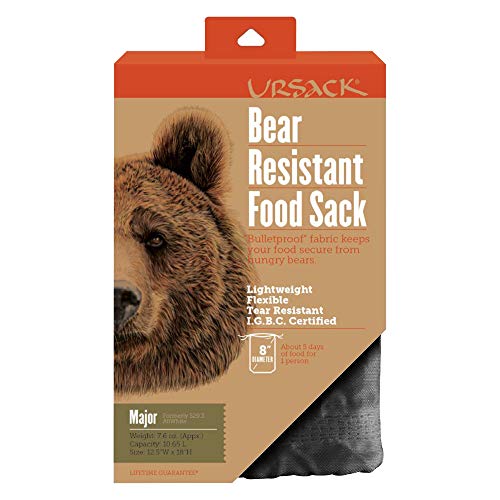
Ursack Major
An IGBC-certified Kevlar-type sack at about 7.6 oz that ties to a tree and saves about 2 lb over a canister.
Field check: About 7.6 oz (Ursack) · 650 cu in / 10.65 L (listed) · IGBC certified · ties to a tree, no hang
The Ursack is what you carry when the rules let you. The Ursack Major is a sack of bear-resistant UHMWPE fabric with a 650 cu in, 10.65 L listed capacity, about 5 to 6 days of food for one, at a weight Ursack lists at about 7.6 oz. You fill it, close it with the supplied cord using the knot Ursack specifies, and tie it to a tree trunk or a sturdy root at about chest height. No throwing, no branch, no counterbalance. It passed the IGBC's captive-grizzly test, which is the same certification the canisters carry.
Against a PCT hang, the Ursack is about 4 oz heavier and roughly $135 more, and it works every night in every camp, including above tree line, in scrub, and in the dark. Most hangs do not. That is the case for it: a container that is as light as a hang and as reliable as a canister, in the places that accept it. At about $165 it is the most expensive option here and it is priced like the specialized fabric it is made of.
- Listed weight
- about 7.6 oz (Ursack spec)
- Capacity
- 650 cu in (10.65 L listed)
- Dimensions
- 14 x 8 in (listed)
- Days
- About 5 to 6 for one person
- Certification
- IGBC certified bear-resistant
- Use
- Tie to tree trunk or root with supplied cord; no hang required
- Price
- about $165
What we like
- About 2 lb lighter than the BV500
- Ties off anywhere; works above tree line
- IGBC certified
- Packs flat when empty
Worth noting
- Not legal where hard canisters are required
- Contents can be crushed
- Rodents need the optional liner
Who should buy it: Buy the Ursack Major if your trips are in zones that accept IGBC-certified soft containers (most national forests, much of the Appalachian Trail, and others; verify), if you camp above tree line or in forest too dense to hang, or if 2 lb matters and the permit allows it.
What we don't like: Not accepted where hard canisters are required, which covers the most famous bear country in the Sierra and the Adirondacks. A bear can crush the contents. Rodents can chew through without the liner. About $165, the priciest option here, and about 4 oz more than a hang.
Bottom line: Where it is accepted, the Ursack Major is the right answer and the weight saving is enormous: about 7.6 oz per Ursack against the BV500's 2 lb 9 oz for nearly the same capacity. It is a bear-resistant fabric sack, IGBC certified, that you tie to a tree trunk with the supplied cord rather than hang, so it works above tree line with a rock and in dense forest where a proper hang is impossible. It costs about $165, a bear can crush what is inside, and rodents can chew it without a liner. And it is not legal where hard canisters are required.
04 · PCT hang where legal
Hang Bag
Sea to Summit Ultra-Sil Dry Bag, 8 L
The 8 L food bag for a PCT hang: about 2 oz, waterproof, and only as good as the hang.
Field check: 8 L · about 2 oz (listed 30D siliconized nylon) · roll-top · the bag half of a PCT hang
The bag is the easy part of a hang; the branch is the hard part. An 8 L Ultra-Sil dry bag holds about four days of food for one, weighs about 2 oz, and rolls closed waterproof. Add 50 ft of 2 mm cord, a small carabiner, and a rock sack, and you have a PCT hang kit at about 4 oz and about $40. Done properly, the bag hangs 12 ft off the ground, 5 ft from the trunk, and 5 ft below the branch, with the cord tied off with a stick at the carabiner rather than to the trunk, so a bear that pulls the cord gets nothing.
Against the Ursack, the hang saves about 4 oz and $130 and costs you 20 minutes at dusk and a reliance on trees. If your camps are mostly forested and the rules allow it, that is a fair trade for a weekend. If you camp above tree line, arrive in the dark, or hike where bears are habituated, buy the Ursack and stop throwing rocks at branches.
- Capacity
- 8 L (about 4 days for one)
- Listed weight
- about 2 oz (30D siliconized nylon, roll-top)
- Hang kit
- Add 50 ft 2 mm cord, carabiner, rock sack (about 2 oz)
- Where legal
- Only where hangs are allowed; never where containers are required
- Price
- about $30
What we like
- About 2 oz; the lightest option
- About $30
- Waterproof; doubles as the organizer bag inside a canister
- Fine where trees and rules allow
Worth noting
- Protects nothing without a good hang
- Most camps lack the right branch
- Illegal in container-required zones
Who should buy it: Buy the 8 L dry bag as a hang bag if your zone allows hangs, your camps have real trees, and you have practiced a PCT hang. It is also the food-organizing bag to use inside an Ursack or canister.
What we don't like: It resists nothing; the hang does all the work, and most hangs fail. Needs a branch 15 ft up that alpine forest rarely offers. Not legal where containers are required. Cord and carabiner sold separately.
Bottom line: A PCT hang is the lightest legal food storage in the zones that allow it, and this is the bag for it: an 8 L roll-top dry bag at about 2 oz and $30, plus 50 ft of cord and a small carabiner you supply. It keeps food dry and smell-contained enough to hang. What it does not do is resist a bear; the hang does that, and the hang depends on a branch 15 ft up and 5 ft out that most camps do not have. Where the trees cooperate and the rules allow, this is the answer. Everywhere else, it is not.
More gear worth comparing
Beyond this guide: the highest-rated gear across every category and budget, with a live price check on each.




As an Amazon Associate we may earn from qualifying purchases, at no cost to you.
Quick shop: every pick
Skip the scroll — the whole lineup, with a live price check on each.
- BearVault BV500 JourneyCanister zones, 5+ nightsBearVault · about $100Check price →
- BearVault BV450 JauntCanister zones, weekendsBearVault · about $90Check price →
- Ursack MajorUrsack-accepted zones: 2 lb lighterUrsack · about $165Check price →
- Sea to Summit Ultra-Sil Dry Bag, 8 LPCT hang where legalSea to Summit · about $30Check price →
How we chose
What we did: we read the current backcountry food-storage rules for the units hikers ask about most (Yosemite, SEKI, the JMT, the Adirondack High Peaks, Rocky Mountain, Olympic, Glacier, Grand Teton, and the Appalachian Trail corridor), pulled each product's listed weight and capacity from the makers and the live Amazon listings (re-verified August 23, 2026), and built the decision around the question that actually comes first: what does the permit require. The day-count estimates assume about 100 to 120 cu in of food per person per day, which is the usual working figure.
What we did not do: we did not test any container against a bear, and no one outside the IGBC does. We did not weigh the products. Regulations change every season; treat every acceptance claim here as a prompt to verify, not as permission.
Key terms
- IGBC certification
- The Interagency Grizzly Bear Committee's bear-resistant products test, a captive-grizzly trial that both hard canisters and the Ursack pass. Certification is not the same as acceptance: some land managers require hard-sided containers regardless of it.
- Hard-sided canister
- A rigid bear-resistant container such as the BearVault BV500 or BV450. Required in Yosemite, SEKI, the Adirondack High Peaks, and other units; works without a tree.
- Ursack
- A bear-resistant fabric sack tied to a tree trunk rather than hung. IGBC certified, about 7.6 oz, accepted in many national forests and on most of the AT, not accepted where hard canisters are required.
- PCT hang
- A counterbalance-free food hang: cord over a branch, bag clipped to a carabiner on the cord, hauled up, then a stick clove-hitched through the carabiner so the bag hangs free with no cord tied to the trunk. Requires a branch about 15 ft up and 5 ft out.
Questions, answered
Is a bear bag or a bear canister better?
The permit decides. Where a hard canister is required (Yosemite, SEKI, the Adirondack High Peaks, most of the JMT, and more), a canister is the only legal option. Where IGBC soft containers are accepted, an Ursack Major saves about 2 lb over a BV500 and works without a branch. A hang is lightest but fails most often.
Is the Ursack allowed in Yosemite?
Not as of this writing. Yosemite requires an approved hard-sided canister in its wilderness and does not accept the Ursack despite its IGBC certification. Sequoia-Kings Canyon and the Adirondack High Peaks take the same position. Verify the current rule before your trip.
How much lighter is an Ursack than a bear canister?
About 2 lb. Ursack lists the Major at about 7.6 oz; BearVault lists the BV500 at 2 lb 9 oz and the BV450 at 2 lb 1 oz. The Ursack's capacity (650 cu in listed) sits between the two canisters.
Do I need a bear canister on the Appalachian Trail?
Generally no, outside a few local areas that require them; verify current rules for the sections you plan. Most of the AT accepts hangs and Ursacks, and many shelters have bear cables or boxes. Where cables exist, use them.
Do I need a bear canister on the John Muir Trail?
Yes, for most of it. The JMT runs through Yosemite, SEKI, and Inyo and Sierra National Forest canister zones, and an approved hard-sided canister is required through nearly the whole corridor. The BV500 holds about a week, which matches the usual resupply spacing.
Can a bear break an Ursack?
The fabric passed the IGBC captive-grizzly test, so a bear is unlikely to open it, but a bear can crush, chew, and slobber on the contents. Use a liner bag inside, tie it to a trunk with the specified knot, and expect a damaged meal rather than a lost one if a bear finds it.
What size bear canister do I need?
Plan about 100 to 120 cu in per person per day with repackaged food. The BV450 (440 cu in) covers 3 to 4 days; the BV500 (700 cu in) covers 6 to 7. Pack the first day's food outside the canister to gain a day.
Filed under Explainer
Part of Gear Comparisons
Keep reading
The Best Bear Canisters (2026)
The full canister guide: BV500, BV475, BV450, and the bear spray question.
Best Bear Spray (2026)
Food storage protects the camp; spray protects the encounter. Range, spray time, and which can to carry.
The Best Backpacking Packs (2026)
A BV500 wants a pack with room for an 8.7 in cylinder. Ranked picks.
Leave No Trace and the Ten Essentials
The systems every pack should carry, bear country or not.