Our Pick: Anker
Check price →The Best Travel Tech Accessories (2026)
Ninety percent of travel tech misery comes from five failures: dead devices, wrong plugs, lost bags, tangled cables, and seatback screens your headphones cannot hear. Each has a small, cheap, permanent fix. We ranked the six accessories that solve all five, from a $13 pair of spare cables to the 65W listed GaN brick that retires your laptop charger.
By The WorldHike Gear Desk · ~14 min read · Updated 2026-08-03
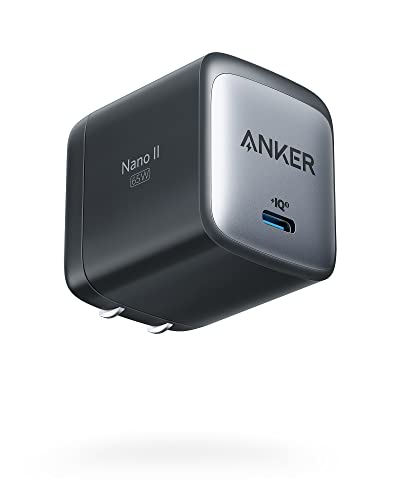
Anker Nano II 65W
Anker
65 listed watts of GaN from a pocket brick: the one charger that replaces the pile.
Check price★ Our Top Pick
Best Power Pick
Anker Nano II 65W
65 listed watts of GaN from a pocket brick: the one charger that replaces the pile.
Not sure yet? Compare all 6 picks below ↓
Travel tech misery is remarkably unoriginal. Across a million trips it is the same five failures on repeat: the phone that dies mid-navigation in a city you cannot read, the wall socket shaped like nothing you own, the checked bag that went to the wrong continent, the pouch-of-shame cable tangle at the bottom of your pack, and the seatback movie playing silently at your wired-headphone-less ears. That is the whole taxonomy. Five failures, and every one of them has a small, cheap, one-time fix that then works for every trip you take for the rest of your life. This guide is those five fixes, plus the spare that keeps the whole system honest.
The teaching spine of the category is watts and plugs, because power is where most travelers over-pack and under-solve. The old way was a charger per device: the laptop brick, the phone cube, the tablet's orphan. The new way is one small gallium nitride (GaN) charger, and the Anker Nano II 65W is the pick: 65 watts listed is laptop territory, which means the one pocket-sized brick charges the laptop, the phone, and everything else with a USB-C port, one at a time from one socket. The brick solves the watts; the EPICKA universal adapter (about $20) solves the wall, translating your plug to the sockets of most of the world with a USB hub thrown in. Around that power core, the rest of the kit: Apple AirTags in a 4-pack (about $89) so every bag reports its own location, the Twelve South AirFly Pro (about $55) to pipe seatback audio into your wireless earbuds, the BAGSMART organizer (about $15) so every cable has an address, and a $13 two-pack of Anker USB-C cables because the system's weakest link should never be the one you have no spare of.
One disclosure, up front and plainly: no brand paid for a spot in this guide, nobody placed a product, and no manufacturer saw it before publication. Some links go to Amazon; if you buy through one we may earn a small commission at no extra cost to you, and that never moves a pick up or down. Wattages and capabilities below are the manufacturers' listed figures, hedged as such every time, and prices are approximate street prices at publication, so always check the live listing.
The short version
- Our power pick is the Anker Nano II 65W (about $30): 65 listed watts is laptop-class from a brick the size of the old phone cube, so one charger replaces your whole pile.
- The EPICKA universal adapter (about $20) solves the wall: one gadget covers the plug shapes of most of the world, with a listed USB hub for the family's devices. It translates plugs, it does not convert voltage.
- The Apple AirTag 4-pack (about $89) is the lost-bag answer: one per bag, and 'the airline lost it' becomes 'it is at Terminal 4, here is the map.'
- The AirFly Pro (about $55) is the cult item that earns it: seatback screens finally play through your wireless earbuds, which is the difference between a movie and a mime show on a long-haul.
- The system is watts plus plugs plus spares: 65W GaN brick for the devices, universal adapter for the wall, $13 spare cables because the cheapest item is the one whose absence strands everything else.
| Item | The misery it fixes | Listed capability | What you get | Approx. price |
|---|---|---|---|---|
| Anker Nano II 65W | Dead devices | 65W listed, GaN | One brick replaces the charger pile | ~$30 |
| EPICKA Universal Adapter | Wrong plugs | All-region plug + USB hub | Your plug, translated to most of the world | ~$20 |
| Apple AirTag (4-Pack) | Lost bags | 4 trackers listed | Every bag reports its own location | ~$89 |
| Twelve South AirFly Pro | Silent seatback screens | Bluetooth transmitter | Seatback audio in your wireless earbuds | ~$55 |
| BAGSMART Organizer | Tangled cables | Electronics organizer | Every cable and charger gets an address | ~$15 |
| Anker USB-C Cable (2-Pack) | The single point of failure | 2 cables listed | The spare that keeps the system honest | ~$13 |
The 2026 travel-tech kit at a glance, one fix per misery. Wattages and capabilities are the manufacturers' listed figures; prices are approximate street prices at publication, verified against our dataset in July 2026.
01 · Best Power Pick
Our PickAnker Nano II 65W
65 listed watts of GaN from a pocket brick: the one charger that replaces the pile.
Field check: 65W listed · GaN (gallium nitride) design · laptop-class output at phone-cube size
Every gear category has one number that changed it. For travel chargers, the number is the wattage that fits in your pocket. The Anker Nano II 65W uses gallium nitride, the semiconductor tech that runs cooler and switches faster than old silicon, to put a laptop-class 65 listed watts into a housing closer to a phone cube than a laptop brick. That single spec collapses your charging kit: the laptop charger, the phone charger, and the tablet's orphan cube all become one object, because 65 listed watts covers the hungriest device you carry and everything below it follows.
The travel logic compounds in ways the spec sheet undersells. One brick means one wall socket, which matters enormously in hostels, airports, and old European hotel rooms where sockets are rationed like amenities. One brick plus the universal adapter below means your entire power infrastructure occupies one pocket of the organizer. The honest trade of a single-port strategy: one device charges at a time, so the laptop charges over dinner and the phone overnight. Travelers who must charge everything simultaneously should add a second brick, not a bigger one.
- Listed output
- 65W
- Technology
- GaN (gallium nitride)
- Strategy
- One brick replaces laptop + phone + tablet chargers
- Approx. price
- ~$30
What we like
- 65 listed watts: laptop-class from a pocketable brick
- Replaces the entire charger pile with one object
- One socket powers your whole kit, in sequence
- About $30 for the best consolidation buy in travel
Worth noting
- Single port: one device charges at a time
- Runs warm under full listed load, as compact GaN does
- USB-C only: your legacy cables are on their own
Who should buy it: Buy the Nano II 65W if you travel with a USB-C laptop, a tablet, or simply a pile of chargers you are tired of: it is the consolidation play. It is also the right first GaN brick for anyone rebuilding their kit around USB-C, which in 2026 is everyone eventually.
What we don't like: One port means one device at a time, and the couples-with-four-devices crowd will want a second brick or a multi-port GaN unit instead. At full listed load it runs warm, which is normal for compact GaN and still surprises people. And it does nothing for your last micro-USB stragglers; this is a USB-C-era purchase.
Bottom line: The Nano II 65W is the whole argument for GaN in one object: 65 listed watts, enough to charge a USB-C laptop at real speed, from a brick that disappears into a pocket where the old laptop charger needed its own bag corner. It charges the laptop, then the phone, then the earbuds, all from one socket, which on the road means one adapter, one wall hunt, one thing to forget instead of three. At about $30 it is the best watts-per-dollar-per-cubic-inch buy in travel.
02 · The Wall Solver

EPICKA Universal Travel Adapter
One gadget that fits the wall sockets of most of the world, with a USB hub thrown in.
Field check: All-region plug design listed · built-in USB hub · ~$20 street price
The wall is the one piece of infrastructure you cannot pack, so you pack its translator. The EPICKA adapter is the whole world's socket problem in one chunky cube: sliders deploy the listed plug shapes that cover most of the countries you will ever land in, and your own gear plugs into the universal face on the back. The built-in USB hub is the sleeper feature, turning a single hotel socket, and hotel sockets are always singular, into charging for phones, watches, and earbuds simultaneously while the main outlet feeds your GaN brick.
Now the sentence that prevents the most fried gear, so we will say it plainly: an adapter changes plug shape, not voltage. The good news is that nearly everything a modern traveler carries, phone chargers, laptop bricks, camera chargers, is built dual-voltage and says so on its label, so shape is genuinely the only translation needed. The things that die abroad are single-voltage heating appliances, hair dryers and straighteners above all, and no $20 cube saves them. Check the label once at home: if it reads 100-240V, and your chargers almost certainly do, the EPICKA is all you need.
- Coverage
- All-region plug shapes, listed
- Bonus feature
- Built-in USB hub for small devices
- What it does not do
- Voltage conversion: plug shape only
- Approx. price
- ~$20
What we like
- One gadget covers most of the world's sockets
- USB hub multiplies one hotel socket into a family's charging
- Teams with a GaN brick into a complete power kit
- About $20 for permanent international readiness
Worth noting
- Bulky on the wall; can sag in worn recessed sockets
- Does not convert voltage: heating appliances stay home
- Sliding mechanisms reward gentle handling
Who should buy it: Buy the EPICKA if you ever leave your home plug region, which makes it the single most universal item in this guide. It earns permanent status in the travel organizer of international travelers, and the USB hub makes it the family-trip MVP where one wall socket must charge four people's devices.
What we don't like: It is a chunky object hanging off a wall socket, and in worn or recessed sockets that leverage can sag. It translates plugs, never voltage, so single-voltage appliances are still on their own. And like all all-region adapters it is a mechanical gadget with sliding parts; treat the sliders gently and it lasts, force them and it will not.
Bottom line: The EPICKA is the standing answer to the second-most-common travel tech disaster: arriving somewhere your plugs do not fit. Its listed all-region design slides out the right prongs for most of the world's socket shapes, and its built-in USB hub quietly multiplies one foreign wall socket into charging for the whole family's small devices. It translates plug shapes only, not voltage, and we spell out below why for modern electronics that is exactly enough.
03 · The Lost-Bag Answer
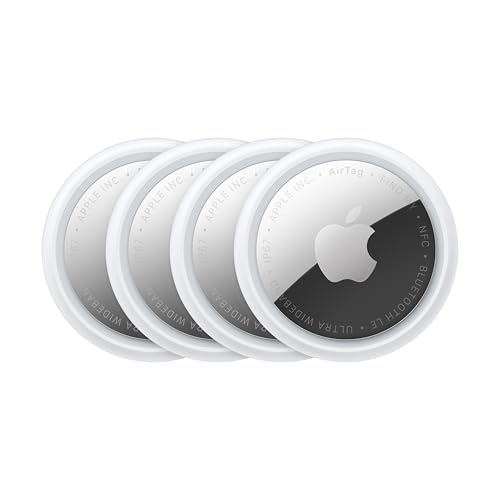
Apple AirTag (4-Pack)
One per bag, and lost luggage stops being a mystery and becomes a map pin.
Field check: 4 trackers listed per pack · Find My network coverage · one-per-bag doctrine
The worst part of a lost bag was never the loss. It was the not knowing. An AirTag ends the not knowing: the coin-sized tracker reports its location through Apple's Find My network, which crowdsources position from the iPhones that pass near it, and an airport is the single densest iPhone habitat on earth. Your checked bag pings its way through the system, and when it fails to appear you are no longer a supplicant at the lost-luggage desk; you are a person pointing at a map saying it is in Terminal 4, and travelers have been repeating that exact story since the week these launched.
The 4-pack matters because half-measures fail here. The bag that goes missing is always the one you did not tag, so the doctrine is total coverage: checked bag, carry-on, daypack, camera bag. At about $89 for four, tagging your whole fleet costs about what a single checked-bag round trip does, runs for a long time on cheap replaceable coin batteries, and transfers to every trip you take afterward. The honest limits: AirTags live on iPhone density, spectacular in airports and cities, sparse in the true backcountry, and Android travelers should buy the equivalent tracker for their own ecosystem rather than this one.
- Listed pack
- 4 trackers
- Network
- Apple Find My (crowdsourced)
- Doctrine
- One per bag, every bag, every trip
- Approx. price
- ~$89
What we like
- Turns lost luggage into a live map pin
- 4-pack covers your whole bag fleet at once
- Airports are the densest coverage on earth
- Cheap replaceable batteries, transfers to every future trip
Worth noting
- iPhone ecosystem only
- Crowdsourced coverage thins in the backcountry
- Information, not prevention: the bag still has to be fetched
Who should buy it: Buy the 4-pack if you check luggage even occasionally and live in the Apple ecosystem: one per bag, forever, is the whole strategy. It is also the right buy for families and gear-heavy travelers, hikers with duffels of kit included, for whom any single lost bag is a trip-altering event.
What we don't like: It requires an iPhone to be useful; Android travelers need a different ecosystem's tracker. Coverage is crowdsourced, so remote trailheads report far less faithfully than airports. It reports location rather than preventing loss, and about $89 for the pack is real money, even if per-bag per-year it rounds to nothing.
Bottom line: The AirTag did not make airlines better at handling luggage; it made their failures visible, which turns out to be most of the battle. Drop one in each bag and 'we are locating your luggage' becomes a map pin you can show the desk agent: still at your origin, sitting at the transfer airport, or riding the correct carousel one terminal over. The 4-pack at about $89 is the right unit of purchase because the doctrine is one per bag, every bag, every trip.
04 · The Flight Unlock

Twelve South AirFly Pro
The dongle that lets your wireless earbuds hear the seatback screen: a cult item that earns the cult.
Field check: Bluetooth transmitter for wired jacks · the seatback-screen unlock · ~$55 street price
Somewhere in the wireless revolution, airplanes did not get the memo. Your earbuds lost their wires years ago, but the seatback entertainment system still speaks only through a headphone jack, leaving you the choice between the airline's disposable foam headphones and a silent movie. The AirFly Pro is the translator: it plugs into the seatback jack and transmits that audio over Bluetooth to your wireless earbuds, which means the entertainment system finally plays through the noise-cancelling buds you already own. On a long-haul flight, that upgrade is not subtle.
The details are what built its reputation. It pairs to your buds, holds the connection across a flight on its rechargeable battery, and the Pro version transmits to two sets of earbuds at once, which turns it into the couples-and-kids peacekeeper: one screen, one movie, two headphones. Off the plane it keeps working anywhere a headphone jack survives, gym equipment, hotel gyms, rental cars whose Bluetooth predates your phone. The honest note is that Bluetooth transmitting adds the format's usual whisper of latency; most travelers never notice on movies, and rhythm-game perfectionists were not the target market at 38,000 feet.
- Type
- Bluetooth audio transmitter (headphone-jack source)
- Signature job
- Seatback screen → your wireless earbuds
- Second job
- Gyms, rental cars, anything with a jack
- Approx. price
- ~$55
What we like
- Seatback audio through your own noise-cancelling buds
- Pro version feeds two sets of earbuds at once
- Rechargeable battery built for long-haul lengths
- Keeps earning at gyms and in old rental cars
Worth noting
- A $55 single-purpose dongle, honestly labeled
- One more tiny thing to charge and to lose
- Bluetooth latency exists, though movies mask it
Who should buy it: Buy the AirFly Pro if you fly long-haul even a few times a year and own wireless earbuds, which in 2026 is nearly everyone in seat 34B. It is doubly right for couples and families sharing a screen, and for anyone whose noise-cancelling earbuds are the difference between arriving human and arriving wrecked.
What we don't like: About $55 is real money for a single-purpose dongle, and travelers who fly short-haul on airlines that stream to your phone will use it rarely. It is one more small thing to charge and one more small thing to lose. And Bluetooth's inherent whisper of latency exists, though films and TV hide it almost completely.
Bottom line: The AirFly Pro fixes a problem the industry created and then abandoned: your earbuds went wireless, and the seatback screen kept its headphone jack from 2009. Plug the AirFly into the jack and it transmits the audio over Bluetooth to your own earbuds, which means long-haul movies through your noise-cancelling buds instead of the airline's foam apologies. It is the definition of a cult item, one job, done completely, and at about $55 it earns the cult on the first long flight.
05 · The Cable Sanity
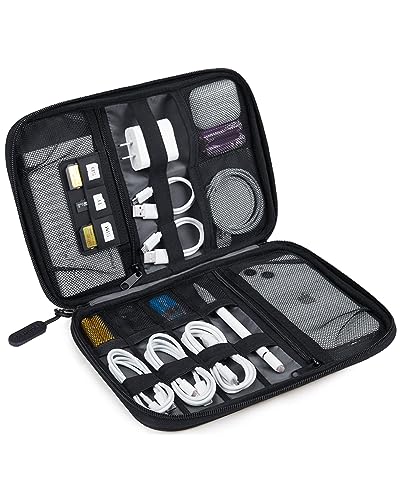
BAGSMART Electronics Organizer
Every cable, brick, and dongle gets an address: fifteen dollars ends the pouch of shame.
Field check: Dedicated electronics organizer · elastic-loop and pocket layout · ~$15 street price
Every traveler owns the pouch of shame: the bag-within-a-bag where cables go to breed knots. The BAGSMART organizer replaces it with infrastructure. Inside, elastic loops hold each cable in its own labeled-by-location lane, mesh and zip pockets take the GaN brick, the adapter, the AirFly, and the SD-card-sized flotsam, and the whole thing closes into a flat book that slides into a daypack like a laptop sleeve. Everything in this guide except the AirTags in your other bags lives in this one object.
The payoff compounds daily in a way no other pick here matches. You charge devices every night and pack every morning, so the organizer gets used more times per trip than anything else in this guide, and every use is three seconds instead of a ninety-second excavation. Its quiet superpower is the audit: open the book flat and every empty loop is a checklist item, which is how you notice the cable still plugged in behind the hotel nightstand before the taxi, not after. At about $15, that one saved cable pays for the organizer; the saved charger pays for it three times over.
- Type
- Electronics organizer (elastic loops + pockets)
- Signature job
- Every cable and brick gets an address
- Quiet superpower
- Empty loops audit your packing at a glance
- Approx. price
- ~$15
What we like
- Ends cable tangle for about $15, permanently
- Used more times per trip than anything else here
- Empty-loop audit catches left-behind chargers
- Turns the whole kit into one grab-and-go book
Worth noting
- Requires the discipline to actually loop the cables
- Fully loaded, it is a chunky little book
- Budget-grade materials, honestly priced for it
Who should buy it: Buy the BAGSMART if you carry more than two cables, which is everyone reading a travel-tech guide. It is the right purchase for commuters as much as travelers, and the correct gift for the person whose backpack bottom is an archaeology site of tangled USB.
What we don't like: It is only as good as your discipline: cables shoved in loose recreate the pouch of shame with extra steps. A fully loaded book is thicker than the sum of its parts feels like it should be. And at about $15 the materials are honest budget-grade; it organizes brilliantly but is not the heirloom object the rest of your kit might be.
Bottom line: The BAGSMART organizer is the packing cube philosophy applied to the worst-behaved category in your bag: electronics. Elastic loops hold each cable in its own lane, pockets swallow the bricks, dongles, and cards, and the whole kit zips into one flat book that drops into any bag and opens flat at any security tray. At about $15 it is the cheapest item here and arguably the one that pays off most often, because you dig for a cable every single day of every trip.
06 · The Spares
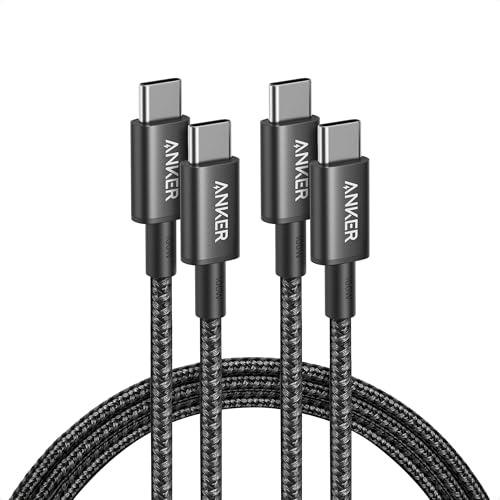
Anker USB-C Cable (2-Pack)
Thirteen dollars of redundancy for the component every other gadget depends on.
Field check: 2 cables listed per pack · Anker build reputation · ~$13 street price
Every system has a single point of failure, and in your travel tech kit it is not the expensive part. The GaN brick is solid-state and durable, the adapter is a brick of plastic, but the cable, the one component in the chain that gets bent, coiled, yanked, slept on, and left behind, is what actually fails on the road. A dead cable with no spare turns your entire elegant power system into pocket ballast. The Anker 2-pack is the doctrine answer: two listed cables, so the primary lives with the brick and the spare lives in the organizer, untouched until the day it saves the trip.
The brand matters more in cables than travelers assume, because cables fail invisibly: frayed conductors and worn connectors show up as mysterious slow charging and intermittent connections long before anything visibly breaks, and the airport-kiosk cable is the most counterfeited, corner-cut product in electronics. Anker built its reputation on being the boring, reliable answer here, which is exactly the personality you want in the component you think about least. Two identical known-good cables also give you a diagnostic for free: when charging misbehaves, swap cables, and you instantly know whether the problem is the cable, the brick, or the socket.
- Listed pack
- 2 USB-C cables
- Role
- Primary with the brick, spare in the organizer
- Free bonus
- Two known-good cables = instant charging diagnostics
- Approx. price
- ~$13
What we like
- About $13 to redundancy-proof the whole power system
- Anker's cable reputation is the boring kind you want
- Spare doubles as a charging-problem diagnostic
- Weighs nothing, saves trips
Worth noting
- The least exciting purchase in this guide, by design
- USB-C cable classes vary: match listed specs to your devices
- Legacy-port devices still need their own cables
Who should buy it: Buy the 2-pack alongside literally any other item in this guide: it is the redundancy layer of the whole system. It is doubly right for long-trip and remote-destination travelers, where a failed cable cannot be replaced at the corner store, and for anyone whose current cables came free with something years ago.
What we don't like: It is a pack of cables; the excitement ceiling is low and we will not pretend otherwise. USB-C cable specs are a genuine labyrinth (charging speeds and data rates vary by cable class), so match the cable's listed capability to your hungriest device. And travelers deep in legacy ports will still need their old cables alongside.
Bottom line: Here is the uncomfortable systems truth: the 65W brick, the universal adapter, and the dead phone all depend on one humble component, and it is the one most likely to fray, vanish behind a nightstand, or stay plugged into the wall of a hotel three cities back. The Anker 2-pack is the fix, from the brand whose cables have the best survival record in the category. At about $13 it is the cheapest line in this guide and the one that keeps every other line functional.
More gear worth comparing
Beyond this guide: the highest-rated gear across every category and budget, with a live price check on each.




As an Amazon Associate we may earn from qualifying purchases, at no cost to you.
Quick shop: every pick
Skip the scroll — the whole lineup, with a live price check on each.
- Anker Nano II 65WBest Power PickAnker · ~$30Check price →
- EPICKA Universal Travel AdapterThe Wall SolverEPICKA · ~$20Check price →
- Apple AirTag (4-Pack)The Lost-Bag AnswerApple · ~$89Check price →
- Twelve South AirFly ProThe Flight UnlockTwelve South · ~$55Check price →
- BAGSMART Electronics OrganizerThe Cable SanityBAGSMART · ~$15Check price →
- Anker USB-C Cable (2-Pack)The SparesAnker · ~$13Check price →
How we chose
We judge travel tech accessories against one standard: does it permanently retire a specific, recurring trip-ruiner, at a size and price that make carrying it a non-decision? That framing is why this guide has six items instead of sixty. The spine is watts and plugs. A charger's wattage decides what it can charge: phone chargers live in the low double digits, and laptops need roughly 60 watts and up, which is why the 65W listed figure on our GaN pick matters; it is the line that lets one pocket brick charge everything you own, one device at a time. GaN (gallium nitride) is the semiconductor tech that shrank laptop-class chargers to phone-cube size. The adapter question is separate and simpler: an adapter changes your plug's shape to fit foreign sockets, and that is all it does. Every wattage and capability we cite is the manufacturer's listed figure, hedged as such, and prices are approximate street prices at publication.
We also weight honesty about what each gadget does not do, because travel tech marketing is where physics goes to be exaggerated. Adapters do not convert voltage, trackers do not prevent loss, and no charger fixes the cable you forgot. So each pick carries a clear 'who should buy' and an equally clear 'what we don't like,' the kit is judged as a system with the spare cables as its deliberate redundancy, and no brand has bought a placement.
Key terms
- GaN (gallium nitride)
- The semiconductor technology behind the new generation of tiny high-wattage chargers: it runs cooler and switches faster than old silicon, which is how a 65W listed laptop-class charger now fits in the housing a phone cube used to occupy. The single biggest recent upgrade in travel power.
- Wattage (and why 65W is the line)
- A charger's listed wattage decides what it can charge at full speed: phones need little, USB-C laptops need roughly 60W and up. Buying one brick at 65W listed covers the hungriest device you carry, so every smaller device inherits the same charger. The core of the one-brick strategy.
- Universal travel adapter
- A gadget that changes your plug's shape to fit foreign wall sockets, typically covering most of the world's socket types with sliding prongs. It translates shape only: it does not convert voltage, which is why dual-voltage electronics (almost all modern chargers) travel safely and single-voltage hair tools do not.
- Find My network
- Apple's crowdsourced location system: an AirTag reports its position via the iPhones that pass near it, no cellular plan required. Densest exactly where luggage gets lost (airports, cities), thinnest in the true backcountry. The reason a coin-sized tracker can follow a bag across the planet.
- Bluetooth transmitter
- A device that takes audio from a wired source, like a seatback entertainment system's headphone jack, and broadcasts it over Bluetooth to wireless earbuds. The AirFly Pro is the travel-famous example, built for the airplane problem the wireless revolution forgot to solve.
- Listed specs
- The manufacturer's published figures, wattage, pack counts, and capabilities, which is what every spec in this guide is unless stated otherwise. We hedge them as 'listed' because we report the maker's claims rather than presenting them as our own bench measurements.
Questions, answered
What travel tech accessories are actually worth buying?
Judge every candidate by one test: does it permanently retire a recurring trip-ruiner at a price and size that make carrying it automatic? Five categories pass for almost everyone: a GaN charger like the 65W listed Anker Nano II (about $30) so one brick powers everything, a universal adapter like the EPICKA (about $20) for foreign walls, trackers like the AirTag 4-pack (about $89) so bags report their own location, a cable organizer (about $15) so charging stops being archaeology, and spare cables (about $13). The AirFly Pro (about $55) joins the list the moment you fly long-haul with wireless earbuds. Most everything else in the travel-gadget aisle fails the test.
Is a 65W charger enough for a laptop and phone?
For most travelers, yes, with one clarification. 65 listed watts is squarely in USB-C laptop territory, so a brick like the Anker Nano II charges a typical ultrabook at real speed, and a phone is trivial by comparison. The single-port catch is that it charges one device at a time: laptop over dinner, phone overnight is the standard rhythm. Power users with big gaming laptops should check their machine's listed requirement, and travelers who must charge laptop and phone simultaneously should carry a multi-port GaN brick or add a second small charger rather than sizing up a single port.
Do universal travel adapters convert voltage?
No, and this is the most important sentence in travel tech: an adapter changes your plug's shape, nothing else. The reason that is usually fine is that nearly all modern electronics, phone chargers, laptop bricks, camera chargers, are dual-voltage by design and say so right on the label (look for 100-240V). Those travel safely anywhere with a $20 shape adapter like the EPICKA. The gear that dies abroad is single-voltage heating appliances, hair dryers and straighteners above all. Check the label at home; if a device is not dual-voltage, leave it behind or buy a true voltage converter, which is a different, heavier gadget.
Are AirTags worth it for luggage?
If you check bags and carry an iPhone, they are among the highest-value travel purchases per dollar. An AirTag converts a lost bag from a mystery into a map pin: airports are the densest iPhone environments on earth, so Find My coverage is at its best exactly where luggage goes astray, and travelers routinely locate 'lost' bags faster than the airline's own system does. The 4-pack (about $89) is the right buy because the doctrine is one per bag, every bag; the untagged bag is always the one that vanishes. Honest limits: it informs rather than prevents, coverage thins in the backcountry, and Android users should buy their ecosystem's equivalent instead.
What is the AirFly Pro and do I actually need one?
It is a small Bluetooth transmitter that plugs into a headphone jack, most famously the airplane seatback jack, and broadcasts that audio to your wireless earbuds. You need one if two things are true: you fly long-haul at least occasionally, and your earbuds are wireless, because that combination otherwise leaves you with the airline's foam headphones or a silent movie. The Pro version transmits to two sets of earbuds at once, which makes it the shared-screen fix for couples and kids. At about $55 it is a single-purpose purchase, but it is single-purpose at a misery you meet on every long flight for the rest of your life.
How do I keep my cables organized when traveling?
Use a dedicated electronics organizer, and use it with one rule: everything loops in, every time. A ~$15 organizer like the BAGSMART gives each cable an elastic lane and each brick a pocket, so your whole power kit becomes one flat book you grab in one motion. The underrated feature is the audit: open it flat before checkout and every empty loop is an item still plugged in behind the nightstand. Pair it with the spares doctrine, a $13 two-pack of cables with one riding as an untouched backup, and cable chaos is solved for roughly the cost of one airport-kiosk replacement cable.
Should I buy an all-in-one travel adapter with USB ports instead of a separate charger?
Only if you travel phone-only. Built-in adapter USB ports are modest phone-class chargers, nowhere near the 65 listed watts a laptop wants, so laptop travelers should run the two-piece combo: a dedicated adapter (about $20) translating the wall, and a GaN brick (about $30) supplying the real wattage through it. The combo is also more resilient: adapters lead hard mechanical lives, and when an all-in-one dies abroad it takes your only charger with it, while a dead standalone adapter is a cheap corner-store replacement anywhere on earth and your brick keeps working. Two objects, one pocket, no single point of failure.
What should be in a minimal travel tech kit?
For domestic trips: the 65W listed GaN brick, two USB-C cables, and the organizer they live in, about $58 total, one organizer pocket, and your devices stay alive. Going international, add the universal adapter (about $20). Checking bags with an iPhone, add AirTags. Flying long-haul with wireless earbuds, add the AirFly Pro. Built out to all six items the kit runs a little over $220 at street prices, which is roughly two checked-bag round trips, and unlike bag fees it transfers to every trip you take for years. Start with the power core; the rest earns its slot trip by trip.
Filed under Buyer's Guide
Keep reading
The Best Airport Survival Kit (2026)
The rest of the terminal loadout: everything between check-in and boarding that this kit does not cover.
The Best Packing Cubes & Compression Cubes (2026)
The clothing half of the organized-bag doctrine: the cheapest upgrade to every trip you will ever take.
The Best Power Banks for Thru-Hiking (2026)
When the wall socket is four days away: the battery math for keeping devices alive on trail.
The Best EDC Gear (2026)
The same small-objects-big-payoff philosophy, applied to what rides in your pockets every day.
The Best Hikes in the World
The destinations this kit exists to get you to with a live phone and a located bag.